Joy to the World: 1st Percussion Sheet Music Preview

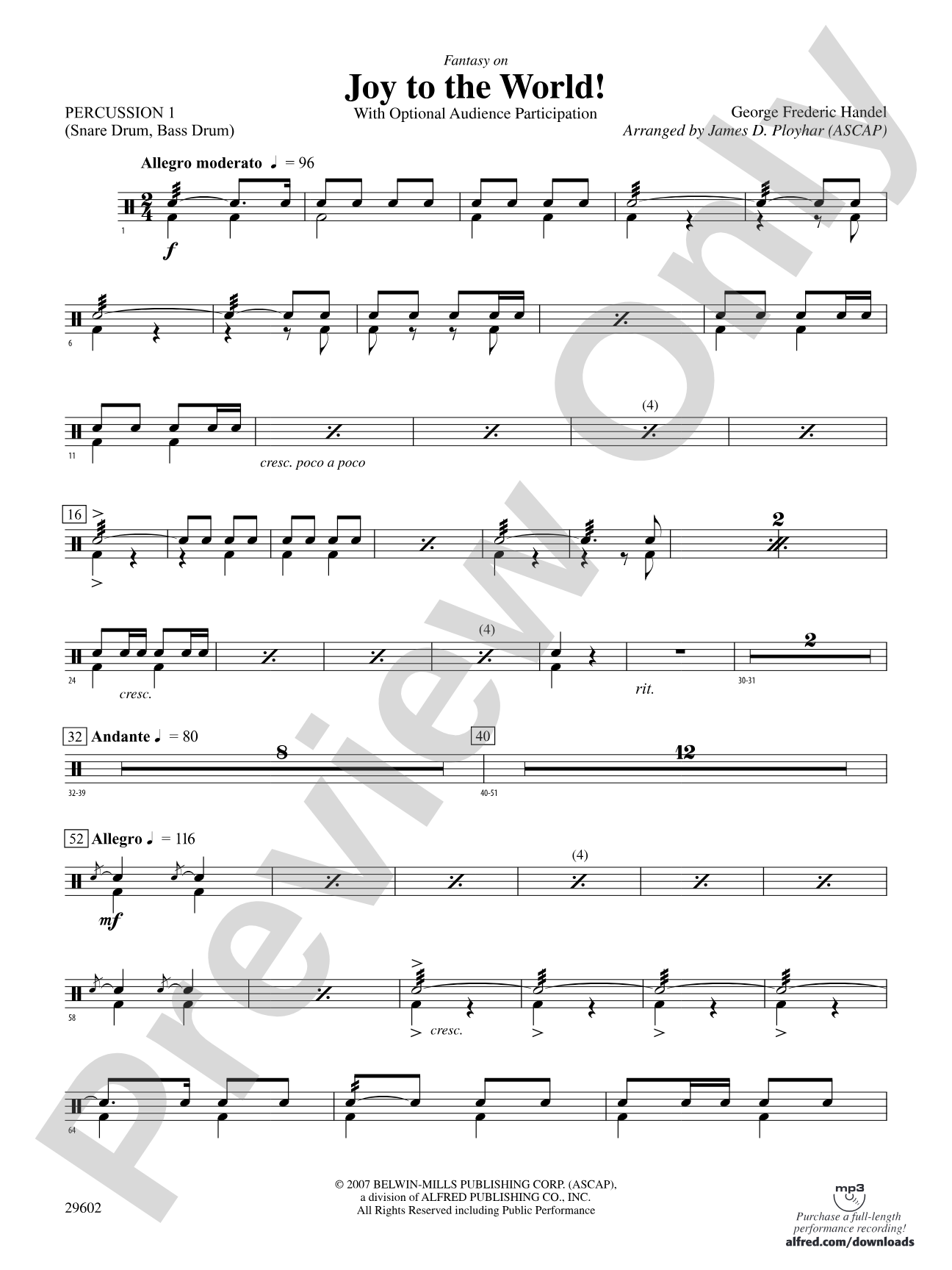
Joy to the World: 1st Percussion

Arr. James D. Ployhar

Grade: 3 (Medium Easy)

Item: 00-PC-0001492_PC1

Digital Download
$3.00
Description
This timeless melody by George Frederic Handel is probably one of the best-loved hymns associated with the holiday season. Most audiences will recognize the classic melody and be familiar with the words.

Don't just read it, hear it, play along with it, and watch your students grow with it. In MakeMusic Cloud, Joy to the World: 1st Percussion comes alive with professional accompaniment, adjustable tempo, and built-in practice tools that turn solo practice into real progress.

Sample Audio
0:00
0:00
Sample Video
Additional Details
Series: Belwin Concert Band
Publisher: Alfred Music
Page Count: 236
SKU: 00-PC-0001492_PC1

More about this title

About the Arranger: James D. Ployhar

James D. Ployhar

James D. Ployhar has shaped generations of young musicians through more than 800 published compositions and arrangements. His Contemporary Band Course, now published by Alfred Music, has become standard curriculum in music education programs across North America and beyond, including adoption throughout Norway in both the original English and translated versions.

Ployhar's credentials span composition study under Morris Hutchings Ruger at California State University-Long Beach, orchestration mentorship with Knud Havalde of the Danish Royal Philharmonic, and nearly two decades of public school teaching. He has served as a clinician and guest conductor throughout the United States, Canada, and Europe, and received the National Band Association Citation of Excellence for his sustained contributions to band music and music education.

Why we love this

Ployhar's arrangement respects the architectural integrity of Handel's melody while making it genuinely playable for Grade 3 bands. The orchestration balances transparency with full sound, ensuring the beloved tune stays front and center without getting lost in harmonic complexity. Directors will appreciate how accessible this is without sacrificing musicality.

What to expect

Handel's melodic gift shines through in every phrase. The arrangement opens with dignified simplicity, its descending scale instantly recognizable to nearly every listener. There's reverence in the harmonic language without being heavy; the piece carries the quiet certainty of a melody people have sung for centuries.

Who it's for

Concert bands working at the Grade 3 level looking for holiday repertoire that connects with audiences through familiarity and accessibility. This arrangement works equally well for groups building toward more ambitious winter concert programming and for those whose performing experience or roster limitations call for straightforward, well-written charts.

How to get the most out of it

  • Shape the opening phrase as a single musical statement. Avoid treating the descending scale figure as separate fragments; let it breathe as one arc from the opening leap down.
  • Balance the inner voices so the melody rides naturally above the harmony. This piece lives and dies by clarity of line, especially in the middle and low woodwinds.
  • Control the tempo to match the hymn's contemplative character. Audiences know this melody intimately; rushing it diminishes its impact.
  • Attend to intonation during sustained harmony passages. With Grade 3 players managing both their parts and the responsibility of a recognizable work, slow sections expose pitch issues quickly.

How to use it

This works as an elegant opener for a holiday concert, setting a serene tone before moving into more energetic selections. Consider pairing it with other Ployhar arrangements at similar difficulty to create a thematic set, or use it as the anchor of a sacred or seasonal themed program where audience recognition enhances the emotional connection.

Skills your students will build

  • Sustaining lyrical phrasing across longer melodic lines
  • Reading concert band voicing with clear melody-to-accompaniment relationships
  • Balancing intonation in block harmony passages
  • Managing ensemble blend when carrying a widely recognized melody

You May Also Like