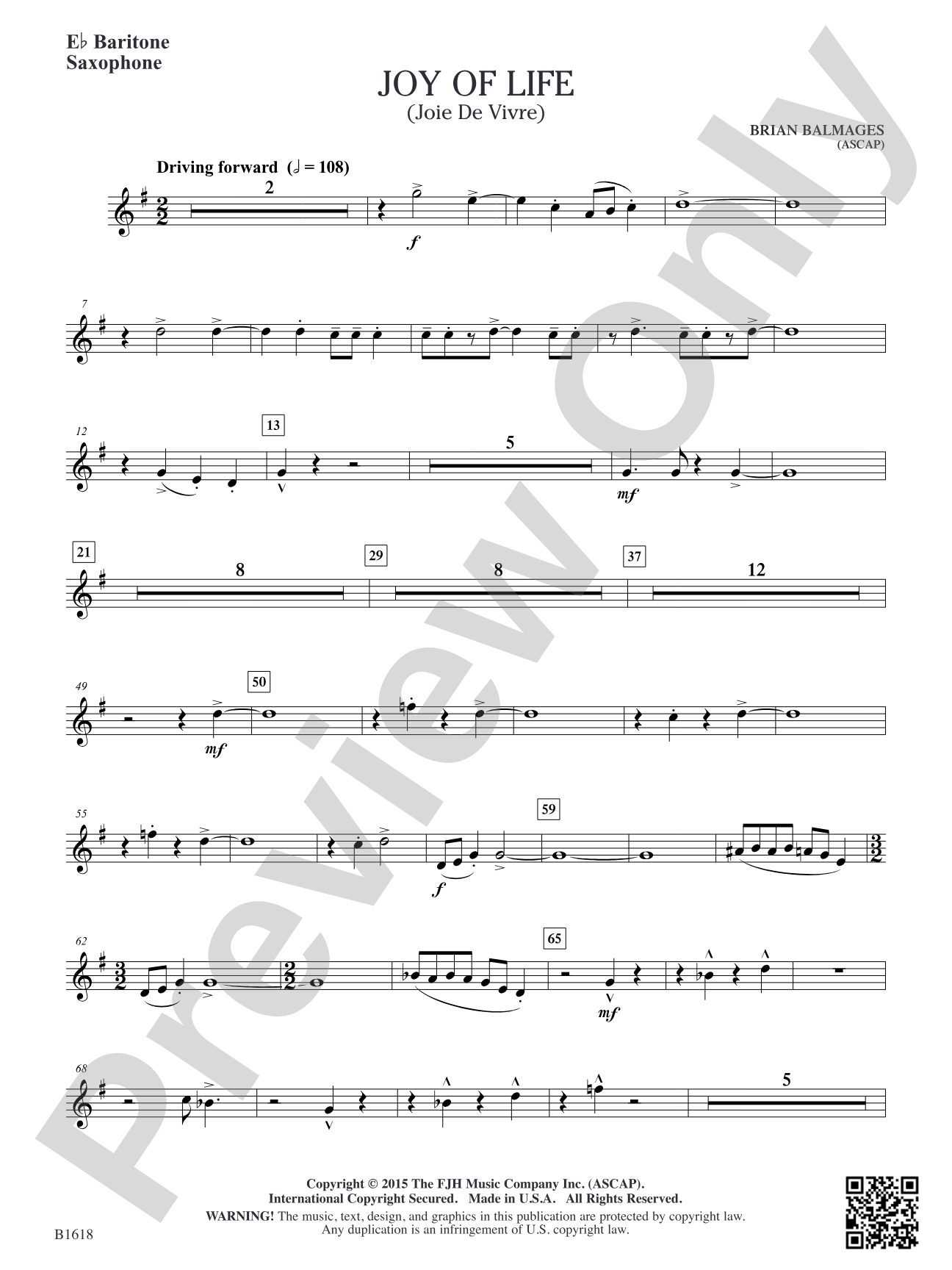
Joy of Life: E-flat Baritone Saxophone Sheet Music Preview

Joy of Life: E-flat Baritone Saxophone

By Brian Balmages

Grade: 4

Item: 98-PC-DB1618_BTX

Digital Download
$7.00
Description
Add some Cajun flavor to your program with this piece that centers around the musical culture of Louisiana. Spirited, powerful and playful melodies weave together as the ensemble and audience experience a wide range of musical styles. Subtle references to Eternal Father, Strong to Save celebrate the proud men and women from the area who served their country. A culturally-inspired work with an incredibly powerful conclusion!

Joy of Life: E-flat Baritone Saxophone isn't in MakeMusic Cloud just yet...but it could be. Let us know you'd like to see it, and you'll help shape what comes next. In the meantime, start a free trial and dive into thousands of interactive titles your students can play along with today.

Sample Audio
0:00
0:00
Sample Video
Additional Details
Series: FJH Symphonic Band
Publisher: The FJH Music Company, Inc.
SKU: 98-PC-DB1618_BTX

More about this title

About the Composer: Brian Balmages

Brian Balmages

Brian Balmages has established himself as a composer and conductor with deep roots across orchestral, band, and chamber music idioms. His works have been premiered and performed by ensembles ranging from professional orchestras to school bands at iconic venues including Carnegie Hall, the Kennedy Center, and the Sydney Opera House.

Recognized by the American School Band Directors Association with the A. Austin Harding Award and an elected member of the American Bandmasters Association, Balmages has won the 2020 NBA William D. Revelli Composition Contest and received commissions from major institutions. He served as guest conductor at the Midwest Clinic, College Band Directors Conference, and regional all-state ensembles worldwide. Currently, he directs MakeMusic Publications and Digital Education for Alfred and MakeMusic.

Why we love this

Balmages captures the spirited character of Louisiana culture with genuine melodic invention rather than surface-level gestures. The integration of hymn references alongside Cajun-inflected material creates a work that honors regional pride while remaining musically sophisticated enough to engage serious concert programs. At Grade 4, it sits at that sweet spot where technical accessibility never compromises artistic depth.

What to expect

Spirited and celebratory, with an undercurrent of sincerity beneath the playfulness. The music shifts fluidly between exuberant Cajun-influenced passages and moments of quiet reverence, building to a conclusion that feels both powerful and earned.

Who it's for

Concert bands at the Grade 4 level looking for repertoire with genuine regional character and sophisticated programming appeal. This work rewards ensembles that can balance technical demands with stylistic versatility and works equally well for festival competition or concert performance.

How to get the most out of it

  • Balance the multiple melodic layers so that thematic material from different sections reads clearly; Cajun-inflected passages often demand careful dynamic shaping to maintain the playful character without losing definition.
  • Approach the hymn references with reverence and weight, treating them as moments of genuine reflection within the broader narrative rather than brief quotations.
  • Build intentionally toward the powerful conclusion; the energy and drive through the middle sections should feel purposeful rather than merely loud, with careful attention to ensemble cohesion at accelerating tempos.

How to use it

Program this as the centerpiece of a concert exploring American regional music, pairing it with folk-inspired works from other traditions. Its combination of accessibility and sophistication makes it equally effective as a contest piece or as a concert anchor that demonstrates your ensemble's range and musical maturity.

Skills your students will build

  • Reading and executing syncopated rhythmic patterns characteristic of Cajun musical idioms
  • Maintaining tonal blend across multiple simultaneous melodic lines
  • Dynamic control and narrative shaping across contrasting sections
  • Ensemble precision in accelerating tempos and complex rhythmic passages
  • Stylistic sensitivity when performing hymn-based material alongside vernacular musical idioms

You May Also Like