
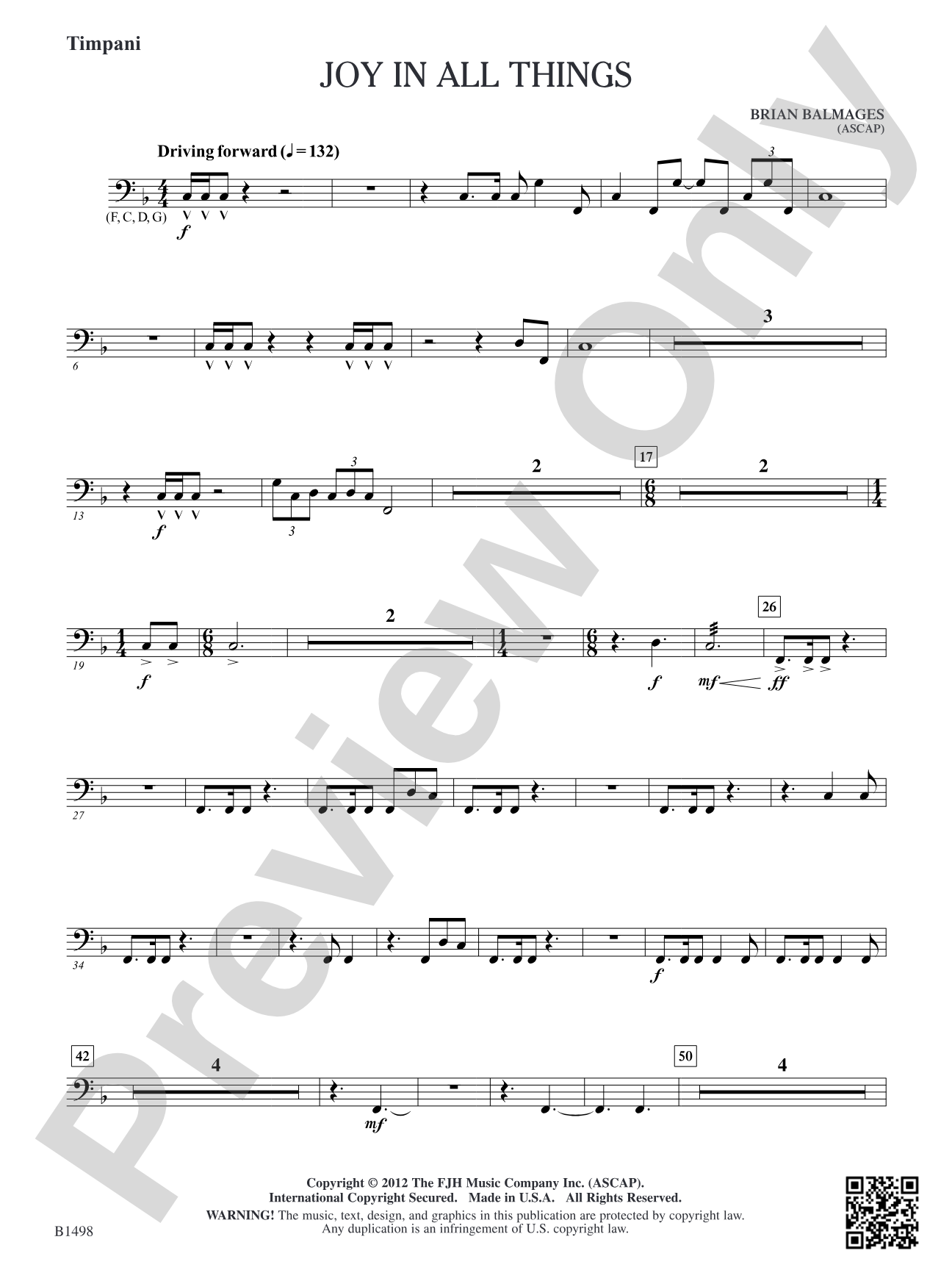

Joy in All Things: Timpani
By Brian Balmages
Grade: 4
Item: 98-PC-DB1498_TMP
$7.00
Pickup currently not available
Description
This exuberant expression of joy begins with a series of brass fanfares punctuated by percussion interludes and woodwind flourishes. Moving between bold multi-meter sections and lighter passages, the opening music propels forward until a reflective center section arrives, featuring solos for onstage and offstage flutes. The end of the work brings back all the intensity of the opening along with expanded fanfares and multi meter passages. Fantastic!


Don't just read it, hear it, play along with it, and watch your students grow with it. In MakeMusic Cloud, Joy in All Things: Timpani comes alive with professional accompaniment, adjustable tempo, and built-in practice tools that turn solo practice into real progress.
Open in the Player
Jump straight in and assign it today.
Start Your Free Trial
Open this title and explore the full library in minutes.
Sample Audio
1
Audio File
--:--
0:00
0:00
Sample Video
No sample videos found.
Additional Details
Series:
FJH Symphonic Band
Publisher:
The FJH Music Company, Inc.
SKU:
98-PC-DB1498_TMP
More about this title
About the Composer: Brian Balmages

Brian Balmages stands among today's most performed composers across orchestral, band, and chamber music. His works have appeared on stages worldwide, from Carnegie Hall and the Kennedy Center to the Sydney Opera House and beyond, performed by ensembles spanning professional orchestras to elementary school groups. He holds membership in the American Bandmasters Association and received the A. Austin Harding Award from the American School Band Directors Association. His composition Love and Light won the 2020 NBA William D. Revelli Composition Contest.
Balmages brings equal skill as a conductor, with regular appearances at all-state ensembles, university groups, and professional orchestras internationally. He has served as a guest conductor at major conferences including the Midwest Clinic, Western International Band Clinic, and the American School Band Directors Association National Conference. His music earned recognition at the 2013 Presidential Inaugural Prayer Service, and he has received commissions from major institutions including the University of Miami. Currently, he directs MakeMusic Publications and Digital Education for Alfred and MakeMusic.
Why we love this
Balmages crafts concert band writing that moves beyond functional filler. The architecture here balances genuine architectural stakes—bold brass gestures and rhythmic complexity in the outer sections—with a reflective center that gives players and audiences a chance to breathe. At Grade 4, the multi-meter sections and onstage/offstage flute placement demand real musicianship without inflating the difficulty, making this a piece that sounds more sophisticated than it plays.
What to expect
The piece radiates infectious exuberance in its outer sections, with brass announcements that feel almost ceremonial, punctuated by sharp percussion hits and spiraling woodwind lines. The reflective center offers genuine contrast—intimate and introspective—before the work rebuilds its energy and intensity to a powerful close that leaves both players and audience energized.
Who it's for
Concert bands working at the Grade 4 level who are ready to tackle multi-meter writing and layered textures without getting lost in complexity. This score works well for groups developing sectional independence and confidence with contemporary sonorities, and for ensembles preparing for festival or contest performance.
How to get the most out of it
- Balance the brass fanfares so they project energy without overwhelming the woodwind flourishes that punctuate them; these textural shifts are central to the piece's forward motion.
- Coordinate the onstage and offstage flute solos carefully during the reflective center section. Even slight timing misalignments will pull focus away from the introspection Balmages creates here.
- In the expanded fanfares and multi-meter passages that close the work, lock the rhythm section (timpani, bass drum, and low brass) so that syncopation and meter shifts land with precision rather than chaos.
How to use it
Program this as a festival opener or a closing number on a concert devoted to contemporary band literature; its immediate appeal and uplifting character anchor either position. It also pairs well with more contemplative or romantic-era repertoire, as its brightness and optimism provide meaningful contrast while its internal reflective section prevents the work from feeling superficial.
Skills your students will build
- Reading and executing multi-meter passages (transitions between simple and compound meters)
- Ensemble coordination across separated instrumental groups (onstage and offstage flutes)
- Dynamic control and textural balance in layered brass and woodwind writing
- Articulation precision in fanfare figures and percussive interludes
- Musical storytelling through contrasting sections (exuberant to reflective to climactic)