

Joy Be With You All: SATB, a cappella Choral Octavo
Scottish Folk Song
Arr., with new words, by Douglas E. Wagner
Item: 00-PO-0001757
$1.85
Minimum order quantity: 20 copies
Pickup currently not available
Related Items
Joy Be With You All: SATB, a cappella Choral Octavo |
$1.85
|
View |
Description
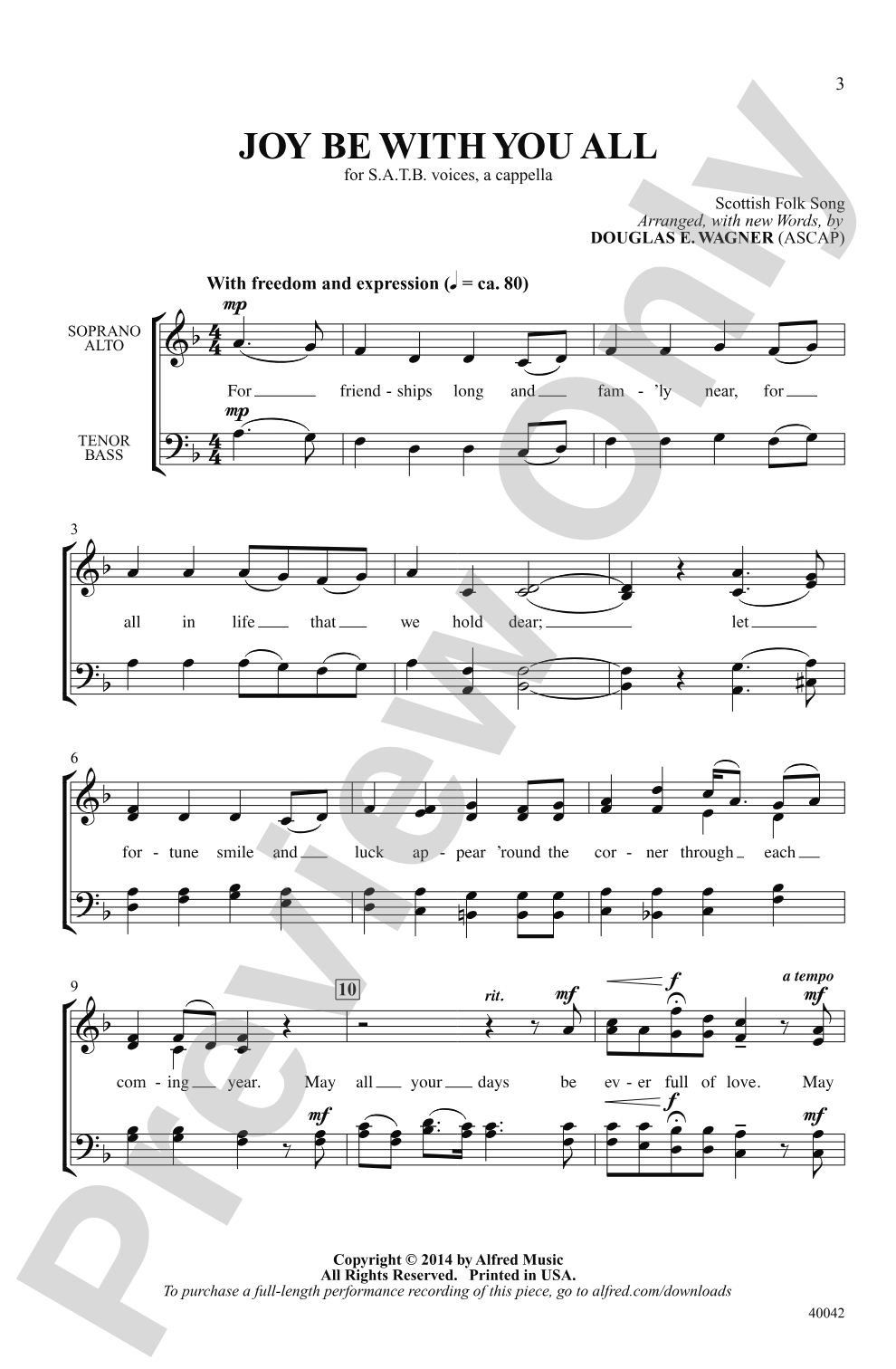
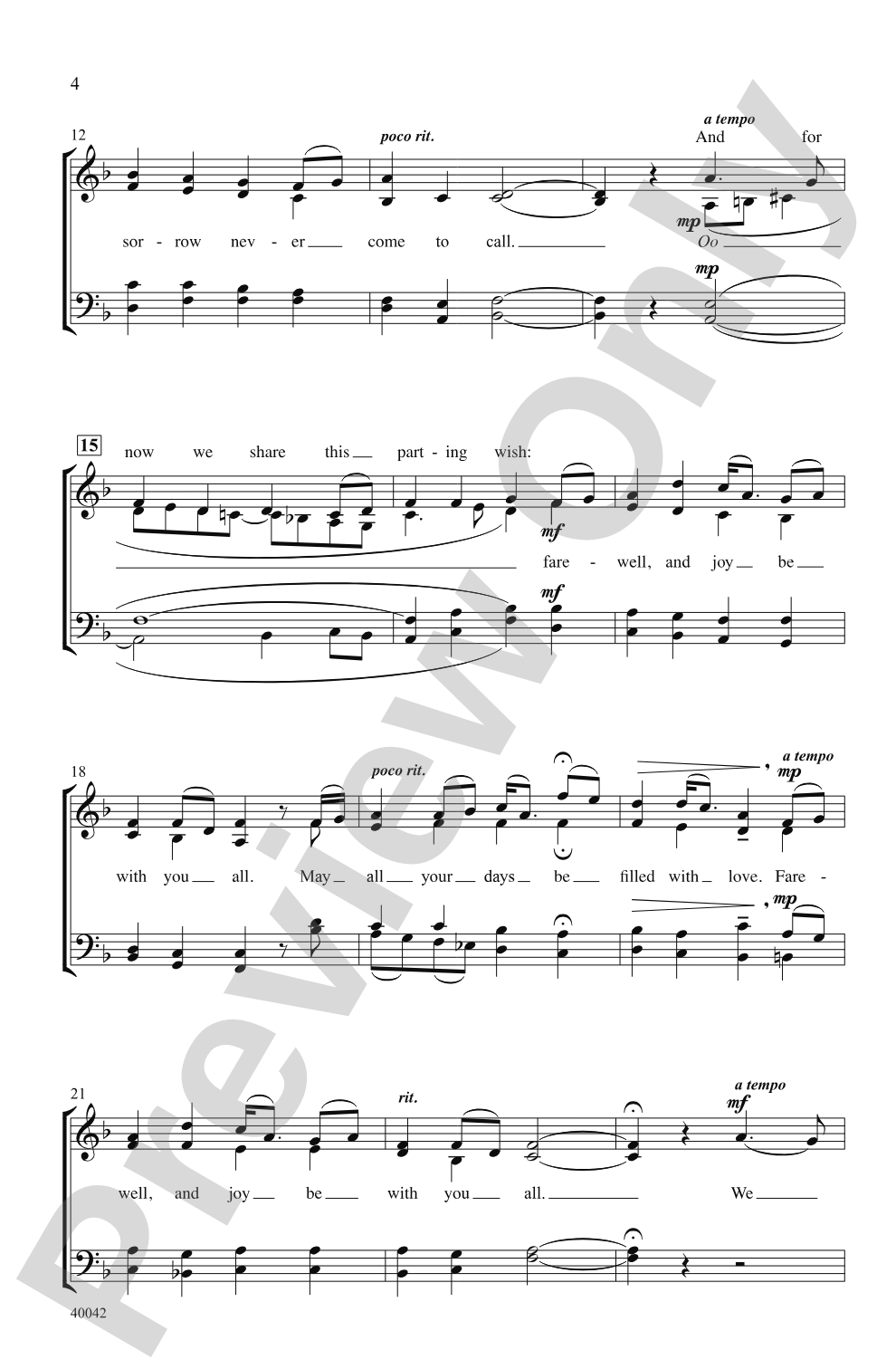
This thoughtful closing sentiment is appropriate for any time of year. Imagine your singers joining hands as they blend and tune their voices. Just when you think you've heard the finest of a cappella harmonies, the final cadence delivers even more. This title is available in Music Prodigy.


Joy Be With You All: SATB, a cappella Choral Octavo isn't in MakeMusic Cloud just yet...but it could be. Let us know you'd like to see it, and you'll help shape what comes next. In the meantime, start a free trial and dive into thousands of interactive titles your students can play along with today.
Request This Title
Tell us you want it.
Start Your Free Trial
Explore everything that's ready to play right now.
Sample Audio
1
Audio File
--:--
0:00
0:00
Sample Video
No sample videos found.
Additional Details
Series:
Alfred Choral Designs
Publisher:
Alfred Music
Page Count:
8
SKU:
00-PO-0001757
More about this title
About the Arranger: Douglas E. Wagner

Douglas E. Wagner grew up in Chicago and earned both undergraduate and graduate degrees in music from Butler University. He spent three decades in the high school music classroom as educator and administrator before transitioning to full-time composition and arranging work.
Since 1973, Wagner has published more than 3,500 compositions across virtually every ensemble type: choral groups at all levels, concert and marching bands, orchestras, handbells, organ, piano, and vocal soloists. His music has reached an estimated 17 million performers worldwide and continues to appear in concert halls, broadcasts, and educational settings internationally. He now lives in Indianapolis with his wife, Sandy.
Why we love this
Wagner's gift for voice leading shines here. The progression toward that final cadence rewards careful listening from both singers and audience, making this a standout closer that feels earned rather than predictable. The phrase "Joy Be With You All" carries real warmth at any time of year, yet the a cappella writing demands the kind of focused intonation and blend work that transforms a rehearsal into something memorable.
What to expect
The harmonies are warm and grounded, with a folk sensibility that feels genuine rather than quaint. The journey toward that final cadence carries quiet momentum, and when it arrives, the richness of the four-part a cappella writing becomes almost physical. There's generosity in this piece—both in what it offers singers and in the blessing it extends to listeners.
Who it's for
This piece suits choral directors seeking a closing number that works year-round, from holiday concerts to spring pops programs to end-of-year celebrations. It's accessible for good community or school choirs with solid fundamentals in blend and intonation but won't feel elementary to more advanced groups.
How to get the most out of it
- Approach the final cadence as a unified gesture. Conductor and singers should agree on how the last chord lands: is it a gentle resolution, a moment of stillness, or something with more arrival? This single choice shapes the entire performance.
- Build blend from the harmonic foundation upward. Lock the bass line first, then add tenor and alto voices that lock to it. Soprano enters last and sits on top without pulling sharp.
- Use the hand-joining moment mentioned in the text literally. This physical act shifts singers' focus from their individual lines to the collective sound and creates genuine musical cohesion.
How to use it
Program this as your closing selection when you want a moment of genuine connection rather than spectacle. It works equally well after an upbeat opener or following something more serious; the piece has enough musical substance to anchor a program's ending without feeling like filler.
Skills your students will build
- Tuning four-part a cappella harmony without instrumental support
- Balancing individual voice parts within ensemble blend
- Shaping a phrase toward a climactic harmonic moment
- Breathing as a unified ensemble in legit vocal music
- Intonation awareness and correction through listening and vocal adjustment