
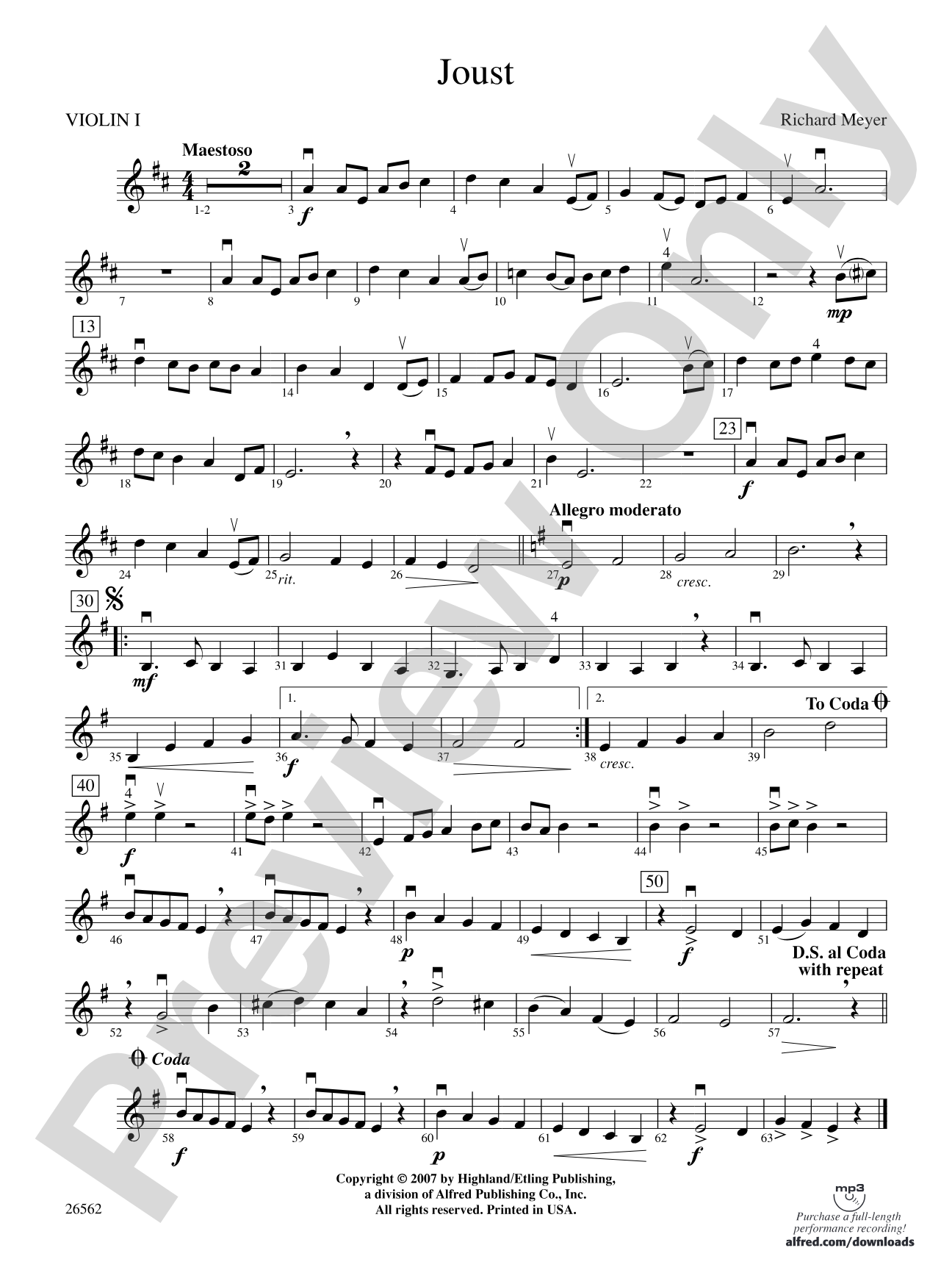

Joust: 1st Violin
By Richard Meyer
Grade: 1.5
Item: 00-PC-0001078_VN1
$5.99
Pickup currently not available
Description
This simple, yet mature-sounding piece is sure to spark your students' imagination, taking them back to the exciting jousting tournaments of medieval times. Driving eighth notes, minor and modal harmonies, and unexpected accents contribute to the excitement and energy. This piece is a great opportunity to improve students' readying on the lower strings. Correlates with String Explorer Book 1, Unit 12. This title is available in MakeMusic Cloud.


Don't just read it, hear it, play along with it, and watch your students grow with it. In MakeMusic Cloud, Joust: 1st Violin comes alive with professional accompaniment, adjustable tempo, and built-in practice tools that turn solo practice into real progress.
Open in the Player
Jump straight in and assign it today.
Start Your Free Trial
Open this title and explore the full library in minutes.
Sample Audio
1
Audio File
--:--
0:00
0:00
Sample Video
No sample videos found.
Additional Details
Series:
Highland/Etling String Explorer
Publisher:
Alfred Music
Page Count:
36
SKU:
00-PC-0001078_VN1
More about this title
About the Composer: Richard Meyer

Richard Meyer spent 35 years teaching string students across elementary, middle, and high school levels in California public schools. At Oak Avenue Intermediate School in Temple City, he directed orchestras for 22 years, expanding the program from 29 students to 200, while simultaneously overseeing the city's elementary string curriculum. He also led the Pasadena Youth Symphony Orchestra for 16 years, taking the ensemble to performance venues in New York, Washington D.C., Vienna, Australia, and Canada.
Beyond the classroom and concert hall, Meyer has become a nationally recognized composer with over 190 published works and arrangements. He served as string editor for Alfred Publishing Company for 16 years and co-authored several string method series, including the widely adopted String Explorer curriculum. His "Giving Bach" program, launched in 2009, uses interactive concerts to reach students with special needs and those in under-resourced urban schools throughout Southern California. Meyer has been a clinician at the A.S.T.A. National Conference, the Texas Orchestra Directors' Association Conference, and string workshops at major universities.
Why we love this
Meyer writes with deep understanding of what beginning string orchestras can accomplish musically without oversimplifying the artistic intent. The medieval joust setting gives students a narrative anchor, but the driving eighth-note texture and modal harmonies do the real work of engaging their ears and fingers. Lower strings get genuine material here, not just padding; that's rare at this level.
What to expect
The opening delivers immediate energy through relentless eighth-note figuration that evokes the thundering hoofbeats and clashing armor of a medieval tournament. Minor and modal harmonies give the piece a darker, more sophisticated tone than typical Grade 1.5 fare, while unexpected accent marks create moments of dramatic tension that punctuate the forward surge.
Who it's for
String orchestras at the Grade 1.5 level, particularly those using the String Explorer curriculum, will find this piece accessible and rewarding. Conductors working with beginning to early-intermediate ensembles who want programmatic music with genuine orchestral character will appreciate Meyer's economical writing.
How to get the most out of it
- Establish a steady pulse before introducing the driving eighth notes. Have the ensemble tap the rhythm on their instruments (or lightly on desks) to internalize the forward motion before adding pitch.
- Flag the unexpected accents in rehearsal by marking them clearly in parts and conducting them distinctly. These moments break the momentum intentionally and need ensemble awareness to land together.
- Balance the lower strings prominently in the opening and throughout the work. Their harmonic foundation carries the medieval atmosphere; avoid letting upper strings dominate the texture.
- Emphasize the modal color by listening for clean intonation on the characteristic scale degrees. The minor and modal harmonies only resonate when tuning is precise.
How to use it
Program this on a concert alongside lighter, more lyrical selections to showcase the range of your string orchestra's abilities. Its tournament narrative makes it ideal for a thematic concert celebrating historical or medieval subjects, and its contest-ready energy suits festival programming where you want to open or close a set with impact.
Skills your students will build
- Reading and sustaining driving rhythmic patterns across ensemble parts
- Intonation in minor and modal harmonic contexts
- Lower string independence and prominence in orchestral texture
- Executing unexpected accents with ensemble precision
- Understanding programmatic music and narrative scoring