
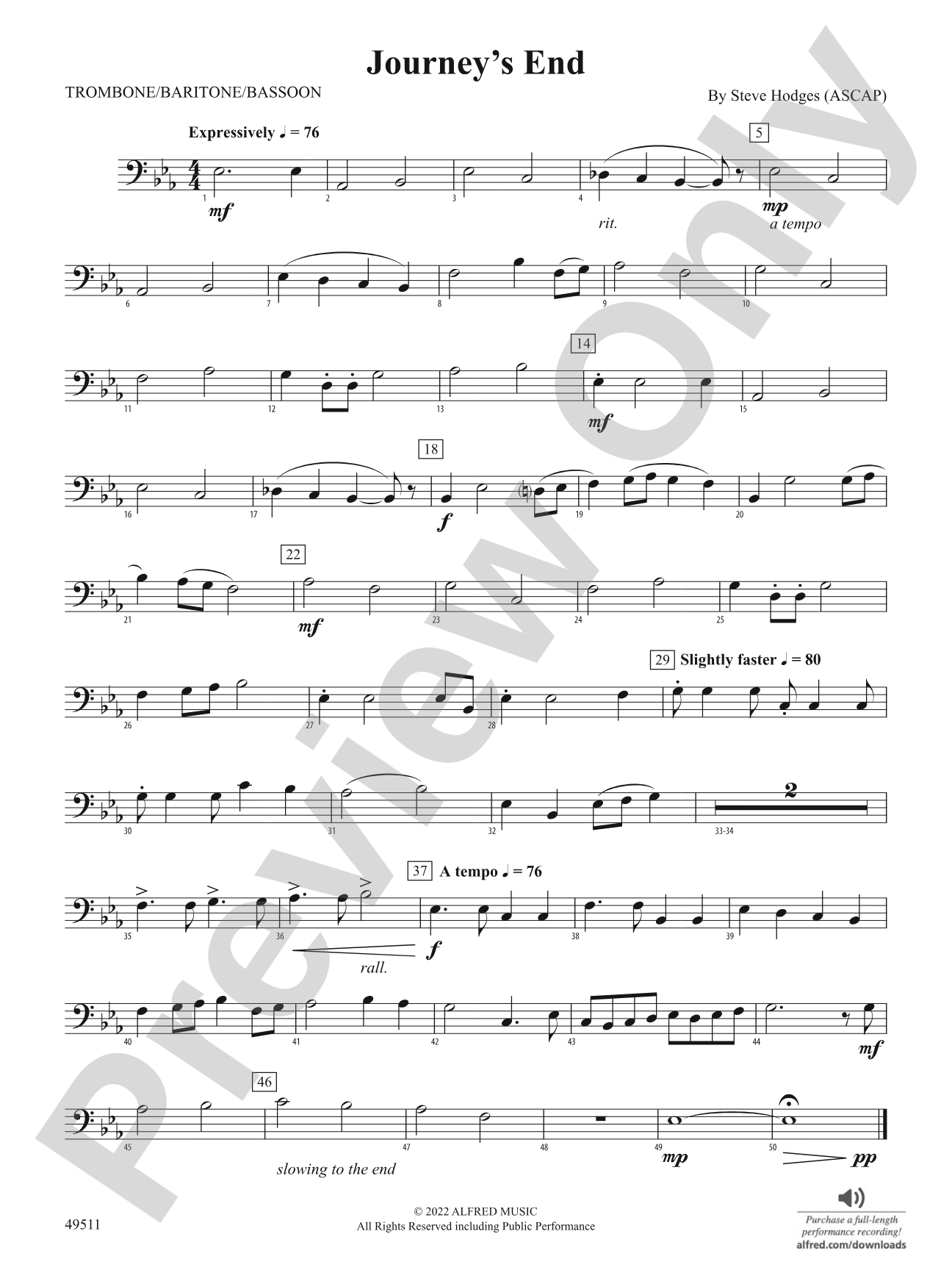

Journey's End: 1st Trombone
By Steve Hodges
Grade: 2
Item: 00-PC-0018804_TN1
$3.00
Pickup currently not available
Description
Upon completion of an activity, an event, or other meaningful experiences, there is a time for reflection for what has been accomplished and what is to follow. This lyrical piece features a memorable melody that is presented by all sections of the band. These reflective presentations lead into a slightly faster minor section indicating the anticipation of plans for the future. The final presentation of the melody indicates a positive feeling of accomplishment and features a moving countermelody by the woodwinds leading to a quiet, contemplative ending. Check out Journey's End, composed by Steve Hodges. (2:48) This title is available in MakeMusic Cloud.


Don't just read it, hear it, play along with it, and watch your students grow with it. In MakeMusic Cloud, Journey's End: 1st Trombone comes alive with professional accompaniment, adjustable tempo, and built-in practice tools that turn solo practice into real progress.
Open in the Player
Jump straight in and assign it today.
Start Your Free Trial
Open this title and explore the full library in minutes.
Sample Audio
1
Audio File
--:--
0:00
0:00
Sample Video
Additional Details
Series:
Developing Band Series
Publisher:
Alfred Music
SKU:
00-PC-0018804_TN1
More about this title
About the Composer: Steve Hodges

Steve Hodges holds degrees from Western Oregon University (Bachelor of Science) and Central Washington University (Master of Music Education). Over four decades directing bands, choirs, and ensembles in public schools, he developed a compositional voice rooted in direct classroom experience.
Since 1986, Hodges has published more than 120 concert band compositions with Alfred Music, along with choral arrangements through Staff Music and Shawnee Press. His works appear regularly at festivals and state conventions across North America and internationally. His commissions span honor bands and schools in Virginia, Iowa, Winnipeg, British Columbia, Oregon, Washington, and North Carolina, and his music has been featured on TBS and ESPN. He holds ASCAP membership and several standard awards. Now retired and based in The Dalles, Oregon, Hodges remains active in community music and delights when his grandchildren report playing his pieces in their own school bands.
Why we love this
Hodges captures something real here: the emotional arc of closure and forward motion. The structural choice to present the main melody across all sections before shifting into a minor section creates natural ensemble engagement, and the countermelody layering near the end rewards careful rehearsal. This is concert band writing that respects what Grade 2 musicians can actually express.
What to expect
The opening invites reflection with an unhurried, accessible melody that feels like a shared memory being recalled. When the minor section arrives, there's a subtle shift toward anticipation and possibility, yet grounded in a minor key's quieter contemplation. The return to the main melody, now accompanied by woodwind countermelody, carries quiet confidence and peaceful resolution.
Who it's for
This piece fits squarely into the Grade 2 concert band curriculum and works for ensembles navigating lyrical writing and textural awareness. It engages developing musicians in genuine musical storytelling without overwhelming technical demands.
How to get the most out of it
- Shape the opening melody statement carefully through your sectional presentations. Each section's turn with the main theme should feel like a complete musical thought, not a passing moment. This builds momentum toward the reflective minor section.
- Balance the woodwind countermelody in the final section with the primary melody. These lines should complement rather than compete, creating a sense of layered reflection rather than conflict.
- Use the quiet, contemplative ending to solidify your ensemble's control of soft dynamics. Sustain tone quality even as the volume decreases; this demands as much musical maturity as a forte passage.
How to use it
Position this near the end of a concert to create a graceful transition into a closing statement or encore. Its reflective tone and positive arc make it an ideal closer for spring concerts, end-of-year celebrations, or transitions between concert themes. The piece also suits festival settings where its emotional directness and accessible difficulty level showcase the ensemble's musical growth.
Skills your students will build
- Sustaining lyrical melodic lines across phrase boundaries
- Balancing multiple independent melodic lines simultaneously
- Controlling soft dynamics while maintaining tone quality
- Shaping longer musical forms through sectional contrast (major/minor/major)
- Responding to subtle expressive cues within a through-composed structure