
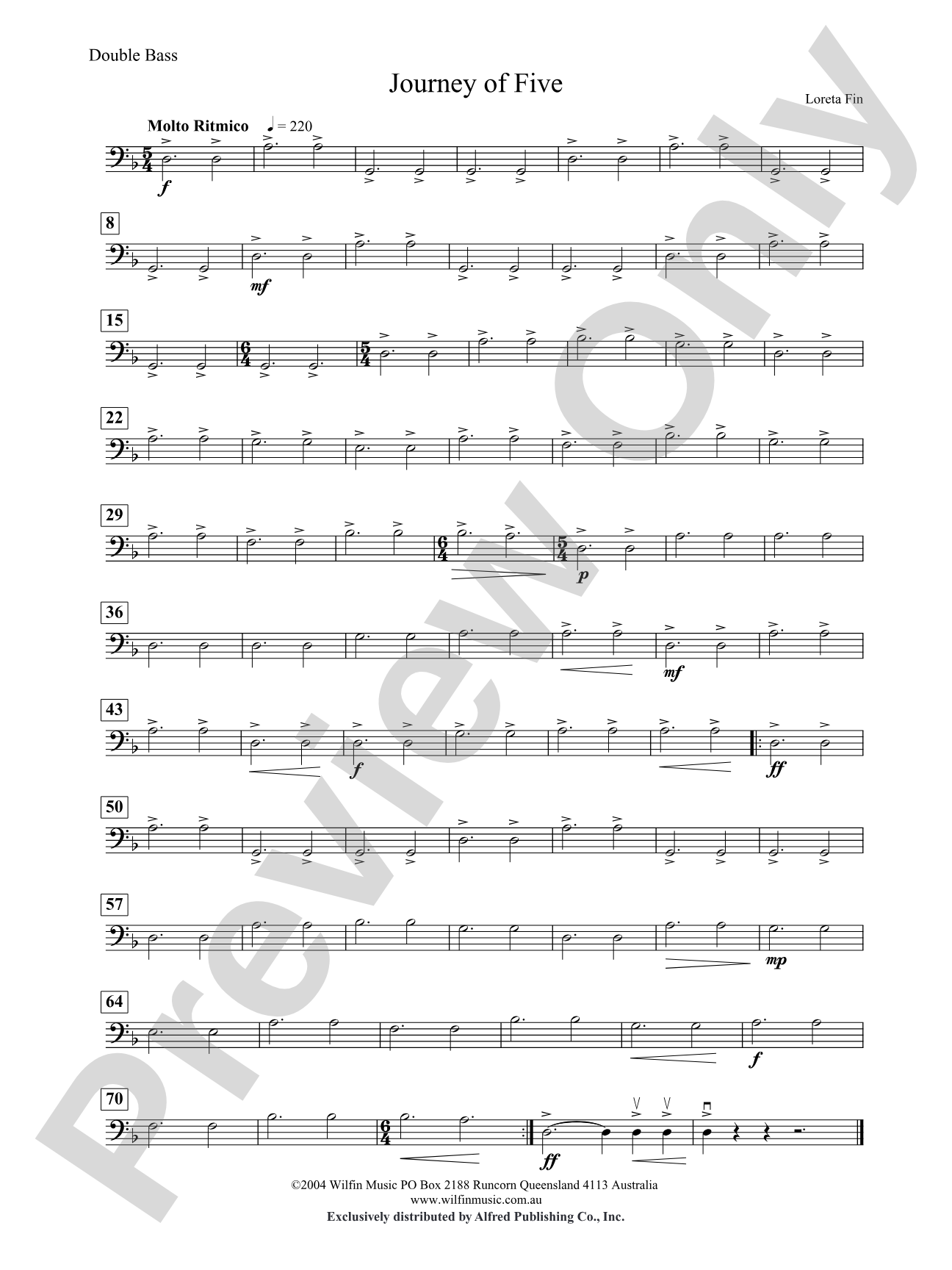

Journey of Five: String Bass
By Loreta Fin
Grade: 3
Item: 76-PC-0000027_SB
$5.99
Pickup currently not available
Description
5/4 is not a time signature that appears frequently in student repertoire, yet it gives an exciting, driving force to the music. This piece requires an edgy "off the string" style of bowing in the accompaniment, which must be sustained, even in softer passages.


Journey of Five: String Bass isn't in MakeMusic Cloud just yet...but it could be. Let us know you'd like to see it, and you'll help shape what comes next. In the meantime, start a free trial and dive into thousands of interactive titles your students can play along with today.
Request This Title
Tell us you want it.
Start Your Free Trial
Explore everything that's ready to play right now.
Sample Audio
No sample audio found.
Sample Video
No sample videos found.
Additional Details
Series:
Wilfin String Orchestra: Young String Ensemble Series
Publisher:
Wilfin Music
Page Count:
108
SKU:
76-PC-0000027_SB
More about this title
About the Composer: Loreta Fin
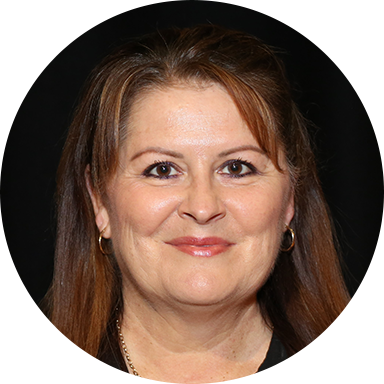
Loreta Fin AM is an Australian composer, violinist, and educator whose career spans performance, teaching, and advocacy. A graduate of the Sydney Conservatorium of Music, she served as Principal Viola player with the Queensland Pops Orchestra for more than 25 years while maintaining an active chamber music practice. Her work as Director of Strings at Somerville House School in Brisbane since 1993 shaped her deep understanding of student ensemble needs and capabilities.
Fin has composed over 100 works for string orchestra, published worldwide by Alfred Music, and her pedagogical contributions extend across multiple roles: she has adjudicated major Australian competitions, presented at national and international string teaching conferences, served as State and National President of the Australian Strings Association, and directed state and national honours ensembles programs since 2015. Her impact on music education was recognized with the National Award for Services to Music and String Teaching in Australia, and she was nominated for an ARIA "Best Teacher" award.
Why we love this
A string director who has taught thousands of students will immediately recognize this piece as a sophisticated introduction to asymmetrical meter without sacrificing the energy that engages young players. The rhythmic drive of 5/4, combined with the technical demand for sustained off-string bowing, builds technical ownership rather than merely checking a box on the curriculum. Fin's experience writing repertoire specifically for student ensembles shows in every bar: the part writing is grateful, the color opportunities are real, and the contest appeal is genuine.
What to expect
The driving momentum of 5/4 creates a restless, forward-moving energy that feels contemporary without straying into contemporary classical complexity. Off-string bowing in the accompaniment produces a percussive, almost pizzicato-adjacent texture that gives the piece an edgy, propulsive character, even during quieter moments.
Who it's for
String orchestra directors working with Grade 3 ensembles who are ready to tackle meter signatures beyond the standard 2/4, 3/4, and 4/4. Ambitious middle school programs and advancing high school ensembles preparing for contests or festivals will find both technical challenge and musical maturity here.
How to get the most out of it
- Establish the pulse by conducting in one (one beat per measure) so the ensemble feels the underlying flow rather than fighting the asymmetrical subdivision. Many young players will lock in faster if the conductor's gesture is large and confident through all five beats.
- Isolate the accompaniment figures in sectional rehearsals before combining them with melody lines. The off-string articulation requires consistent bow height and pressure; let each section drill the bowing pattern independently until it becomes automatic.
- Maintain the edgy, lifted character even in softer passages by reminding players that "soft" does not mean legato or heavy. The bowing style should feel bright and detached throughout, regardless of dynamic level.
- Use the score's full 108 pages to understand the orchestration and harmonic architecture before rehearsal. Fin builds textural interest through systematic part interaction, and knowing where the musical focus shifts will help you shape sectional balance efficiently.
How to use it
Program this at the heart of a contest submission or festival performance where you want to demonstrate your ensemble's rhythmic maturity and technical control. The piece works equally well as a standalone feature or paired with more traditional metered works on the same concert to showcase range and growth.
Skills your students will build
- Playing in 5/4 meter and maintaining pulse accuracy in asymmetrical time
- Sustained off-string bowing technique with consistent bow control and articulation
- Rhythmic independence, particularly in accompaniment voices that do not align with typical metric divisions
- Dynamic control in non-legato passages, balancing brightness with precise intonation
- Score literacy and coordination within a more complex harmonic and textural environment