
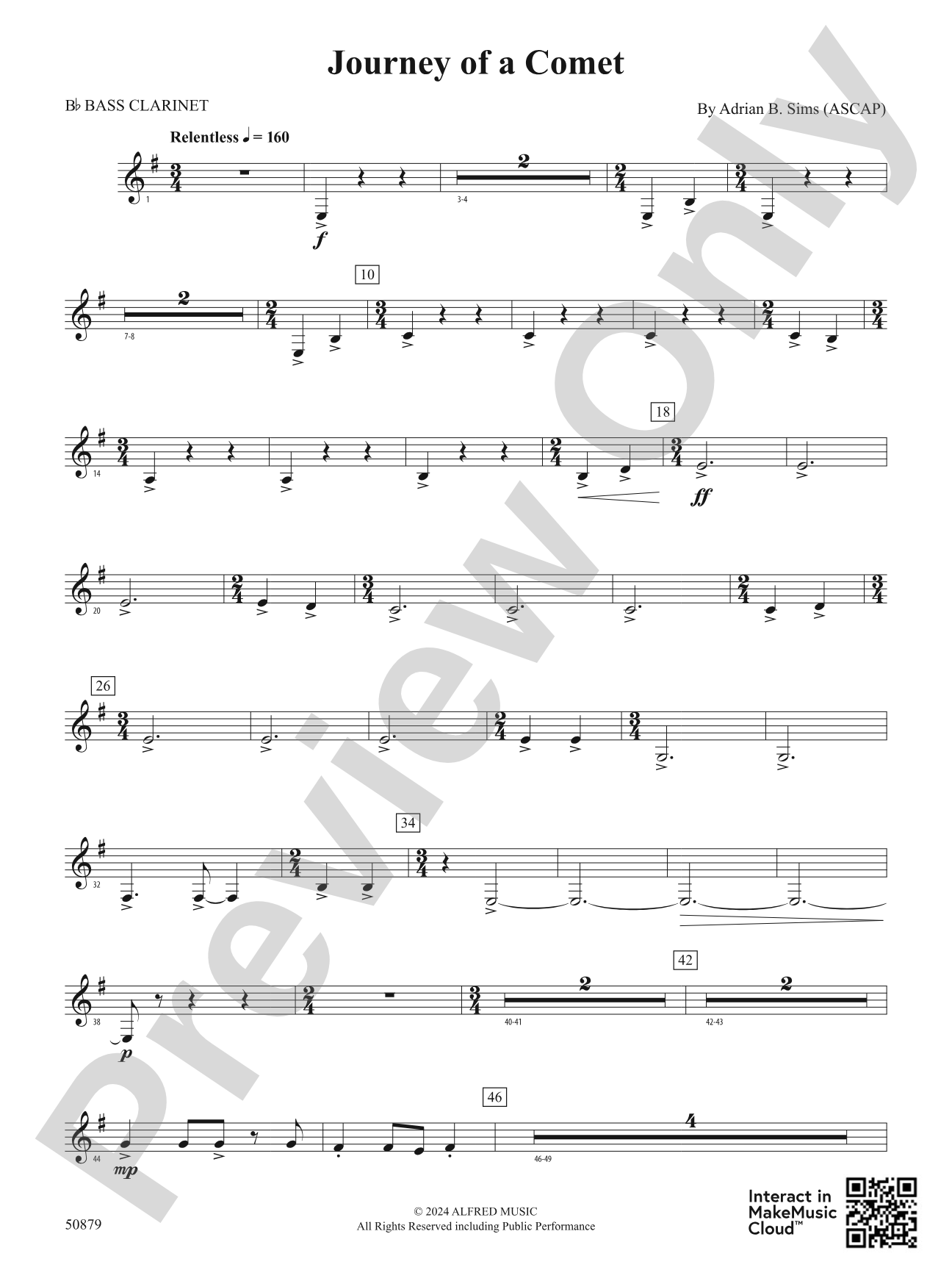

Journey of a Comet: B-flat Bass Clarinet
By Adrian B. Sims
Grade: 3.5
Item: 00-PC-0019300_BC
$3.00
Pickup currently not available
Description
Journey of a Comet, by Adrian B. Sims, was inspired by the mascot of the composer's high school alma mater. This relentless work depicts a comet racing through the sky. After traveling past obstacles ranging from planets to asteroids, the music breaks free from gravitational forces and truly soars. An energetic and inspirational composition! (3:40)


Don't just read it, hear it, play along with it, and watch your students grow with it. In MakeMusic Cloud, Journey of a Comet: B-flat Bass Clarinet comes alive with professional accompaniment, adjustable tempo, and built-in practice tools that turn solo practice into real progress.
Open in the Player
Jump straight in and assign it today.
Start Your Free Trial
Open this title and explore the full library in minutes.
Sample Audio
1
Audio File
--:--
0:00
0:00
Sample Video
Additional Details
Series:
Alfred Concert Band
Publisher:
Alfred Music
SKU:
00-PC-0019300_BC
More about this title
About the Composer: Adrian B. Sims

Adrian B. Sims is an emerging composer, conductor, educator, and trombonist born in Seattle, Washington in 2000. He graduated from Catonsville High School in Maryland, where he developed his foundation in music and composition. His works have been performed at The Midwest Band and Orchestra Clinic and recognized on the Bandworld Top 100 List. Sims has won multiple composition competitions, including the Maryland Music Educators Association Young Composers Project and the Make Music Young Composers Contest.
As both a performer and creator, Sims brings versatility to his musical practice. He has conducted his own compositions in schools throughout Maryland and performs as a trombonist in top ensembles at The University of Maryland, where he studies composition and music education. His teachers include Matthew Guilford, solo bass trombonist with the National Symphony Orchestra, and Dr. Robert Gibson, Professor of Composition at The University of Maryland. Sims credits composer Brian Balmages and his high school band directors Christopher Gnagey and Cindy Stevenson as instrumental in shaping his compositional voice.
Why we love this
Sims captures the drama of celestial motion with genuine excitement rather than overwrought orchestration. The programmatic arc unfolds logically from turbulence through obstacles to a payoff that feels earned, making this an excellent teaching tool for how narrative structure strengthens instrumental writing. A Grade 3.5 band deserves music that respects their growing musicality while still delivering the visceral thrill of flight.
What to expect
Journey of a Comet captures the rush of motion through space with relentless energy. The music propels forward through collisions and gravitational forces, then breaks free into soaring flight, leaving the listener with exhilaration and forward momentum.
Who it's for
Concert bands at the Grade 3.5 level looking for repertoire with clear programmatic appeal that motivates students to engage with phrasing and dramatic arc. This work rewards bands that have developed foundational technique and are ready to think about music as storytelling rather than pure technical exercise.
How to get the most out of it
- Build the momentum gradually through the obstacle section so the final ascent has genuine gravitational release; rushing the early passages erodes the dramatic contrast.
- Balance the melodic voices across the ensemble during the comet's initial descent so the racing figure doesn't overwhelm the harmonic foundation.
- Emphasize the contrast between the turbulent passages and the soaring section by shaping dynamics with intention rather than simply playing louder.
How to use it
Program this on a spring concert where audiences expect high energy and younger musicians benefit from performing something with immediate narrative impact. It also serves well as a festival or contest selection that demonstrates a band's ability to balance technical precision with musical storytelling at an intermediate level.
Skills your students will build
- Sustaining forward momentum through sectional transitions
- Balancing agile rhythmic figures with supporting harmonic textures
- Interpreting programmatic intent through dynamic shaping and articulation choices
- Responding to large-scale structural contrasts (turbulence to flight)