
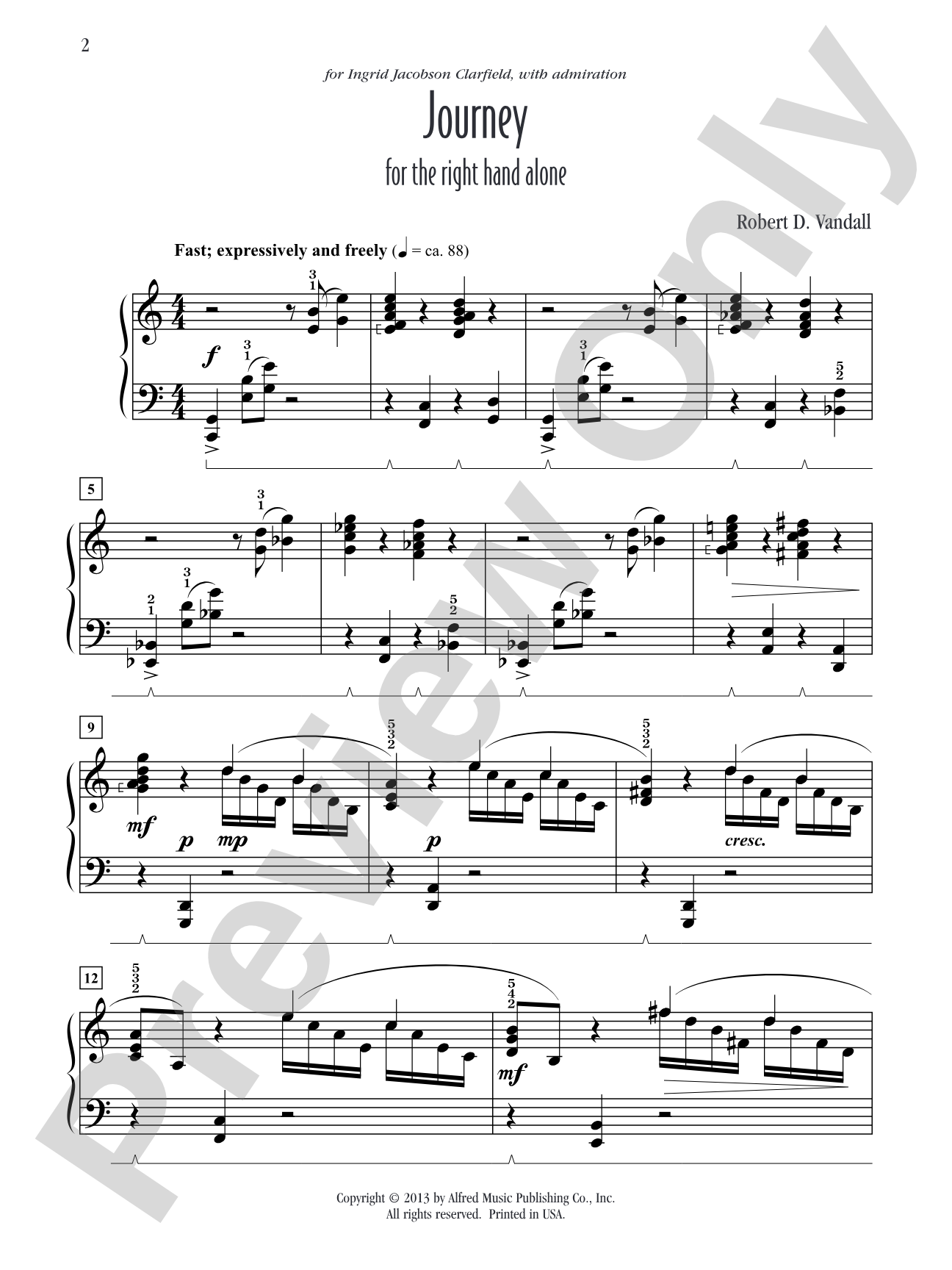

Journey (for right hand alone): Piano
By Robert D. Vandall
Level: Early Advanced
Item: 00-PS-0016238
$2.99
Pickup currently not available
Related Items
Journey (for right hand alone): Piano Sheet |
$2.99
|
View |
Description
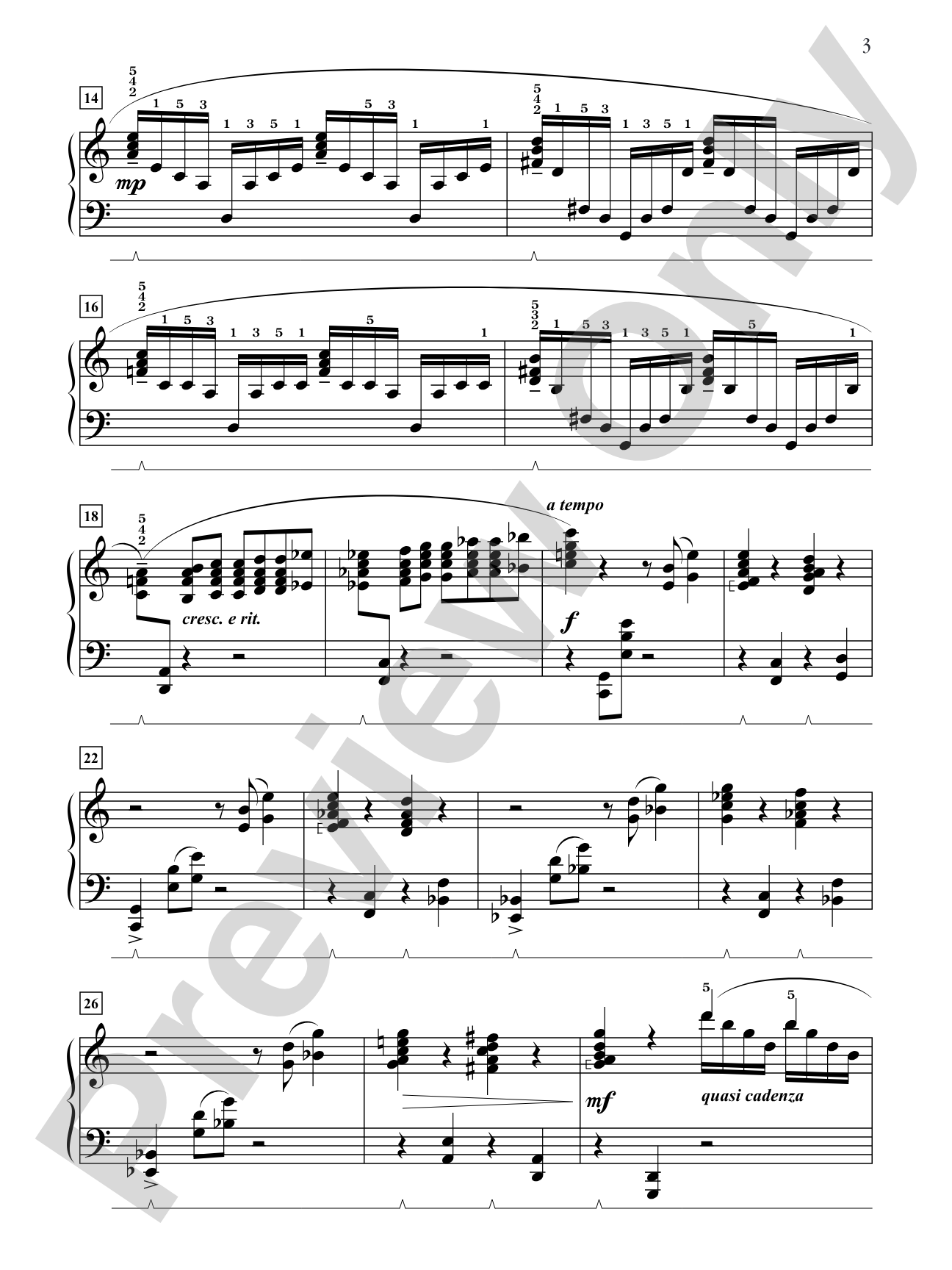
Robert D. Vandall's newest solo will wow audiences at the same time as giving your arm quite a workout! Journey is a piece for the right hand alone, sending just five of your ten fingers on an expedition across the span of the keyboard! Beginning in C major and 4/4 meter, the piece travels through several tempo, key, and meter changes. Alternating between grand chords, and quick runs, students will be challenged to maintain momentum and grandeur between mighty leaps in range. Pedaling is an essential element to this voyage as it will help make the performance sound as though students have full use of both hands. This solo truly shows that it is not the destination, but the journey that makes all the difference. A Federation Festivals 2020-2024 selection.


Journey (for right hand alone): Piano isn't in MakeMusic Cloud just yet...but it could be. Let us know you'd like to see it, and you'll help shape what comes next. In the meantime, start a free trial and dive into thousands of interactive titles your students can play along with today.
Request This Title
Tell us you want it.
Start Your Free Trial
Explore everything that's ready to play right now.
Sample Audio
No sample audio found.
Sample Video
No sample videos found.
Additional Details
Series:
Signature Series
Publisher:
Alfred Music
Page Count:
8
SKU:
00-PS-0016238
More about this title
About the Composer: Robert D. Vandall
Robert D. Vandall is a prolific composer whose output spans decades of accessible yet musically sophisticated piano literature. His works are staples of music festivals and student recitals nationwide, known for balancing technical challenge with genuine musicality and engaging character pieces that hold student interest.
Vandall's compositions for piano students consistently explore what's possible within pedagogical constraints, pushing students toward expressive playing without overwhelming them technically. His Signature Series pieces in particular demonstrate a gift for creating memorable musical moments that reward careful practice and thoughtful interpretation.
Why we love this
Journey stands out precisely because it achieves grandeur and sophistication using only one hand. Rather than accepting the limitations of right-hand-only writing, Vandall turns constraint into creative advantage, crafting a piece that builds genuine momentum through rapid figuration and wide intervallic leaps while teaching essential pedal technique. The tonal journey through multiple keys and meters keeps students engaged across eight pages, and the Festival selection recognition signals that it performs just as impressively as it teaches.
What to expect
Journey propels you forward with its restless energy, alternating between moments of orchestral grandeur and fleet-fingered passagework that demands physical control and precision. The evolving harmonic landscape and rhythmic variety create genuine musical drama, making the solo feel ambitious and expressive rather than merely technical.
Who it's for
Early advanced pianists ready for a technical challenge that doesn't require two-hand independence. This solo works particularly well for students building stamina and navigating the full keyboard with confidence, or for those preparing recital repertoire that stands out at competitions and festival adjudications.
How to get the most out of it
- Map out the hand position shifts before attempting tempo. The wide leaps demand confident muscle memory, so practice transitioning between the lower and upper registers slowly until you can make the reaches without looking.
- Shape the grand chords with weight from the arm, not just the fingers. These moments need the authority and resonance that only full-arm engagement can provide, even though your left hand is resting.
- Layer in the pedal changes gradually. Begin by practicing without pedal to hear the articulation clearly, then add strategic pedal only at the chords and sustained passages where it amplifies rather than muddies the texture.
- Maintain forward motion through the tempo shifts by feeling the underlying pulse rather than treating each new section as a restart. The meter and key changes should feel like developments of one continuous voyage, not separate pieces.
How to use it
This works beautifully as a feature solo on a recital where you want to showcase technical growth and musical maturity. Pair it with contrasting repertoire (perhaps a lyrical slow movement or a delicate two-hand piece) to highlight the distinctive character of the right-hand-alone writing.
Skills your students will build
- Navigating wide intervallic leaps with accuracy and confidence
- Coordinating rapid scalar and chordal figuration in a single hand
- Strategic pedal use to create fullness and resonance on sustained tones
- Reading and executing multiple tempo, key, and meter changes within one continuous arc
- Building hand strength and endurance across an eight-page solo
- Balancing articulation and legato in quick runs while maintaining musical shape