
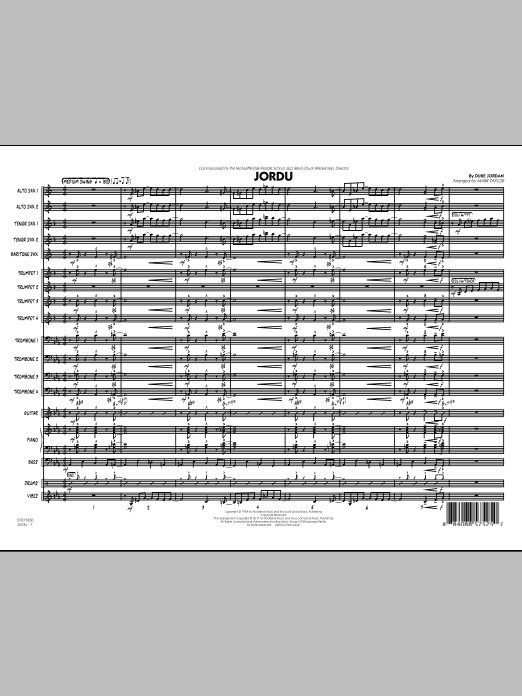

Jordu: Jazz Ensemble Conductor Score & Parts
By Duke Jordan / Arranged by Mark Taylor
Grade: 4
Item: 35-PK00181588
$55.00
Pickup currently not available
Buy Extra Parts (Digital PDF Download)
| Product | Price | Quantity |
|---|---|---|
| Jordu - Full Score | $7.50 | |
| Jordu - Alto Sax 1 | $6.00 | |
| Jordu - Alto Sax 2 | $6.00 | |
| Jordu - Tenor Sax 1 | $6.00 | |
| Jordu - Tenor Sax 2 | $6.00 | |
| Jordu - Baritone Sax | $6.00 | |
| Jordu - Trumpet 1 | $6.00 | |
| Jordu - Trumpet 2 | $6.00 | |
| Jordu - Trumpet 3 | $6.00 | |
| Jordu - Trumpet 4 | $6.00 | |
| Jordu - Trombone 1 | $6.00 | |
| Jordu - Trombone 2 | $6.00 | |
| Jordu - Trombone 3 | $6.00 | |
| Jordu - Trombone 4 | $6.00 | |
| Jordu - Guitar | $6.00 | |
| Jordu - Piano | $6.00 | |
| Jordu - Bass | $6.00 | |
| Jordu - Drums | $6.00 | |
| Jordu - Vibes | $6.00 | |
| Jordu - C Solo Sheet | $6.00 | |
| Jordu - Bb Solo Sheet | $6.00 | |
| Jordu - Eb Solo Sheet | $6.00 | |
| Jordu - Bass Clef Solo Sheet | $6.00 |
Parts Added to Cart!
Description
Notably recorded by Clifford Brown and composed by legendary jazz pianist Duke Jordan, Mark Taylor's arrangement features a medium swing style and a brief duet for tenor and trumpet at the top. Then the saxes take over and do most of the heavy lifting. Solo space is provided for tenor and trumpet, with ample solid hits for the full ensemble.


Jordu: Jazz Ensemble Conductor Score & Parts isn't in MakeMusic Cloud just yet...but it could be. Let us know you'd like to see it, and you'll help shape what comes next. In the meantime, start a free trial and dive into thousands of interactive titles your students can play along with today.
Request This Title
Tell us you want it.
Start Your Free Trial
Explore everything that's ready to play right now.
Sample Audio
No sample audio found.
Sample Video
No sample videos found.
Additional Details
Publisher:
Hal Leonard
SKU:
35-PK00181588
More about this title
About the Composer: Duke Jordan
Duke Jordan (1922-2002) was a pianist and composer whose harmonic sophistication and melodic sensibility shaped modern jazz. Beyond his work as a sideman and bandleader, Jordan wrote standards that have become essential vehicles for improvisation and ensemble work. His compositions reward both soloists and section players with clear harmonic frameworks and memorable themes.
Why we love this
Mark Taylor's arrangement preserves the tune's elegance while giving your ensemble real work to do. The blend of composed sections, solo space, and full-band hits makes this feel like a complete performance, not a showcase for one or two players. Your saxes get the spotlight they earn, and the tenor/trumpet duet at the top gives you a moment of real intimacy before the energy builds.
What to expect
Jordu swings with an urbane, conversational quality. The melody moves with ease, the harmonies remain accessible yet sophisticated, and the arrangement creates pockets of conversation between soloists and the ensemble. There's a sense of sophistication without pretension.
Who it's for
Jazz ensembles at the intermediate level looking for a tune that builds musicianship across the whole band, not just the soloists. Directors wanting to program something with both compositional credibility and genuine playability will find this rewarding.
How to get the most out of it
- Balance the opening duet carefully; the tenor and trumpet should sit at the same dynamic level so neither dominates the call-and-response feel of those opening bars.
- Lock the rhythm section into a solid medium swing groove before working on soloists. Once your piano, bass, and drums have the feel dialed in, the soloists will have a stable pocket to play into.
- Give your saxes attention in the section work. These passages sit higher in the ensemble texture and need clarity without sounding thin; think projection rather than volume.
- Mark the ensemble hits crisply and in time. These punctuation marks are what give the arrangement its personality and drive the solo sections forward.
How to use it
Program this as a centerpiece in a jazz concert where you want to showcase solid ensemble musicianship alongside individual soloists. It also works beautifully in a mixed program pairing classical and jazz repertoire, since its harmonic language and structural clarity speak to audiences comfortable with both traditions.
Skills your students will build
- Medium swing feel and phrasing
- Ensemble cohesion through composed section writing
- Listening skills in small group duets
- Solo construction over a jazz standard
- Punctuation and ensemble hits in context