Jolene (arr. Gitika Partington) Sheet Music Preview

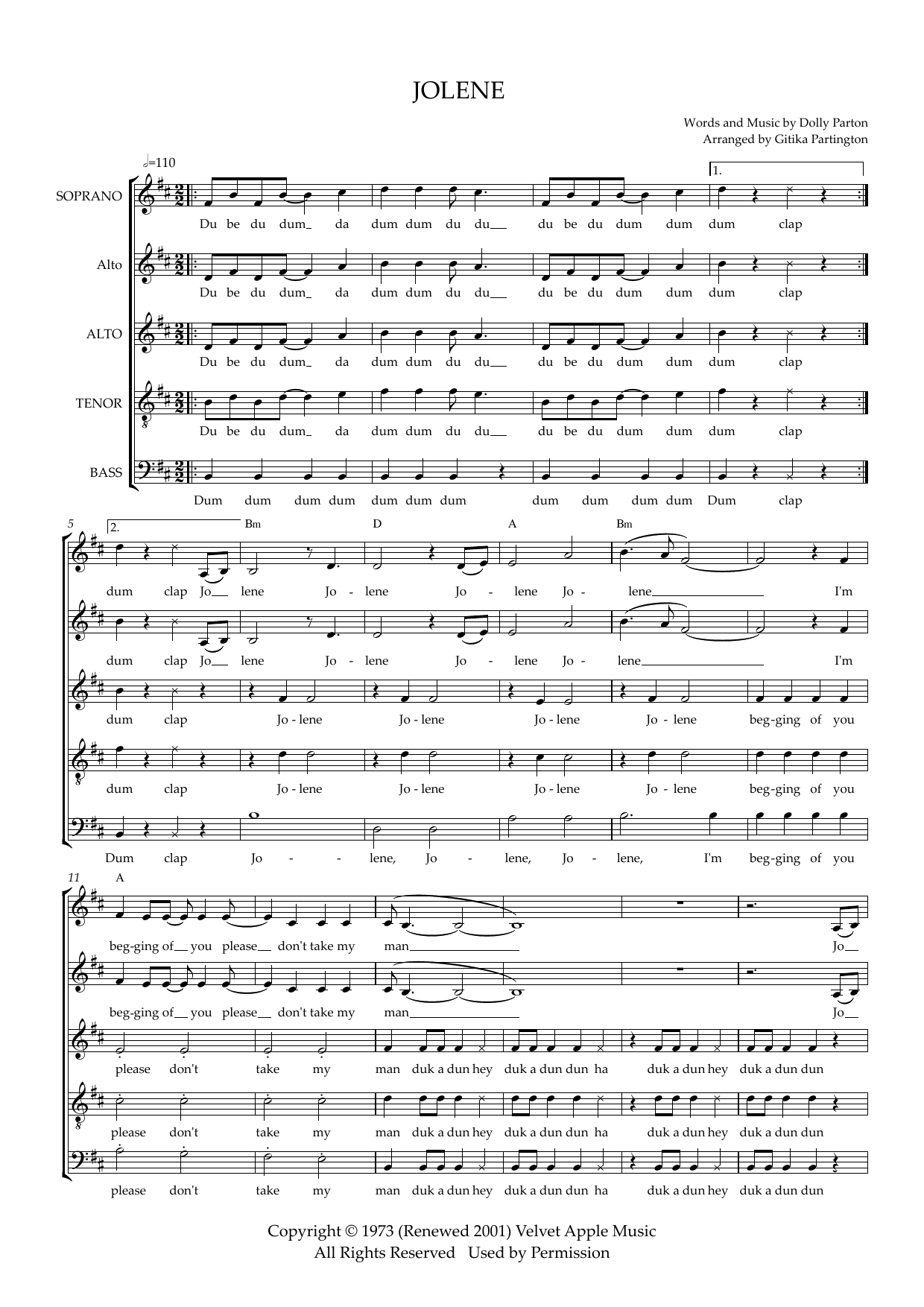
Jolene (arr. Gitika Partington): SAATB Choral Octavo

As performed by Dolly Parton / Arranged by Gitika Partington

Item: 35-DS00457631

Digital Download
$1.99
Description

Jolene (arr. Gitika Partington): SAATB Choral Octavo isn't in MakeMusic Cloud just yet...but it could be. Let us know you'd like to see it, and you'll help shape what comes next. In the meantime, start a free trial and dive into thousands of interactive titles your students can play along with today.

Sample Audio
No sample audio found.
Sample Video
Additional Details
Publisher: Hal Leonard
Page Count: 8
SKU: 35-DS00457631

More about this title

About the Artist: Dolly Parton

Dolly Parton stands as one of the most prolific and influential songwriters in American music history. Her career spans over six decades, during which she has written thousands of songs and earned induction into the Country Music Hall of Fame, the Songwriters Hall of Fame, and the Rock and Roll Hall of Fame. Beyond her recording legacy, Parton's compositions have become standards across multiple genres, recorded by artists ranging from Whitney Houston to The White Stripes.

For music educators, Parton's work offers accessible yet sophisticated material that resonates with students. Her melodies are singable and memorable, her lyrics tell compelling human stories, and her songs bridge the gap between popular and art music in ways that engage young performers. "Jolene," written in 1973, exemplifies her gift for emotional directness and narrative clarity—qualities that make her material ideal for choral education.

Why we love this

Gitika Partington's arrangement honors the song's emotional core while giving the SAATB ensemble real voices to work with. The arrangement avoids oversimplification; this isn't a diluted pop tune but a thoughtful choral setting that respects both the original and the singers performing it. Students connect immediately to material they recognize, and that connection becomes the gateway to building serious musicianship skills.

What to expect

Quiet intensity. The song carries emotional weight without needing volume to land its impact. There's intimacy in the five-part harmony, moments of transparency where the voices thin out to essential lines, and an underlying current of longing that runs through every phrase. This is a ballad that asks singers to find their own vulnerability.

Who it's for

Choirs with adequate four and five part voicing looking for material that connects with singers and audiences alike. This works for high school, community, and collegiate ensembles seeking contemporary repertoire with substance. Directors programming pop and country material alongside classical or jazz will find this arrangement sits naturally in that conversation.

How to get the most out of it

  • Protect the vulnerability in the melody line. This song lives in its restraint, not its volume. Resist the temptation to oversell the drama.
  • Balance the alto and tenor lines carefully during the harmonic passages. They support the soprano melody without pushing into it.
  • Shape the phrase endings by releasing consonants cleanly and allowing the vowels to sing through to the very end of each phrase.
  • Use dynamic contrast to map the emotional arc. The arrangement builds momentum; honor that structure by resisting the urge to sing at full volume from the start.

How to use it

Place this in a program where you want to shift mood and temperature. It's effective after faster material and pairs well with other contemporary songs that treat pop and country standards seriously. Consider programming it in a concert exploring narrative songwriting across genres, or use it as a quiet moment in a mixed repertoire set where emotional contrast matters.

Skills your students will build

  • Singing sustained legit vowels in a contemporary idiom
  • Reading and executing five-part SAATB voicing
  • Balancing ensemble blend when the harmony is close
  • Shaping dynamic contours within phrases rather than relying on dramatic shifts
  • Connecting emotional intention to vocal technique

You May Also Like