
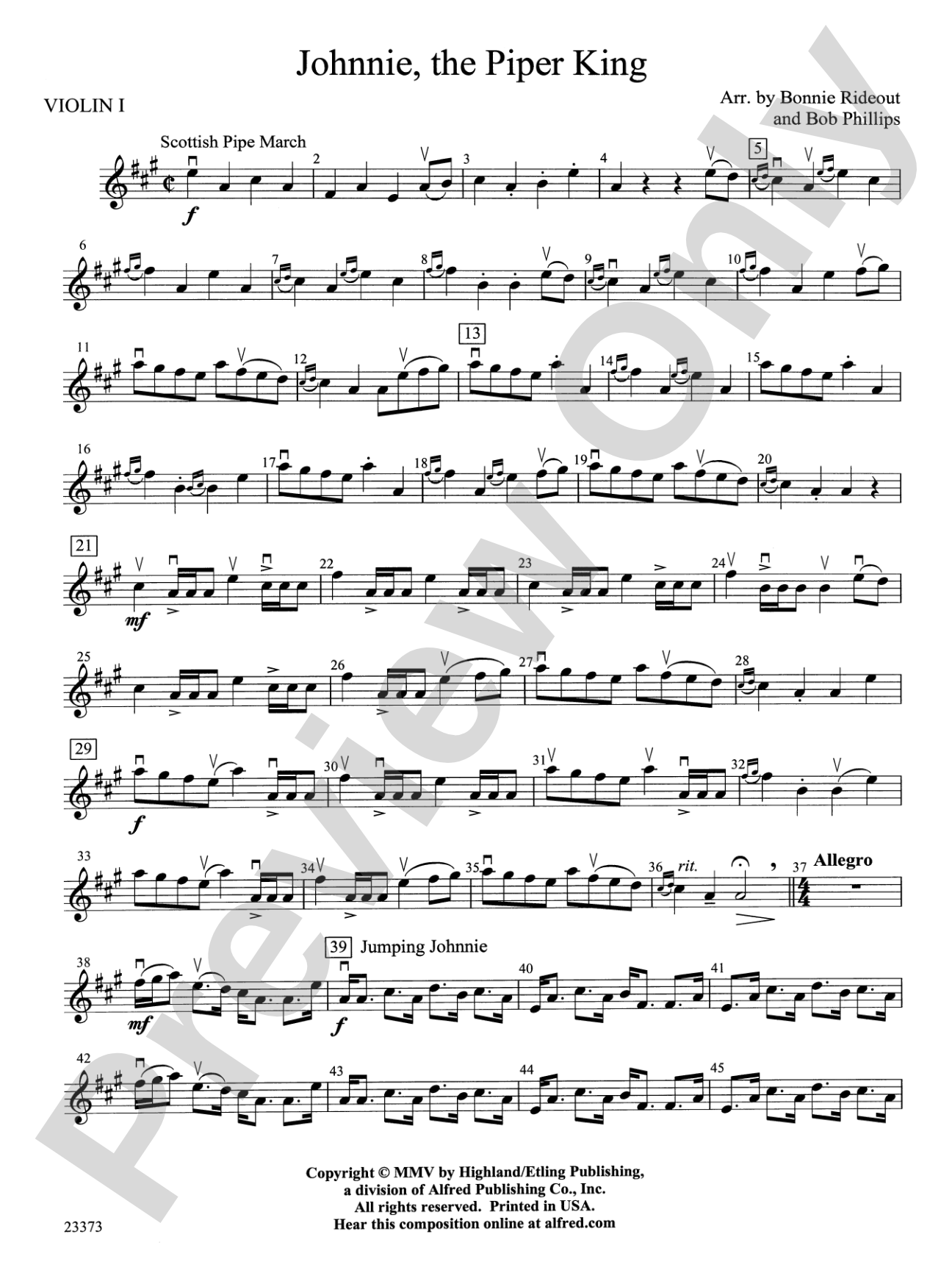

Johnnie, the Piper: 1st Violin
Arr. Bonnie Rideout and Bob Phillips
Grade: 3
Item: 00-PC-0000714_VN1
$5.99
Pickup currently not available
Description
Scottish burls and ornaments adorn this bouncy medley, making it sound more advanced than it is. Perfectly translated from the ancient fiddling tradition to modern string orchestra, Johnnie, the Piper King maintains authenticity while expanding on the musical ideas of three ancient tunes. The first tune, "The Piper King," by J. Scott Skinner, is a pipe march. That is followed by a strathspey, "Jumpin' Johnnie," and a reel titled, "Jinglin' Johnnie," hence the title Johnnie, the Piper King. Based on the authentic playing of recording artist and U.S. Scottish Fiddling Champion Bonnie Rideout, this piece is a sure winner!


Don't just read it, hear it, play along with it, and watch your students grow with it. In MakeMusic Cloud, Johnnie, the Piper: 1st Violin comes alive with professional accompaniment, adjustable tempo, and built-in practice tools that turn solo practice into real progress.
Open in the Player
Jump straight in and assign it today.
Start Your Free Trial
Open this title and explore the full library in minutes.
Sample Audio
1
Audio File
--:--
0:00
0:00
Sample Video
No sample videos found.
Additional Details
Series:
Highland/Etling String Alternatives
Publisher:
Alfred Music
Page Count:
1
SKU:
00-PC-0000714_VN1
More about this title
About the Composer: Bob Phillips

Bob Phillips brings decades of innovation to string education, having composed and authored materials performed by thousands of students annually. A conductor and pedagogue with expertise in large ensemble pedagogy and eclectic musical styles, Phillips has published over 200 works for orchestras and bands, including the influential Fiddlers Philharmonic and Jazz Philharmonic series, and holds recognition as an ASCAP award-winning composer whose works are regularly performed at the Midwest Clinic.
For 27 years, Phillips built a nationally recognized string program in Saline, Michigan, that encompassed both classical and folk traditions. He founded the Saline Fiddlers Philharmonic, which under his direction developed an international reputation, performing extensively throughout the year including multiple performances at the White House. His conducting experience spans numerous youth symphonies, all-state orchestras, and prestigious summer programs including Blue Lake Fine Arts Camp and the Queensland Honour Ensemble Program.
Why we love this
The Scottish ornaments and burls sound technically demanding, but Phillips's arrangement sits comfortably at Grade 3, making it accessible without feeling simplified. Based on authentic fiddling traditions recorded by U.S. Scottish Fiddling Champion Bonnie Rideout, the piece gives students genuine exposure to folk idiom rather than a generic folk-style pastiche. The medley structure keeps energy high across three distinct tunes, making it an engaging concert piece that doesn't require specialized fiddling technique to execute convincingly.
What to expect
Sprightly and character-filled, with the rhythmic snap of Scottish dance forms. The piece carries the energy of a fiddle session translated to modern orchestral textures, brimming with the ornamentation and melodic turns that make Scottish traditional music immediately recognizable and engaging.
Who it's for
String orchestras at the intermediate level looking for folk repertoire that connects to traditional music without compromising orchestral blend and intonation. This works well for programs seeking programming alternatives that engage students in cultural authenticity while building musicianship within familiar Grade 3 technical range.
How to get the most out of it
- Lean into the rhythmic bounce of the strathspey and reel sections; these traditional forms have their own harmonic momentum, so avoid letting them drag or sound plodding.
- Observe the ornaments not as extra decoration but as essential phrasing choices. Scottish burls and grace notes shape the melody's character, so articulate them as integral to the line.
- Balance the first violin line with sensitive accompaniment from lower voices; the melody needs to sing above the harmonic fabric without drowning out the supporting voices that give the piece its rhythmic drive.
- Use light detachés and open string resonance where the fiddling idiom suggests it; this allows the piece to breathe like traditional Scottish folk performance rather than sounding like classical arco technique.
How to use it
Program this as a standalone concert piece when you want to break from classical selections and demonstrate your students' musicianship across genres. It also pairs naturally with other folk or world music arrangements, or stands alone as an accessible introduction to Scottish musical traditions for audiences less familiar with that repertoire.
Skills your students will build
- Executing Scottish ornaments and burls with proper rhythm and articulation
- Playing strathspeys and reels with appropriate rhythmic character and swing
- Balancing melody and accompaniment in folk-idiom contexts
- Reading and performing grace notes and graceful articulation shifts
- Translating fiddling traditions to orchestral string technique and tone production