
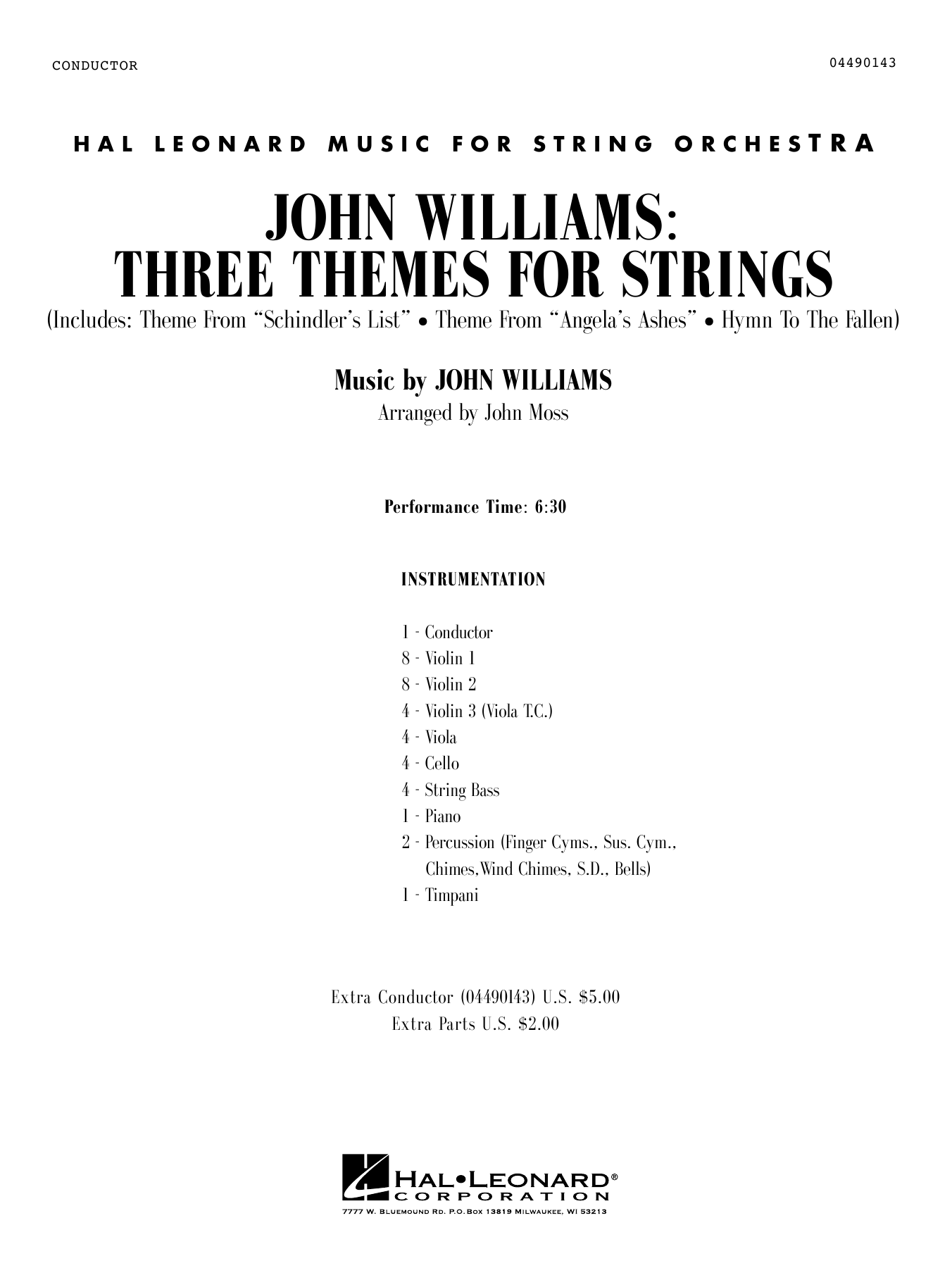

John Williams: Three Themes for Strings (arr. John Moss): String Orchestra Conductor Score & Parts
By John Williams / Arranged by John Moss
Grade: 3-4
Item: 35-PK01412572
$50.00
Pickup currently not available
Buy Extra Parts (Digital PDF Download)
Parts Added to Cart!
Description
Three memorable themes from renowned film composer John Williams are included in this sensitive musical montage. John Moss has captured the emotion and musical drama of these award-winning film scores with his arrangement that includes: "Schindler's List, Angela's Ashes," and "Hymn to the Fallen (from Saving Private Ryan)."


John Williams: Three Themes for Strings (arr. John Moss): String Orchestra Conductor Score & Parts isn't in MakeMusic Cloud just yet...but it could be. Let us know you'd like to see it, and you'll help shape what comes next. In the meantime, start a free trial and dive into thousands of interactive titles your students can play along with today.
Request This Title
Tell us you want it.
Start Your Free Trial
Explore everything that's ready to play right now.
Sample Audio
No sample audio found.
Sample Video
No sample videos found.
Additional Details
Publisher:
Hal Leonard
SKU:
35-PK01412572
More about this title
About the Composer: John Williams
John Williams stands among the most prolific and celebrated film composers of our time, with a career spanning over six decades and a resume that includes some of cinema's most iconic scores. His mastery of orchestration and gift for melody have earned him five Academy Awards and numerous Grammy Awards, establishing him as a foundational figure in modern film music. Williams studied composition at various institutions and apprenticed under some of the finest orchestrators in Hollywood, developing a sophisticated harmonic language rooted in the great symphonic traditions.
For music educators, Williams represents a unique bridge between classical training and accessible contemporary composition. His themes are instantly recognizable, emotionally direct, and orchestrated with such clarity that students can hear and understand the craft decisions at every level. His work demonstrates how traditional compositional techniques remain vital tools for emotional expression, making him an invaluable model for young musicians studying how great composers communicate across different mediums.
Why we love this
This collection gives your ensemble direct access to three of cinema's most moving moments without requiring the advanced technical demands of the full orchestral scores. Moss's arrangement respects the original emotional architecture of these themes while creating a string-focused texture that allows every section of your orchestra meaningful work. Programming three such universally recognized pieces in a single setting transforms them from isolated moments into a coherent artistic statement about loss, resilience, and remembrance.
What to expect
These three themes create a sustained meditation on memory and loss. The arrangement moves between moments of quiet introspection and passages of genuine grandeur, with the string writing capturing both the vulnerability of intimate expression and the power of collective voice. There's a reverential quality throughout, as if the orchestra is honoring something larger than itself.
Who it's for
String orchestras at the intermediate level seeking repertoire with immediate emotional impact and professional-level orchestration. This works equally well for high school orchestras, youth orchestras, and semi-professional ensembles looking to program something meaningful that audiences will recognize and connect with.
How to get the most out of it
- Balance the melody between first violins and violas during the transitions between themes; these inner voices carry essential harmonic weight that can easily disappear if the upper strings dominate.
- Resist the impulse to push tempo during the more lyrical passages. Williams's themes gain their power through space and breath, not momentum.
- Attend to dynamic shaping in the cello and bass lines. These voices anchor the harmonic foundation and create the sense of weight these themes require.
- Allow vibrato to vary naturally across the ensemble rather than enforcing uniformity. The emotional content of these arrangements deepens when players respond individually to phrase shape and dynamic intent.
How to use it
Consider using this as the centerpiece of a concert exploring how music functions in film, pairing it with other film music arrangements or with classical works that share similar thematic concerns. Alternatively, it serves as a powerful closing piece for a concert focused on themes of loss and reflection, or as a meaningful entry point for students new to Williams's compositional language. The three-theme structure also works beautifully as an intermission piece if you're programming a longer concert format.
Skills your students will build
- Balancing melody and harmonic support across multiple string sections
- Sustaining tone and vibrato through extended passages without rhythmic anchors
- Responding to subtle dynamic and expressive markings that convey emotional content
- Playing with awareness of harmonic function in tonal music
- Ensemble cohesion when navigating tempo shifts between contrasting thematic material