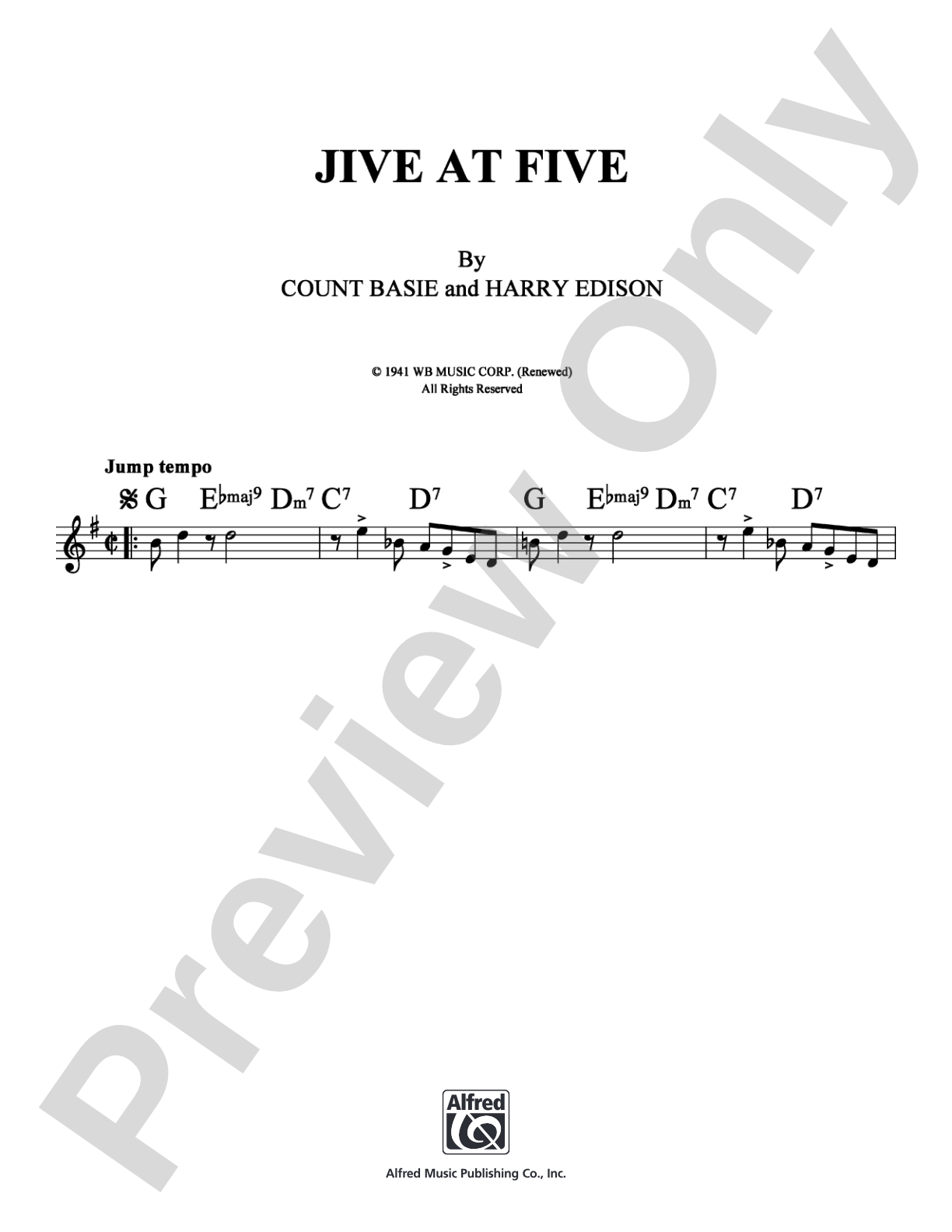
Jive at Five: Lead Sheet Digital Sheet Music

Jive at Five: Lead Sheet Digital Sheet Music

Count Basie, Harry Edison

Item: 00-PS-0000444

Digital Download
$1.99
Description

Jive at Five: Lead Sheet Digital Sheet Music isn't in MakeMusic Cloud just yet...but it could be. Let us know you'd like to see it, and you'll help shape what comes next. In the meantime, start a free trial and dive into thousands of interactive titles your students can play along with today.

Sample Audio
No sample audio found.
Sample Video
Additional Details
SKU: 00-PS-0000444

More about this title

About the Artist: Count Basie

William James Basie (1904-1984) built one of the most disciplined and swinging big bands in jazz history. His economic piano style and impeccable sense of time became the foundation for an orchestra that could play with effortless groove for decades. Basie's ability to accompany soloists while maintaining absolute rhythmic control made him a model bandleader and composer whose influence shaped how rhythm sections function across all styles of jazz.

Why we love this

Basie's compositions capture the essence of swing orchestration in a format that teaches musicians how a few melodic and harmonic ideas can generate infectious energy. A lead sheet from his catalog gives jazz students direct access to the harmonic structures and melodic sensibilities that defined the Kansas City swing tradition, without the distraction of a full arrangement. The groove encoded in these melodies is impossible to fake—musicians must feel it.

What to expect

Jive at Five captures the relaxed confidence of a band deep in its groove, where everyone knows exactly where the one is and where the melody is headed. The tune unfolds with the ease of a conversation between musicians who have played together a thousand times. There's joy here, but never hysteria; the swing is inevitable and understated.

Who it's for

Jazz ensemble directors, pianists in small-group settings, and upper-level improvisation students will find this lead sheet essential for understanding how Basie's compositions balance simplicity with sophistication. Rhythm section members building comping skills benefit from studying how these melodies sit within the harmonic structure. Any musician serious about swing style needs to internalize how Basie thought melodically and rhythmically.

How to get the most out of it

  • Ground every phrase in the pulse of the walking bass line; the melody dances around a rhythm section that locks in first.
  • Voice the chords with the spaciousness typical of swing-era big bands rather than dense modern voicings; clarity of line matters more than harmonic color.
  • Listen to Basie's own recordings to hear how space and silence punctuate the phrases; restraint is a virtue here.
  • Let comping players build their accompaniment around the melody's contour, not against it; the best swing charts feel like conversation.

How to use it

Feature this in a jazz concert alongside other mid-tempo swing standards to show how Basie's melodic vocabulary differs from bebop and cool jazz compositions of the same era. Use it as a teaching piece for rhythm section rehearsals where pianists and bassists can lock in on a tune that rewards both precision and swing feel. It also works well as a smaller group interlude within a big band concert program.

Skills your students will build

  • Reading lead sheet notation and chord symbols
  • Recognizing and playing swing rhythms at mid-tempo
  • Comping over jazz chord progressions in a supportive, conversational manner
  • Understanding melodic phrasing that sits naturally within harmonic rhythm
  • Building ensemble cohesion through shared groove and time feel

You May Also Like