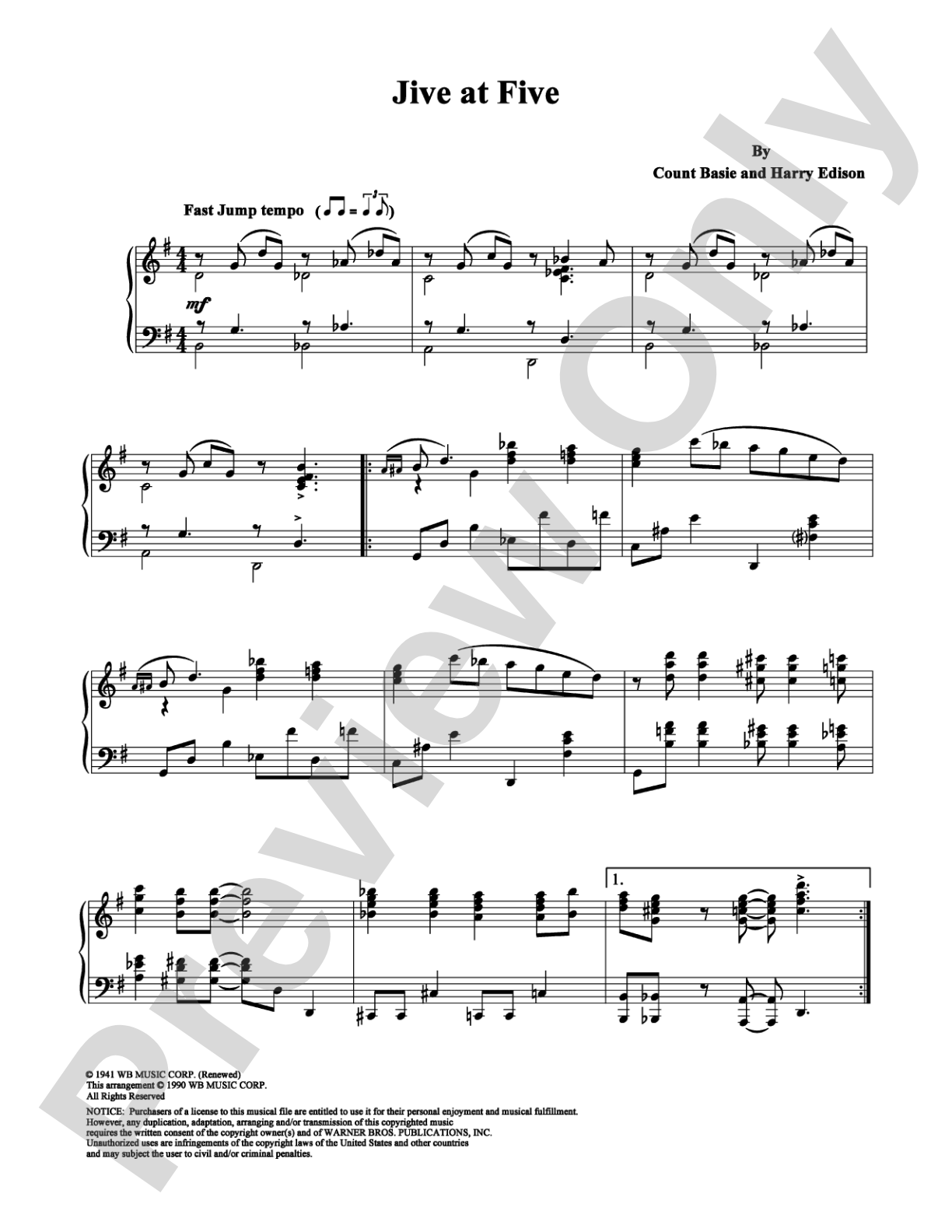
Jive at Five: Piano Digital Sheet Music

Jive at Five: Piano Digital Sheet Music

Count Basie, Harry Edison

Item: 00-PS-0000443

Digital Download
$3.99
Description

Jive at Five: Piano Digital Sheet Music isn't in MakeMusic Cloud just yet...but it could be. Let us know you'd like to see it, and you'll help shape what comes next. In the meantime, start a free trial and dive into thousands of interactive titles your students can play along with today.

Sample Audio
No sample audio found.
Sample Video
Additional Details
SKU: 00-PS-0000443

More about this title

About the Artist: Count Basie

William James Basie transformed American jazz by proving that a big band could swing hard with economy and restraint. His piano playing was deceptively simple, sparse, rhythmically perfect, and always in service of the ensemble, but his bandleading genius lay in building orchestral power from minimal comping and maximum groove. From the 1930s through the 1980s, Basie's Kansas City sound defined swing era sophistication and influenced generations of jazz musicians across every instrument.

Why we love this

This is quintessential Basie: a straightforward vehicle for learning how to comp with rhythmic precision and harmonic confidence. The title promises exactly what it delivers, a five-o'clock blues that teachers can trust to sound authentic while remaining accessible for intermediate pianists discovering the language of swing accompaniment.

What to expect

Relaxed and propulsive at once. The blues form feels inevitable, almost conversational, Basie never rushes, never overplays, but the groove pulls you forward with effortless momentum. This is what happens when a master pianist gets out of the way and lets the music breathe.

Who it's for

Jazz pianists at the intermediate level and above who want to study authentic swing piano vocabulary directly from a master. This also serves pianists preparing for jazz combos or big band settings who need to understand how to comp effectively within an ensemble.

How to get the most out of it

  • Keep the left hand light and metronomic. The rhythm section feeling depends entirely on Basie's rock-solid pulse; let it breathe rather than pushing.
  • Voice the chord changes economically. Avoid filling every space; Basie's genius was knowing when not to play.
  • Lock into the eighth-note swing feel completely. The groove lives in the space between written notes and their actual articulation.
  • Let the piano sit in the mix as an accompaniment voice first. Even though you're playing solo, imagine yourself in a full band context.

How to use it

Use this as a standalone feature in a jazz recital or as a closing number that leaves audiences with the essence of swing. It also works beautifully as a teaching performance in jazz history or jazz piano classes to illustrate authentic comping technique.

Skills your students will build

  • Swung eighth-note articulation and feel
  • Comping with minimal voicings that maintain harmonic clarity
  • Left-hand time keeping independent from right-hand melody or improvisation
  • Reading and responding to jazz chord changes at tempo
  • Understanding ensemble piano roles in small group settings

You May Also Like