
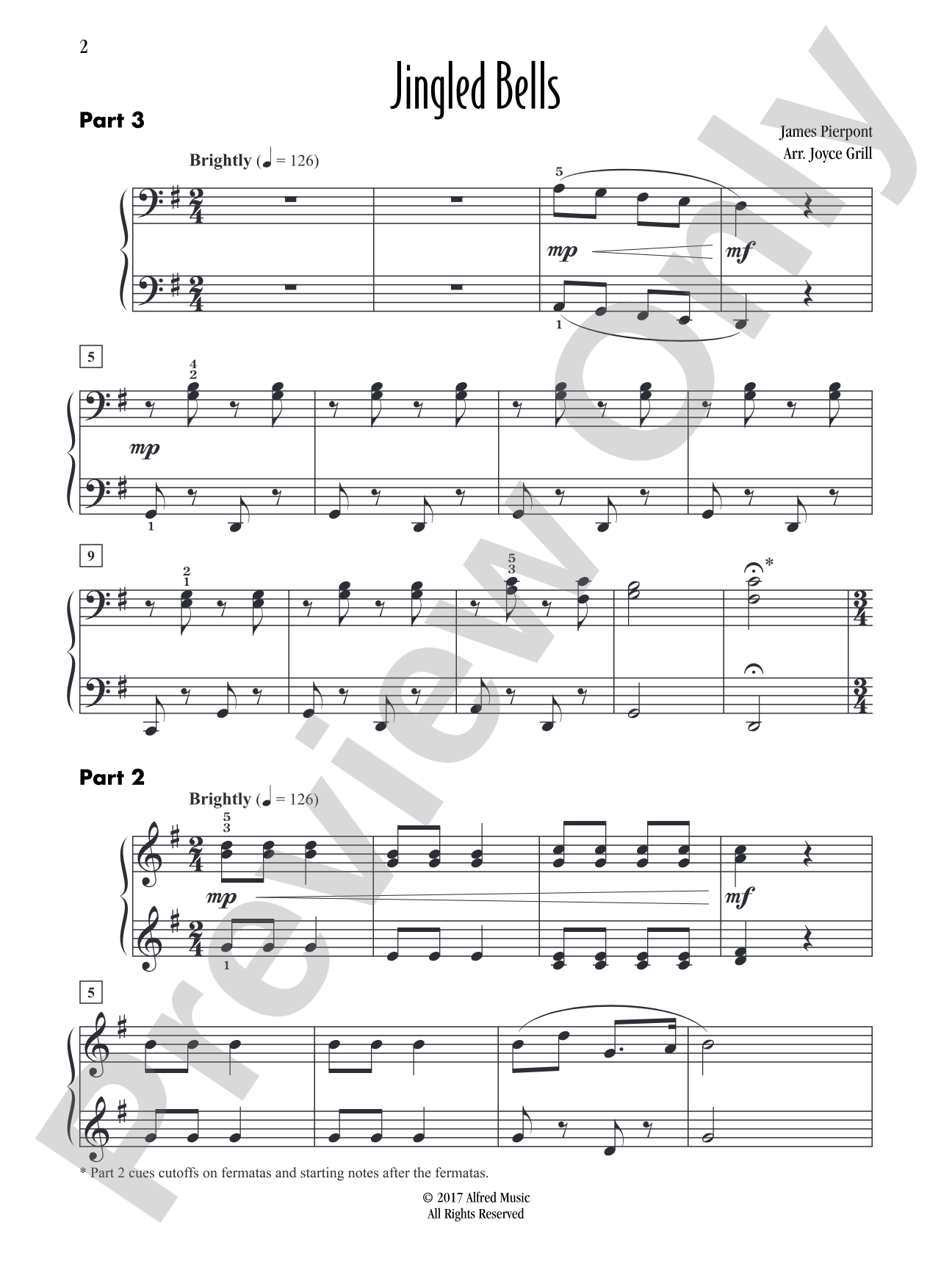
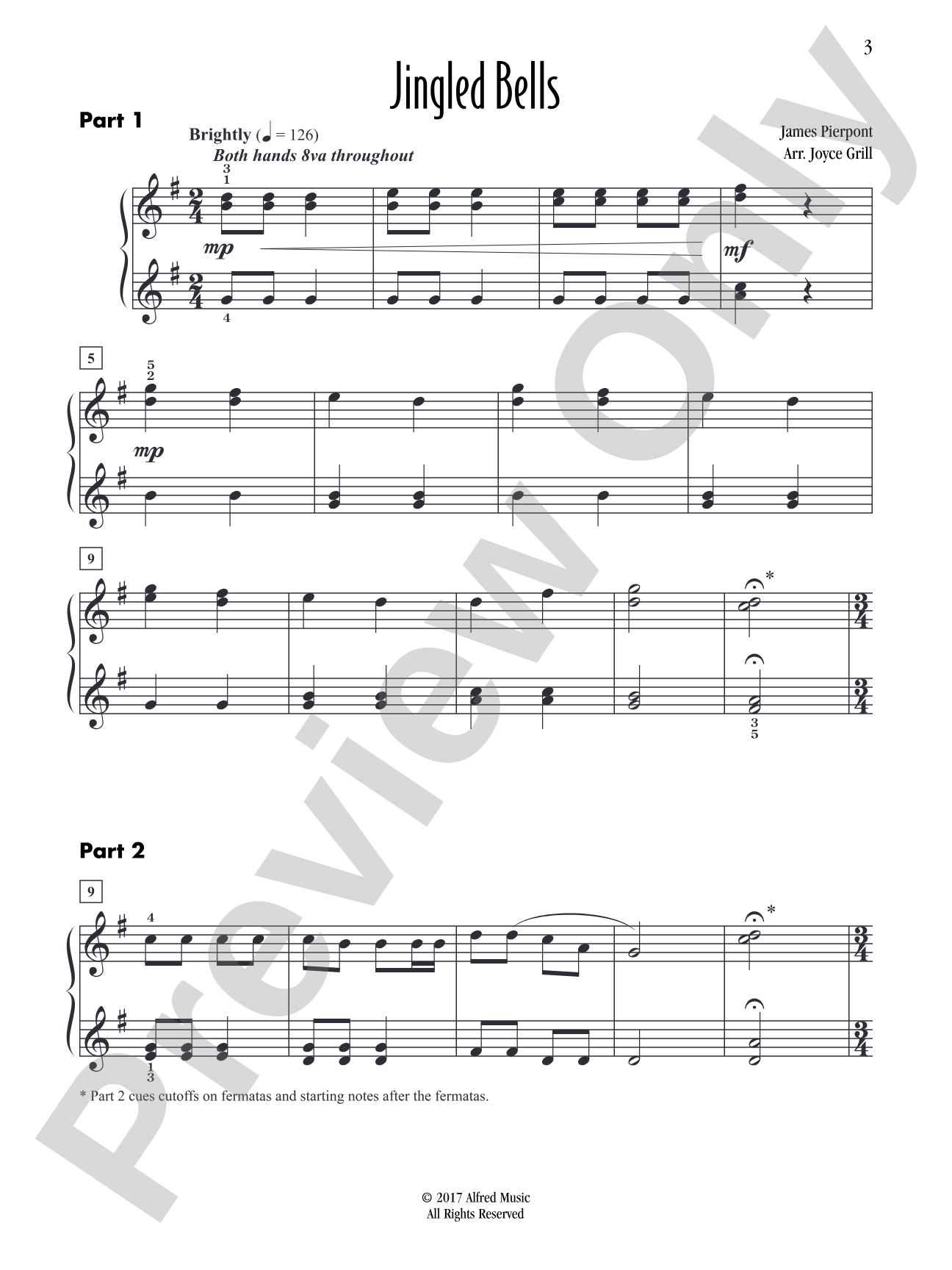

Jingled Bells - Piano Trio (1 Piano, 6 Hands): Piano
Arranged by Joyce Grill
Level: Late Elementary
Item: 00-PB-0000680
$5.99
Pickup currently not available
Related Items
Jingled Bells: Piano Trio (1 Piano, 6 Hands) Sheet |
$5.99
|
View |
Description
Written for one piano, six hands, this is a delightful arrangement of "Jingle Bells." Performance notes are added that, when followed by the three performers, turn the piece into a mini comedy-drama. Following a short introduction, performer 2 begins the arrangement with the chorus of "Jingle Bells." Two variations of the verse follow. One is set in 3/4 time and the other is a transition, leading back to the chorus in a minor key. The lively ending will bring any audience to their feet. A Federation Festivals 2024-2028 selection.


Jingled Bells - Piano Trio (1 Piano, 6 Hands): Piano isn't in MakeMusic Cloud just yet...but it could be. Let us know you'd like to see it, and you'll help shape what comes next. In the meantime, start a free trial and dive into thousands of interactive titles your students can play along with today.
Request This Title
Tell us you want it.
Start Your Free Trial
Explore everything that's ready to play right now.
Sample Audio
No sample audio found.
Sample Video
No sample videos found.
Additional Details
Publisher:
Alfred Music
Page Count:
12
SKU:
00-PB-0000680
More about this title
About the Arranger: Joyce Grill

Joyce Grill spent decades on the faculty at the University of Wisconsin-La Crosse before retiring to pursue her passion for teaching across the country through workshops and clinics. Her credentials run deep: MTNA Master Teacher Certificate, MTNA Foundation Fellow (2006), National Certified Teacher of Music, and study under the legendary Nadia Boulanger at the School of Fine Arts in Fontainebleau. Beyond her own degrees from UW-Madison, Grill has shaped the regional music education landscape by founding the La Crosse Area Music Teachers Association and serving in leadership roles for MTNA at both state and divisional levels.
Her reputation rests on intelligent ensemble writing, particularly for multiple pianos, and she regularly guests conducts multi-piano concerts. Her most enduring publications, originally released through Warner Bros. Publications and now distributed by Alfred Music, have become standards in many studios: In Style, Down the Road, and Accompanist (Yes, It Really Happens) showcase her gift for writing music that feels fresh and approachable without sacrificing musicality.
Why we love this
Six hands on one piano means built-in physical comedy and ensemble interaction that students genuinely enjoy executing. Grill's performance notes transform what could be a straightforward holiday arrangement into a theatrical mini-event, complete with dramatic key shifts to a minor-key chorus and a finale designed to earn applause, making this a genuine crowd-pleaser for winter recitals.
What to expect
Playful, mischievous, and a touch theatrical. The arrangement bounces between the familiar comfort of the chorus and unexpected detours (a verse in 3/4, a key shift to minor), giving the piece a personality that feels more like a story than a simple tune. The ending snaps back to brightness with enough momentum to leave an audience smiling.
Who it's for
Elementary-level pianists ready to experience ensemble playing in a fun, low-pressure context. This works equally well for a holiday recital, a school assembly, or a studio showcase where three students can share one instrument and a moment of connection.
How to get the most out of it
- Spend rehearsal time on the hand placement and crossovers required for three people sharing one bench; blocking out who sits where and when matters more than you might think.
- Treat the rhythmic introduction as a setup, letting the audience settle before Performer 2 enters with the chorus. The contrast creates better comic timing.
- The 3/4 verse variation and the transition back to the minor-key chorus need clean coordination; map out who leads each section and ensure the other performers listen actively rather than playing mechanically.
- The ending's energy comes from commitment. This isn't subtle; lean into the lively character and match the physicality to the sound.
How to use it
Slot this into the middle or closing section of a winter recital when you want to shift the energy and remind the audience that music can be both skillfully written and genuinely fun. The novelty factor makes it a natural bridge between more traditional repertoire and lighter seasonal fare.
Skills your students will build
- Ensemble communication and listening while performing
- Hand placement and independence across three players sharing one instrument
- Rhythmic precision in mixed meters (3/4 and 4/4 in sequence)
- Stylistic contrast through key and tempo variation
- Ensemble balance and dynamics when multiple hands occupy overlapping registers