
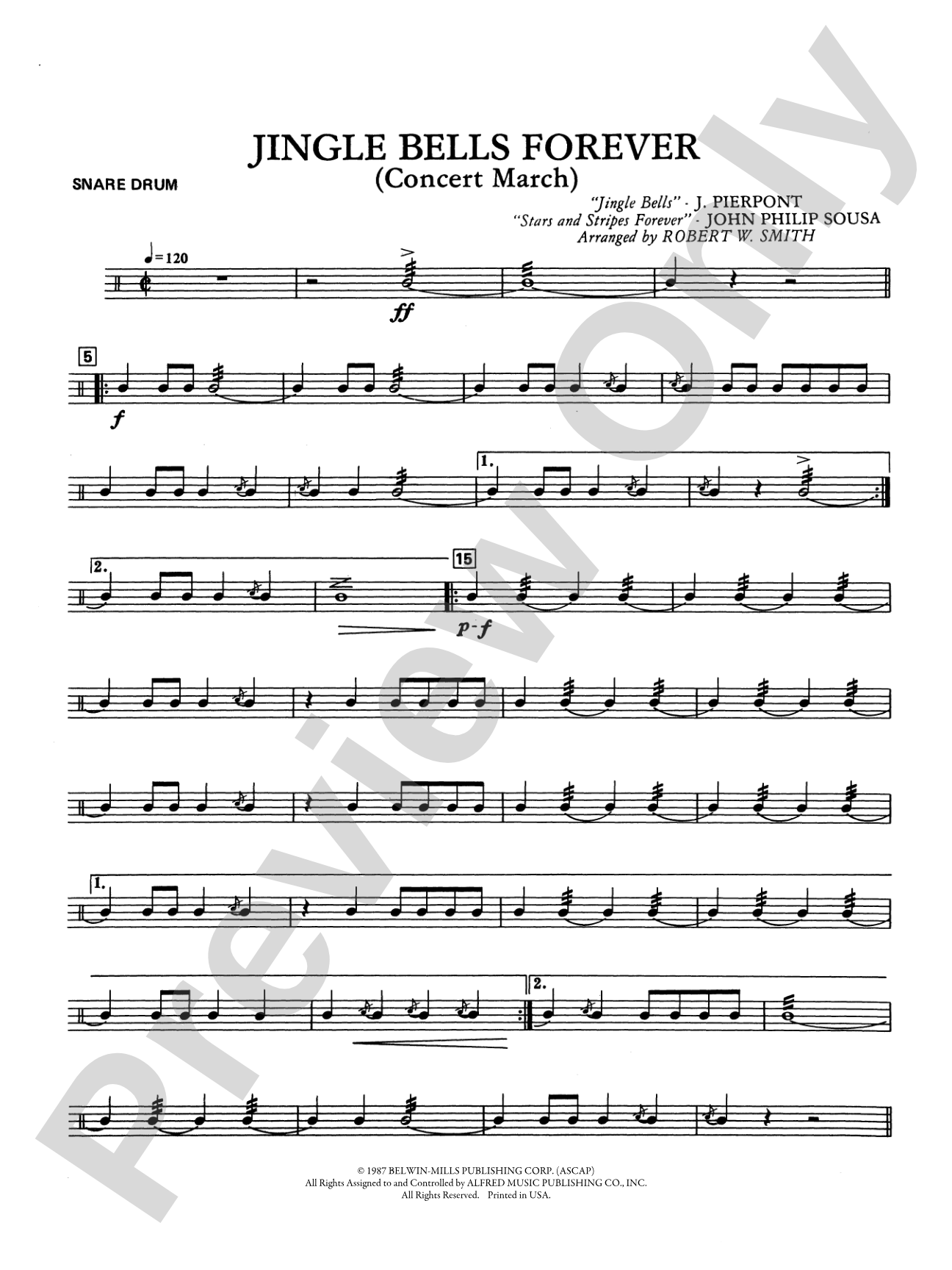

Jingle Bells Forever (Concert March): Snare Drum
Arr. Robert W. Smith
Grade: 3 (Medium Easy)
Item: 00-PC-0015178_SD
$3.00
Pickup currently not available
Description
Take America's favorite Christmas melody and America's favorite march, arrange them with tender loving care, and you get good music and "show biz" all wrapped in one. In the Sousa tradition, we predict your audience will have goose bumps all over. (2:47)


Don't just read it, hear it, play along with it, and watch your students grow with it. In MakeMusic Cloud, Jingle Bells Forever (Concert March): Snare Drum comes alive with professional accompaniment, adjustable tempo, and built-in practice tools that turn solo practice into real progress.
Open in the Player
Jump straight in and assign it today.
Start Your Free Trial
Open this title and explore the full library in minutes.
Sample Audio
1
Audio File
--:--
0:00
0:00
Sample Video
Additional Details
Series:
Belwin Concert Band
Publisher:
Alfred Music
Page Count:
242
SKU:
00-PC-0015178_SD
More about this title
About the Arranger: Robert W. Smith

Robert W. Smith stands among the most recorded and performed composers for concert band in America, with over 400 published works spanning original compositions, arrangements, and orchestrations. His music appears regularly on professional and student ensemble concert programs across North America, Europe, Australia, and Asia, and has been featured on major television broadcasts, Olympic ceremonies, and iconic American events from the Macy's Thanksgiving Day Parade to Opening Day at Dodger Stadium.
Smith holds degrees in music education from Troy State University and a master's degree from the University of Miami. His symphonic works, including The Divine Comedy and The Odyssey, have become repertoire standards alongside his widely performed band compositions for developing and advanced ensembles. As both conductor and clinician, he has worked extensively in schools and at festivals throughout the United States, Canada, Japan, Australia, and Europe.
Why we love this
Smith nails the balance between accessibility and showmanship here. He respects the Sousa march tradition while anchoring everything around a melody audiences already know and love, which means your band can focus on executing crisp articulation and clean ensemble balance rather than learning unfamiliar material. The arrangement delivers genuine concert impact at Grade 3, letting developing bands sound polished and purposeful.
What to expect
This is a march with a heart. The familiar Christmas melody gets treated with affection and dignity rather than novelty, wrapping it in the ceremonial warmth of the Sousa tradition. The result feels both festive and formal, like a holiday processional that honors the occasion while maintaining concert integrity.
Who it's for
Band directors looking for a Christmas concert piece that bridges the gap between accessibility and sophistication. Grade 3 bands with reliable fundamentals in articulation and ensemble balance will perform this effectively, and it works equally well for high school ensembles seeking a polished, crowd-pleasing holiday selection without compromising musical standards.
How to get the most out of it
- Articulation defines this piece. Work for clean, unified tonguing across the band, especially in the syncopated rhythmic figures typical of the march style. Loose or slurred articulation will blur the march character.
- Balance the melody strategically across sections rather than letting it live in a single voice. Smith's orchestration passes the tune around, and keeping that clear without overwhelming accompaniment requires attentive sectional listening.
- Maintain steady, forward-moving tempo throughout. The 2:47 duration suggests a brisk march pace; resist the temptation to slow during thicker harmonic sections or the Christmas melody passages.
- Shape the dynamic arc as you would any march: clear contrasts between themes, gentle swells at phrase peaks, and deliberate dynamic layering rather than a uniform forte throughout.
How to use it
Program this as an anchor piece on a winter concert, pairing it with contrasting holiday fare to show your band's range. It serves equally well as a closing encore or as the finale of a longer concert arc where it can land with maximum impact. The straightforward march style also makes it an effective pops concert selection for community performances where broader audiences attend.
Skills your students will build
- Unified articulation and release in march idiom
- Dynamic shaping and phrasing in a classical march form
- Sectional balance when melody passes between instrument groups
- Maintaining steady tempo and forward momentum in a mid-tempo march
- Clean execution of syncopated rhythmic figures common to march writing