Jingle Bells Forever: 1st Trombone Sheet Music Preview

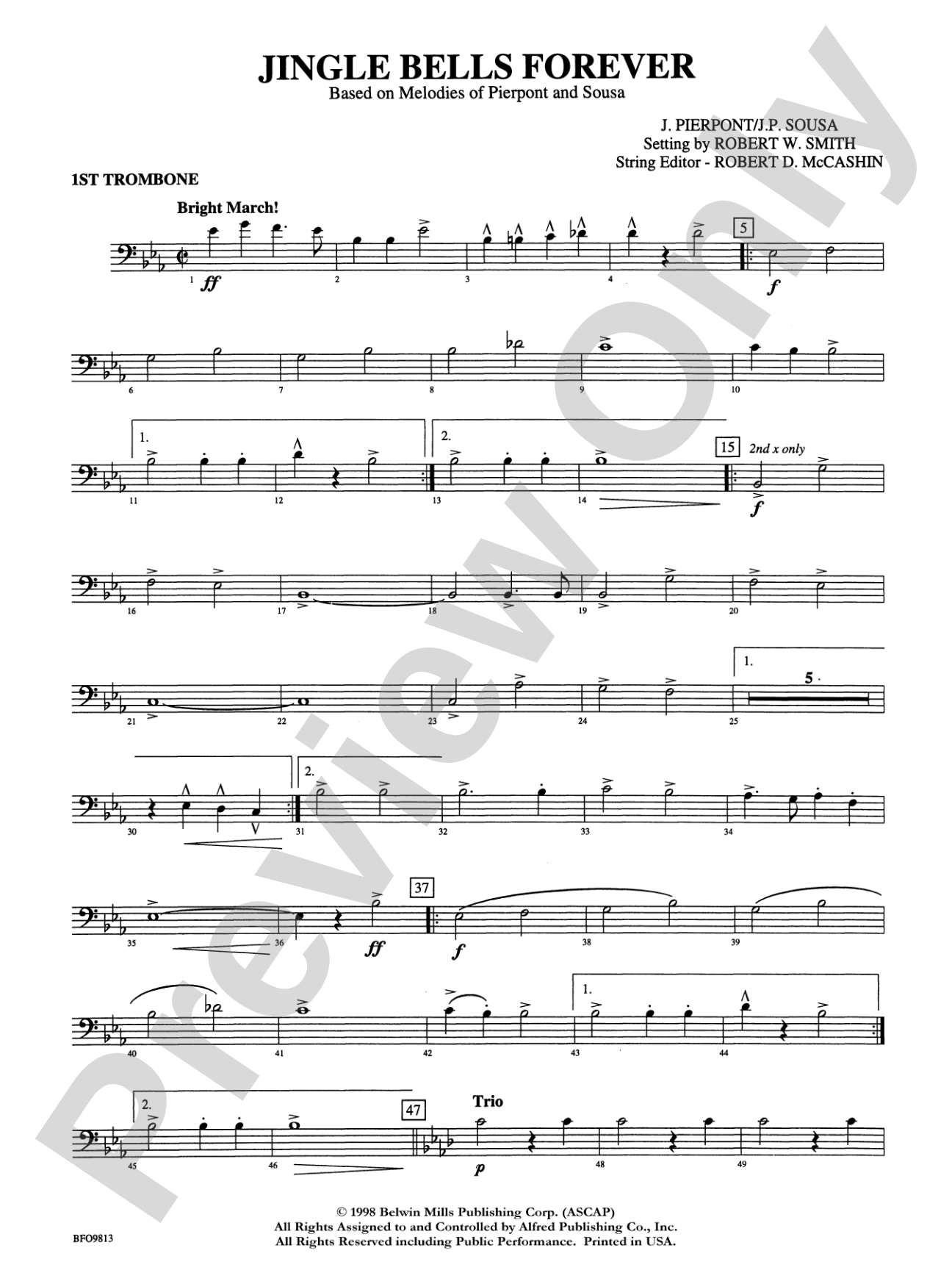
Jingle Bells Forever: 1st Trombone

Arr. Robert W. Smith

Grade: 3.5

Item: 00-PC-0002213_TN1

Digital Download
$3.00
Description
Take America's favorite Christmas melody and America's favorite march, arrange them with tender loving care, and you have good music and showbiz all wrapped in one. In the Sousa tradition, your audience will have goose bumps by the thousands as they recognize "Jingle Bells Forever" in this happy, happy happening! (2:32)

Don't just read it, hear it, play along with it, and watch your students grow with it. In MakeMusic Cloud, Jingle Bells Forever: 1st Trombone comes alive with professional accompaniment, adjustable tempo, and built-in practice tools that turn solo practice into real progress.

Sample Audio
0:00
0:00
Sample Video
Additional Details
Series: Belwin Concert Full Orchestra
Publisher: Alfred Music
Page Count: 236
SKU: 00-PC-0002213_TN1

More about this title

About the Arranger: Robert W. Smith

Robert W. Smith

Robert W. Smith has established himself as a defining voice in American concert band and orchestral composition, with over 400 works published across both mediums. His education includes a Bachelor of Music Education from Troy State University and a Master of Music from the University of Miami. Smith's original compositions, including his symphonies The Divine Comedy and The Odyssey, have resonated with musicians and audiences across North America, Europe, Australia, and Asia, while works like The Tempest have become foundational repertoire for developing ensembles.

Beyond the concert hall, Smith's music has appeared in high-profile contexts spanning Olympic ceremonies, network television broadcasts, the Macy's Thanksgiving Day Parade, and Opening Day at Dodger Stadium. His work as a guest conductor and clinician has taken him throughout the United States, Canada, Japan, Australia, and Europe, where he continues to shape the landscape of American instrumental music.

Why we love this

Smith's gift for orchestration shines here, taking two beloved American melodies and wedding them with orchestral color and theatrical momentum that feels earned rather than inflated. The Grade 3.5 scoring gives every section meaningful material, so your orchestra stays engaged throughout rather than playing rhythmic padding. Audiences recognize the tune instantly, but the arrangement's architecture and energy transform a familiar carol into a concert event.

What to expect

Bright, celebratory, and unabashedly American, with the kind of propulsive energy that makes audiences sit forward in their seats. The orchestration bustles with life, from twinkling upper strings to blazing brass, creating a sense of motion and joy that honors both the carol and the march tradition without condescension.

Who it's for

Orchestras at the Grade 3 to 4 level seeking festive seasonal material with genuine musical substance and audience appeal. This works equally well for holiday concerts, winter pops programs, or any concert needing a joyful closing statement that feels polished rather than cute.

How to get the most out of it

  • Shape the phrasing across full phrases rather than from bar to bar; let the melodic contours breathe and build momentum toward climactic moments.
  • Balance the melody clearly against the countermelody and accompaniment textures; the tune must sing even as orchestral detail increases.
  • Communicate the Sousa march character through crisp articulation in the brass and woodwinds, particularly during the driving rhythmic sections.
  • Use the 2:32 duration as a guide for overall pacing, but allow the arrangement's natural arc to shape your tempo rather than forcing a clock time.

How to use it

Program this as your closing number on a winter concert to send the audience home with genuine warmth and momentum. The piece pairs naturally with more serious winter fare earlier in the program, offering a welcome tonal shift while still reading as polished orchestration rather than novelty.

Skills your students will build

  • Balance and blend across orchestral sections
  • Phrasing in march style articulation
  • Tracking countermelody and primary melody relationships
  • Maintaining ensemble precision at moderate to brisk tempos
  • Dynamic control across a full orchestral range

You May Also Like