
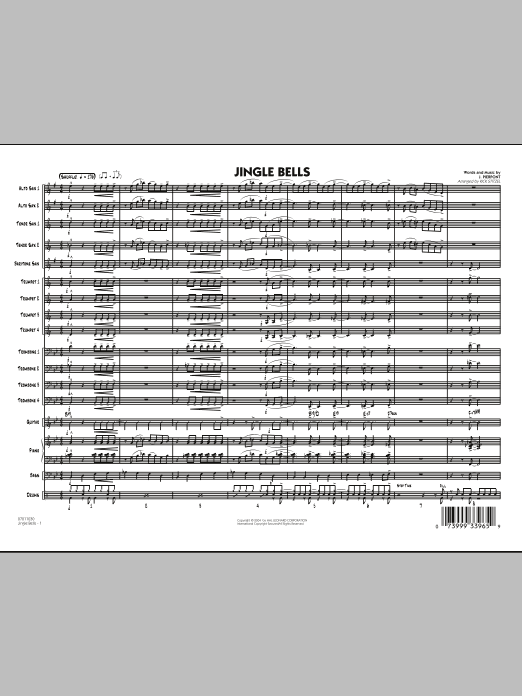

Jingle Bells: Jazz Ensemble Conductor Score & Parts
By J. Pierpont / Arranged by Rick Stitzel
Grade: 3
Item: 35-PK00141199
$50.00
Pickup currently not available
Buy Extra Parts (Digital PDF Download)
| Product | Price | Quantity |
|---|---|---|
| Jingle Bells - Full Score | $7.50 | |
| Jingle Bells - Alto Sax 1 | $6.00 | |
| Jingle Bells - Alto Sax 2 | $6.00 | |
| Jingle Bells - Tenor Sax 1 | $6.00 | |
| Jingle Bells - Tenor Sax 2 | $6.00 | |
| Jingle Bells - Baritone Sax | $6.00 | |
| Jingle Bells - Trumpet 1 | $6.00 | |
| Jingle Bells - Trumpet 2 | $6.00 | |
| Jingle Bells - Trumpet 3 | $6.00 | |
| Jingle Bells - Trumpet 4 | $6.00 | |
| Jingle Bells - Trombone 1 | $6.00 | |
| Jingle Bells - Trombone 2 | $6.00 | |
| Jingle Bells - Trombone 3 | $6.00 | |
| Jingle Bells - Trombone 4 | $6.00 | |
| Jingle Bells - Guitar | $6.00 | |
| Jingle Bells - Piano | $6.00 | |
| Jingle Bells - Bass | $6.00 | |
| Jingle Bells - Drums | $6.00 |
Parts Added to Cart!
Description
Although everyone plays it, "Jingle Bells" was never as hip as in this jumpin' and jivin' swing version from Rick Stitzel. Not just your run-of-the-mill token holiday offering, you won't find anyone in the audience sleeping through this one!


Jingle Bells: Jazz Ensemble Conductor Score & Parts isn't in MakeMusic Cloud just yet...but it could be. Let us know you'd like to see it, and you'll help shape what comes next. In the meantime, start a free trial and dive into thousands of interactive titles your students can play along with today.
Request This Title
Tell us you want it.
Start Your Free Trial
Explore everything that's ready to play right now.
Sample Audio
No sample audio found.
Sample Video
No sample videos found.
Additional Details
Publisher:
Hal Leonard
SKU:
35-PK00141199
More about this title
About the Composer: J. Pierpont
J. Pierpont composed what may be the most recognizable melody in American music. Written in 1857, "Jingle Bells" emerged from a Boston music publisher's shop and quickly became the template for how Christmas music could live in popular culture. Pierpont's simple, memorable tune gave the world a song that transcends genre, proving that strong melodic writing can anchor everything from sleigh ride narratives to swing arrangements.
For music educators, Pierpont's legacy rests on creating material that every student encounters. His work demonstrates how a well-crafted eight-bar phrase can sustain centuries of reinterpretation, making him essential listening when teaching about melody, repetition, and the mechanics of what makes a tune "stick."
Why we love this
Rick Stitzel's arrangement respects the original's melodic integrity while stripping away any possibility of a sleepy performance. The swing energy pulls audiences in immediately, and your ensemble gets to experience how a single tune can be completely reimagined through jazz vocabulary without losing its essential character. This works especially well for groups that need a high-energy holiday moment with legitimate musical substance.
What to expect
The familiar melody suddenly shifts into playful motion, propelled by swinging rhythms and crisp ensemble articulation. There's joy here without sentimentality, and the arrangement captures that particular energy where music celebrates itself as much as the season. Your band swings through something recognizable yet transformed, landing somewhere between novelty and legitimate jazz.
Who it's for
Jazz ensembles at the intermediate level who want a holiday feature with real swing credentials and genuine ensemble challenges. Directors programming winter concerts need a piece that entertains without sacrificing musicianship, and this delivers both. Students get to explore jazz interpretation of material they already know, which removes learning-curve friction and lets them focus on style and execution.
How to get the most out of it
- Nail the rhythm section pocket first. The groove carries everything else, so have your drums, bass, and piano establish the swing feel independently before adding horns.
- Let the melody breathe through the brass section. Stitzel's voicing reads clearly when intonation is tight and attacks are unified across the section.
- Balance the energy peaks. This arrangement has dynamic shape built in; resist the urge to play everything at full volume just because it's swinging hard.
- Check the articulation markings carefully. Jazz style means precision on tonguing and sustain choices, not just general looseness.
How to use it
Place this in the second half of a winter concert where your audience is settled and ready for something with personality. It works beautifully as a palate cleanser between a ballad and a heavier swing number, or as the closing moment of a holiday set when energy is essential. The Grade 3 level ensures accessibility without sacrificing the sound quality needed to impress a listening audience.
Skills your students will build
- Swing interpretation and rhythmic feel (eighth-note triplet phrasing, laid-back articulation)
- Jazz sectional balance and ensemble voicing
- Reading jazz notation and style-specific articulation markings
- Maintaining groove pocket in ensemble context
- Dynamics control and shaping in uptempo material