
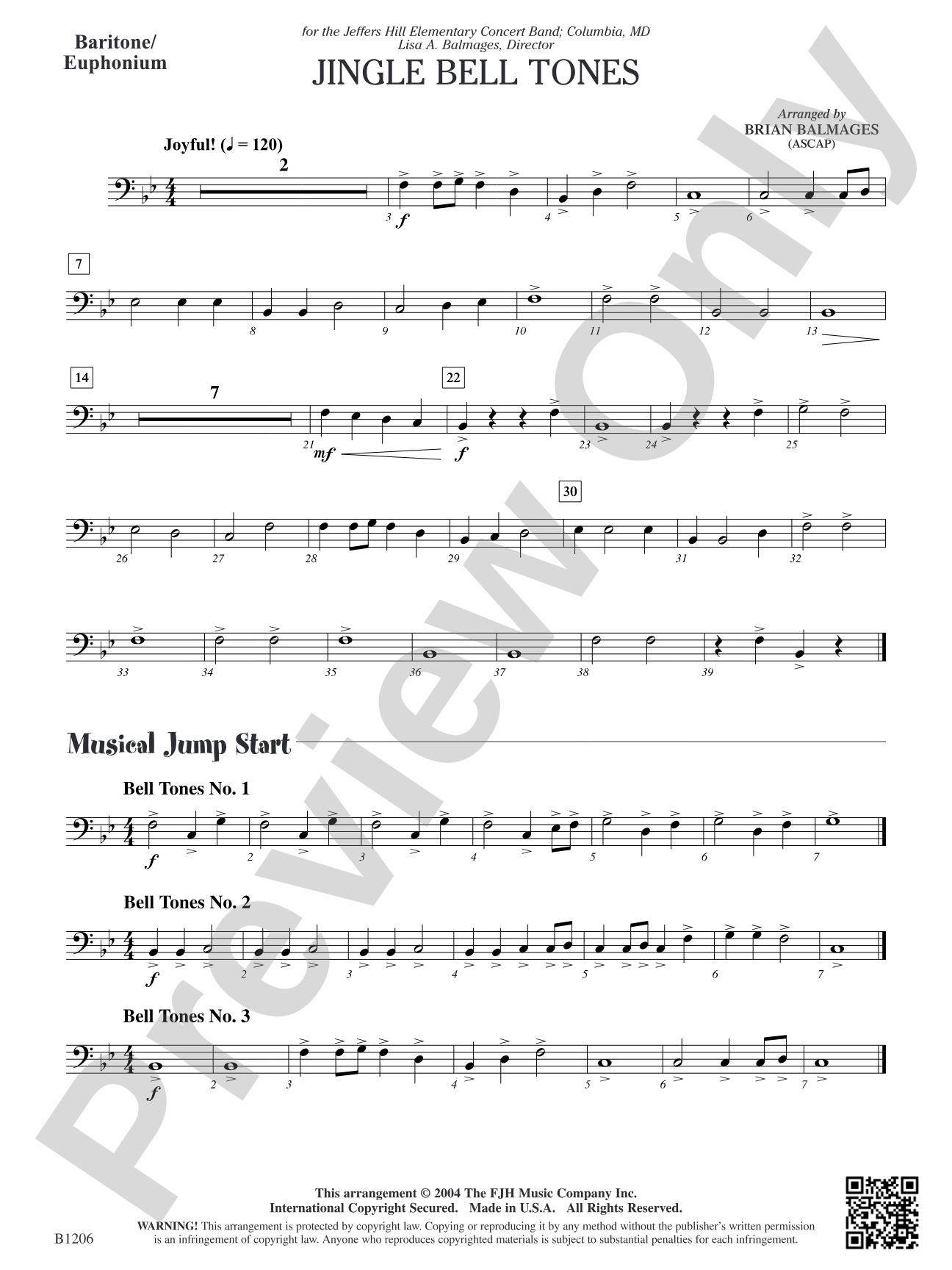

Jingle Bell Tones: Baritone/Euphonium
By Brian Balmages
Level:.5
Item: 98-PC-DB1206_BBC1
$7.00
Pickup currently not available
Description
This very easy holiday fanfare is ideal for teaching accents to your ensemble. The "bell tone" motif occurs several times throughout the work. As the title suggests, the focus of the work is Jingle Bells, though hints of other favorites are heard at the beginning and the end. Three supplemental exercises help students learn the piece, and the exercises themselves can be played together as duets or a trio to encourage practice outside of school. Fabulous sounds with only six notes!


Jingle Bell Tones: Baritone/Euphonium isn't in MakeMusic Cloud just yet...but it could be. Let us know you'd like to see it, and you'll help shape what comes next. In the meantime, start a free trial and dive into thousands of interactive titles your students can play along with today.
Request This Title
Tell us you want it.
Start Your Free Trial
Explore everything that's ready to play right now.
Sample Audio
1
Audio File
--:--
0:00
0:00
Sample Video
No sample videos found.
Additional Details
Series:
FJH Starter Series
Publisher:
The FJH Music Company, Inc.
SKU:
98-PC-DB1206_BBC1
More about this title
About the Composer: Brian Balmages

Brian Balmages has established himself as a composer and conductor with an unusually broad reach across orchestral, band, and chamber music traditions. His works have been performed worldwide by ensembles ranging from professional orchestras at prestigious venues like Carnegie Hall and the Kennedy Center to elementary school bands, earning him the A. Austin Harding Award from the American School Band Directors Association and a 2020 NBA William D. Revelli Composition Contest win.
Balmages holds the distinction of being an elected member of the American Bandmasters Association and has received commissions and honors that reflect his standing in the field, including the inaugural James Madison University Distinguished Alumni Award and a commission from the University of Miami for presidential inaugural music. He maintains an active guest conducting schedule with all-state, regional, university, and professional ensembles internationally. Currently, he serves as Director of MakeMusic Publications and Digital Education for Alfred and MakeMusic.
Why we love this
At Level 0.5, this fanfare accomplishes what most holiday pieces cannot: it teaches a genuine musical concept (accents and articulation) without sacrificing fun or musicality. The constraint of six notes becomes an asset rather than a limitation, allowing every student to participate successfully while the bell tone motif and embedded Jingle Bells theme keep the ensemble engaged. The three supplemental exercises double as practice tools and standalone duet material, making this piece work harder for your program than its simplicity suggests.
What to expect
Bright, festive, and crystalline. The bell tone motif creates a sparkling, ringing quality that feels immediately holiday-appropriate without relying on complex harmonies or rapid passages. The simple texture allows each voice to ring clearly, creating a sense of ensemble accomplishment and musicality that feels earned rather than manufactured.
Who it's for
Conductors working with very young or beginning concert bands who need repertoire that genuinely teaches musicianship rather than merely filling a holiday program. This piece works equally well for elementary school bands, middle school ensembles in their first year of study, or any group where foundational technique around articulation and ensemble blend is the priority.
How to get the most out of it
- Shape each accent with clear articulation; the bell tone motif depends on crisp attacks and controlled releases to sound like actual bells rather than generic notes.
- Balance the hints of other holiday melodies at the opening and closing so they register without overshadowing the Jingle Bells primary theme.
- Use the supplemental exercises as warm-ups before full ensemble rehearsals to lock in the articulation and rhythmic precision the piece requires.
- Encourage students to practice the supplemental duets and trio outside of band rehearsal; the repeated material builds confidence and ownership of the piece.
How to use it
Place this as an opener on a holiday concert to establish festive energy while your ensemble plays with confidence and precision. The supplemental exercises can also serve as a teaching demonstration during a concert talk or as a standalone interlude between larger works, letting audiences hear how ensemble music develops from simple building blocks.
Skills your students will build
- Executing accents with clarity and control
- Achieving balanced bell tone articulation across the ensemble
- Reading and playing simple rhythmic and melodic patterns with focus
- Listening critically to intonation and blend in a minimal texture
- Building individual practice habits through supplemental duet material