
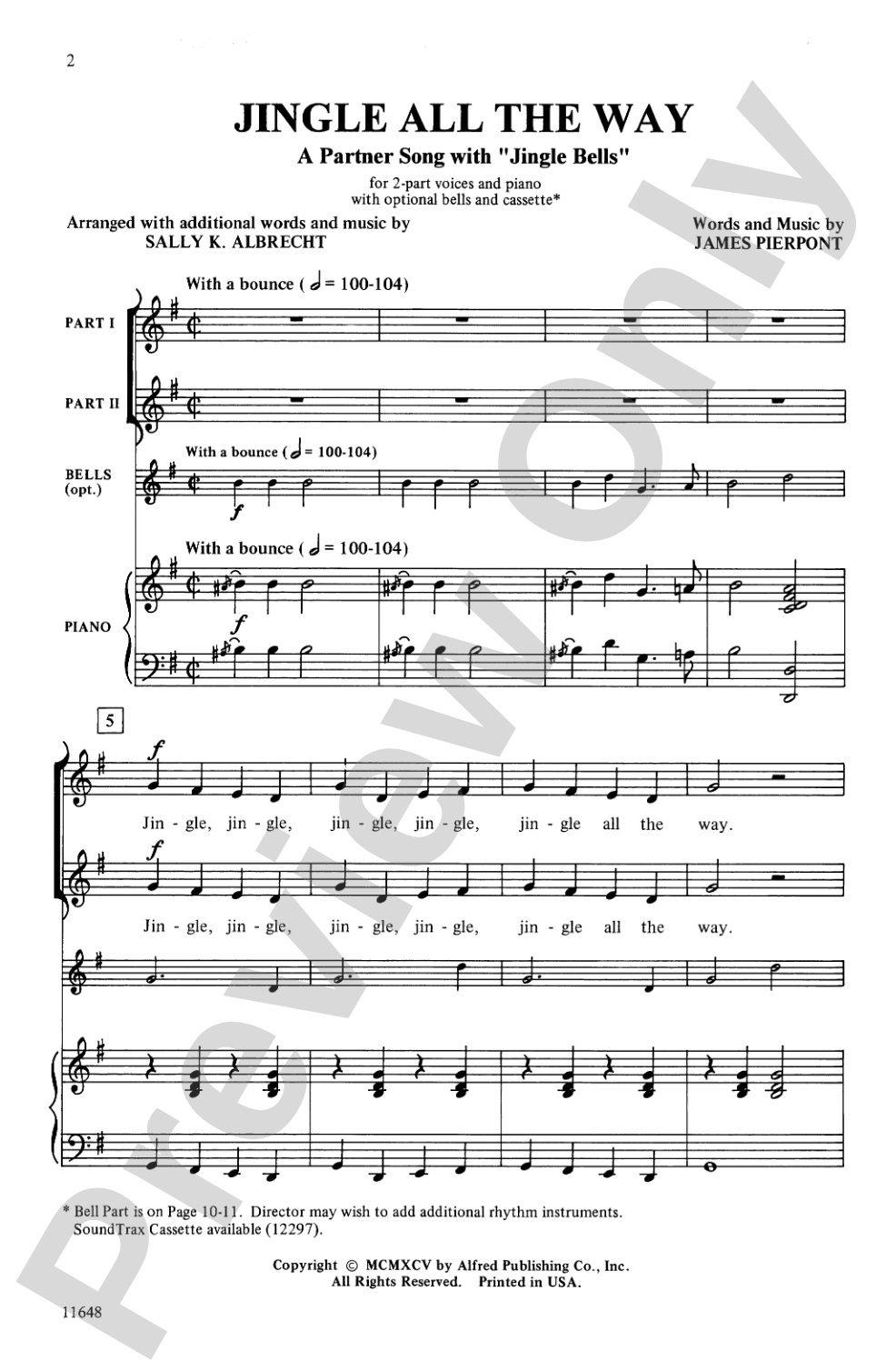
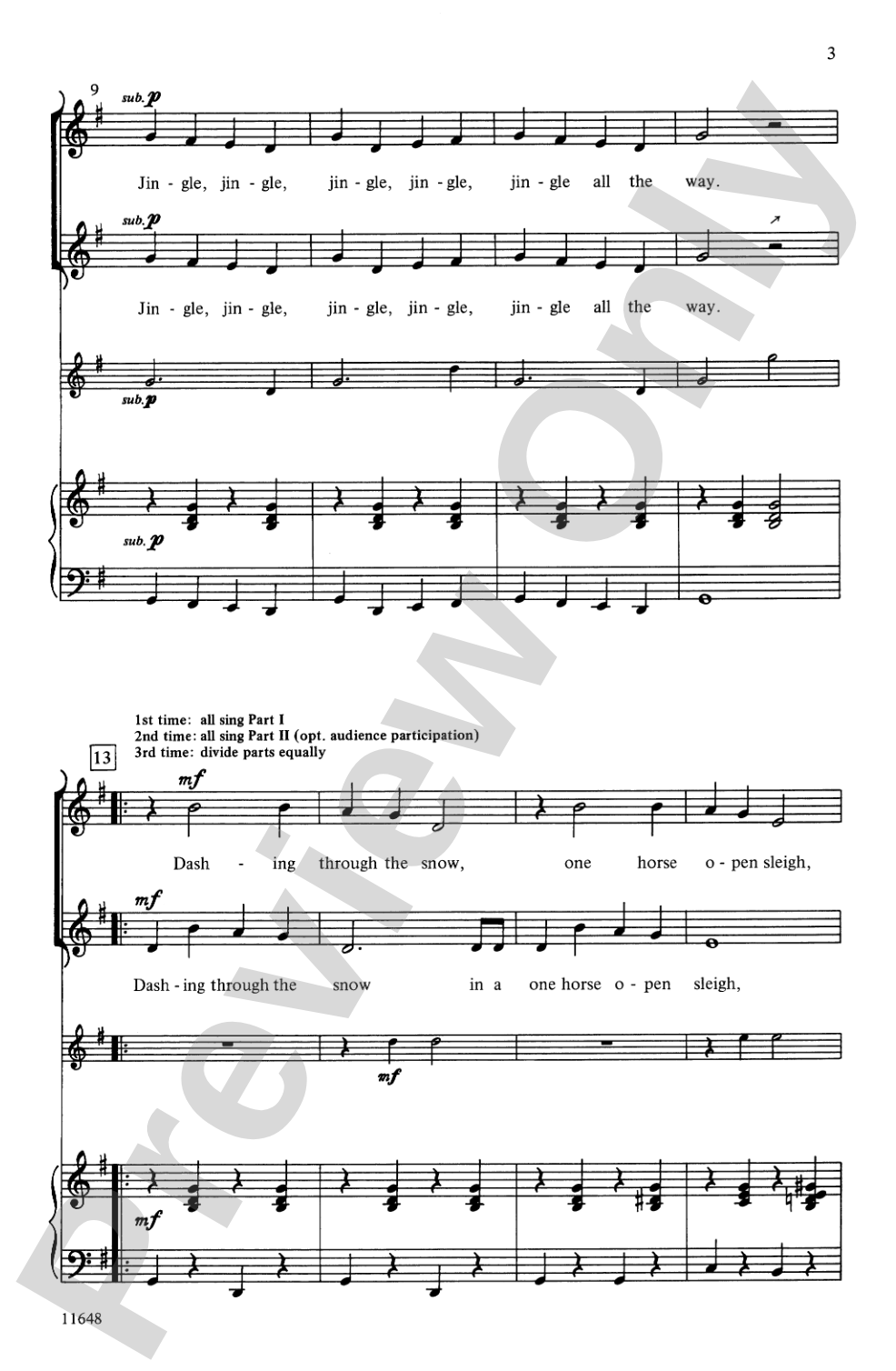

Jingle All the Way: 2-Part Choral Octavo
Arr. Sally K. Albrecht
Item: 00-PO-0003895
$2.25
Minimum order quantity: 20 copies
Pickup currently not available
Related Items
Jingle All the Way: 2-Part Choral Octavo |
$2.25
|
View |
Description
A partner song with "Jingle Bells" featuring clever, new partner melody by Sally Albrecht. First sing the new melody, then "Jingle Bells", then put them together! Optional bell part can be performed on Orff instruments. Two equal voice parts. The arranger suggests inviting the audience to join in singing "Jingle Bells."


Jingle All the Way: 2-Part Choral Octavo isn't in MakeMusic Cloud just yet...but it could be. Let us know you'd like to see it, and you'll help shape what comes next. In the meantime, start a free trial and dive into thousands of interactive titles your students can play along with today.
Request This Title
Tell us you want it.
Start Your Free Trial
Explore everything that's ready to play right now.
Sample Audio
No sample audio found.
Sample Video
No sample videos found.
Additional Details
Series:
Alfred Archive Edition: Alfred Choral Designs
Publisher:
Alfred Music
Page Count:
12
SKU:
00-PO-0003895
Instrumentation:
Opt. Bells or Orff Instruments
More about this title
About the Arranger: Sally K. Albrecht

Sally K. Albrecht has shaped American choral music for over three decades, serving as Director of School Choral, Vocal, and Elementary Publications at major educational publishers, most recently at Alfred Music. A composer and conductor recognized especially for her innovative work integrating movement into choral performance, she has received the ASCAP Special Music Award annually since 1987 and maintains over 600 published choral works in print alongside 75 songbooks and musicals.
Albrecht has conducted honor choirs at prestigious venues including Lincoln Center, Carnegie Hall, and The Kennedy Center, while holding faculty positions at Oakland University, Jersey City State College, and Meredith College. She holds degrees from Rollins College (B.A. in Music and Theater, 1976), the University of Miami (M.A. in Drama, 1977; M.M. in Accompanying, 1979), and was honored with the Distinguished Alumna Award from both institutions in 2021. A native of Cleveland, Ohio, she currently resides in Wake Forest, North Carolina.
Why we love this
Albrecht's clever new melody sits seamlessly alongside the familiar tune, creating a satisfying partner song that students can build progressively rather than all at once. The staged approach—learn the new part, add the original melody, then blend them—keeps younger singers engaged and builds confidence through manageable layers. Including optional Orff bells and audience participation transforms this from a standard choral octavo into an interactive holiday moment that feels special to perform.
What to expect
Bright and playful, with the familiar warmth of "Jingle Bells" enriched by an unexpected harmonic and melodic conversation. The partner song creates a sense of discovery, as if the choir is uncovering a musical secret hidden within a song everyone already knows.
Who it's for
This works beautifully for middle school and upper elementary choirs seeking a holiday selection that feels current rather than dated. It suits choirs of any size since the 2-part voicing accommodates developing singers without condescension, and the optional instrumental layer gives directors flexibility based on what instruments are available.
How to get the most out of it
- Teach the new melody first in isolation so students own it fully before adding the complexity of two independent lines.
- Balance the parts carefully during rehearsal; the new melody should remain audible even when "Jingle Bells" enters, since it carries the fresh musical interest.
- If using the optional bell part, assign it to a smaller group during rehearsals to prevent it from muddying the choir's texture; bells work best as a delicate layer underneath.
- Invite audience participation near the end, but cue it clearly so singers don't lose their focus; a gesture or brief instruction before the final repetition helps.
How to use it
Program this mid-set during a winter concert to shift energy while keeping the audience smiling; the familiar melody gives families an entry point, while the new part signals that this is a polished, arranged piece worth their attention. It also works well as an opener if you want to establish an upbeat mood before moving into more serious holiday literature.
Skills your students will build
- Singing two independent melodic lines simultaneously (partner song technique)
- Balancing part independence with blend
- Connecting new musical material to familiar repertoire
- Interpreting stage movement cues and optional choreography
- Responding to conductor direction for audience engagement moments