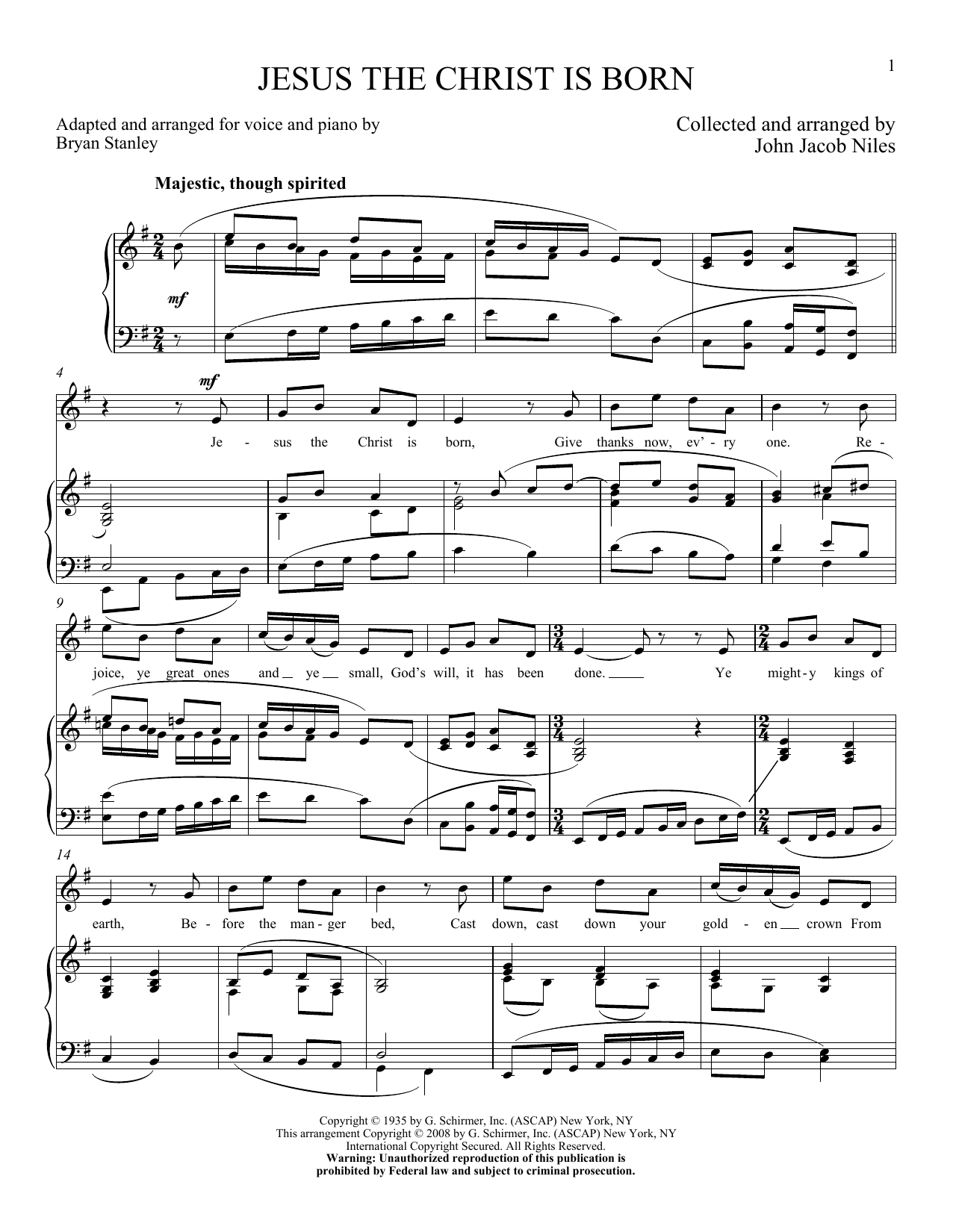
Jesus, The Christ, Is Born Sheet Music Preview

Jesus, The Christ, Is Born: Piano Vocal

As performed by John Jacob Niles

Item: 35-DS00301943

Digital Download
$5.99
Description

Jesus, The Christ, Is Born: Piano Vocal isn't in MakeMusic Cloud just yet...but it could be. Let us know you'd like to see it, and you'll help shape what comes next. In the meantime, start a free trial and dive into thousands of interactive titles your students can play along with today.

Sample Audio
No sample audio found.
Sample Video
Additional Details
Publisher: Hal Leonard
Page Count: 3
SKU: 35-DS00301943

More about this title

About the Artist: John Jacob Niles

John Jacob Niles (1892-1980) was an American composer, singer, and folklorist who devoted his career to collecting, arranging, and performing folk music from the Appalachian region. His work as a field researcher preserved countless traditional melodies while his compositions and arrangements brought authentic folk idioms into concert and educational settings. Niles' deep knowledge of modal harmony and modal melody shaped a compositional voice instantly recognizable for its simplicity and emotional directness.

Why we love this

Niles crafted this carol with the restraint of a true folklorist, letting a modal melody and plain language do the expressive work. The writing sits naturally for high voice singers and the piano part supports without overwhelming, making this genuinely singable for students while maintaining artistic integrity.

What to expect

The tune carries the quiet reverence of a carol sung in a farmhouse or chapel, unadorned and intimate. Modal harmonies create an older, timeless quality that feels both ancient and immediate.

Who it's for

This arrangement works for high voice singers in both solo and choral settings, from advanced high school singers through adult choirs. It suits holiday programming, sacred music units, or any context calling for authentic folk carol treatment.

How to get the most out of it

  • Sustain the modal sonority by resisting the urge to impose major key brightness; Niles built his harmonic language on folk origins where the minor third and raised fourth create the character.
  • Balance the vocal line in the mid register where it sits most comfortably; the piece doesn't demand belting, only clarity and warmth.
  • Shape phrases by the text punctuation rather than by bar lines; let the prayer-like quality emerge through natural speech rhythm.

How to use it

Pair this with other Niles arrangements or folk-based carols for a program section celebrating American sacred music traditions. The modest three-page length and accessible melody make it ideal for filling a choral concert slot without competing with larger works.

Skills your students will build

  • Reading modal melody and harmonic movement outside major-minor tonality
  • Sustaining tone quality across the midrange register
  • Interpreting text-driven phrasing in a folk idiom
  • Tracking independent piano accompaniment while maintaining vocal line independence

You May Also Like