
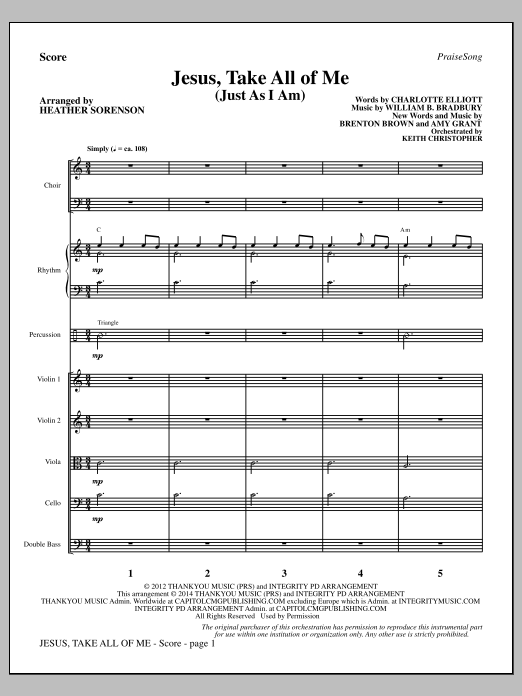

Jesus, Take All of Me: Choral Instrumental Pak
As performed by Amy Grant / As performed by Brenton Brown / As performed by William B. Bradbury / As performed by Charlotte Elliott / Arranged by Heather Sorenson
Item: 35-PK00290949
$40.00
Pickup currently not available
Buy Extra Parts (Digital PDF Download)
Parts Added to Cart!
Description
Uses: General, Commitment, Invitation
Scripture: Isaiah 40:28-31; John 1:29-34; Philippians 3:7-11
Inspired by the ministry of Billy Graham, this song from Brenton Brown and Amy Grant uses the hymn "Just as I Am" as its foundation. Masterfully arranged by Heather Sorenson, this selection is an excellent choice for a time of invitation or commitment.


Jesus, Take All of Me: Choral Instrumental Pak isn't in MakeMusic Cloud just yet...but it could be. Let us know you'd like to see it, and you'll help shape what comes next. In the meantime, start a free trial and dive into thousands of interactive titles your students can play along with today.
Request This Title
Tell us you want it.
Start Your Free Trial
Explore everything that's ready to play right now.
Sample Audio
No sample audio found.
Sample Video
No sample videos found.
Additional Details
Publisher:
Hal Leonard
SKU:
35-PK00290949
More about this title
About the Artist: Amy Grant
Amy Grant is a singer-songwriter whose career spans five decades, making her one of the most commercially successful artists in contemporary Christian music. Her work has consistently bridged sacred and mainstream audiences, earning Grammy Awards and multiple platinum certifications while maintaining a deep commitment to faith-centered songwriting.
For music educators, Grant's legacy matters because her compositions emphasize singable melodies, clear harmonic progressions, and emotional authenticity. Her collaborations with writers like Brenton Brown have produced pieces that engage both congregation and choir with equal accessibility.
Why we love this
Sorenson's arrangement transforms a familiar hymnic foundation into something that feels both reverent and contemporary, using the instrumental pak format to accommodate different ensemble configurations without sacrificing musical integrity. The connection to Billy Graham's evangelistic ministry gives this selection a built-in spiritual intentionality that resonates during moments of genuine vulnerability in worship settings. Directors praise how the piece invites participation rather than demanding perfection, making it genuinely usable across varied choir levels.
What to expect
The piece carries the warmth of congregational singing while maintaining the craftsmanship of a carefully arranged choral work. There's an intimate quality here, something that invites rather than proclaims, supported by harmonies that feel both thoughtful and inevitable.
Who it's for
This pak serves choirs preparing for altar calls, commitment services, or other moments when congregational response is part of the liturgy. It's equally effective for choirs seeking contemporary sacred repertoire that doesn't abandon hymnodic values, and for ensembles wanting material that bridges generations.
How to get the most out of it
- Balance the hymnic melody line with subtle inner harmony; resist the urge to swell dynamically on every chord change. Let the arrangement's architecture support the text.
- Shape the text of the Scripture references with deliberate pacing. The invitation implicit in the song structure works best when singers understand what they're inviting their listeners toward.
- Allow the instrumental accompaniment to breathe between phrases rather than filling every space. White space becomes part of the emotional architecture here.
- Attend closely to any key relationships the arrangement uses. Modulations should feel purposeful, not arbitrary, so intonation in transitions demands rehearsal focus.
How to use it
Sequence this near the conclusion of a service or concert when you want to shift from presentation into invitation. It works particularly well in programming that traces a theological arc from Scripture reading through response, letting the arrangement hold the space between hearing and deciding.
Skills your students will build
- Singing sustained hymnic melodies with dynamic restraint
- Balancing ensemble blend when doubling familiar tune lines
- Interpreting text with intentional pacing tied to emotional arc
- Managing intonation across key changes or modulations
- Following instrumental accompaniment cues within a reverent context