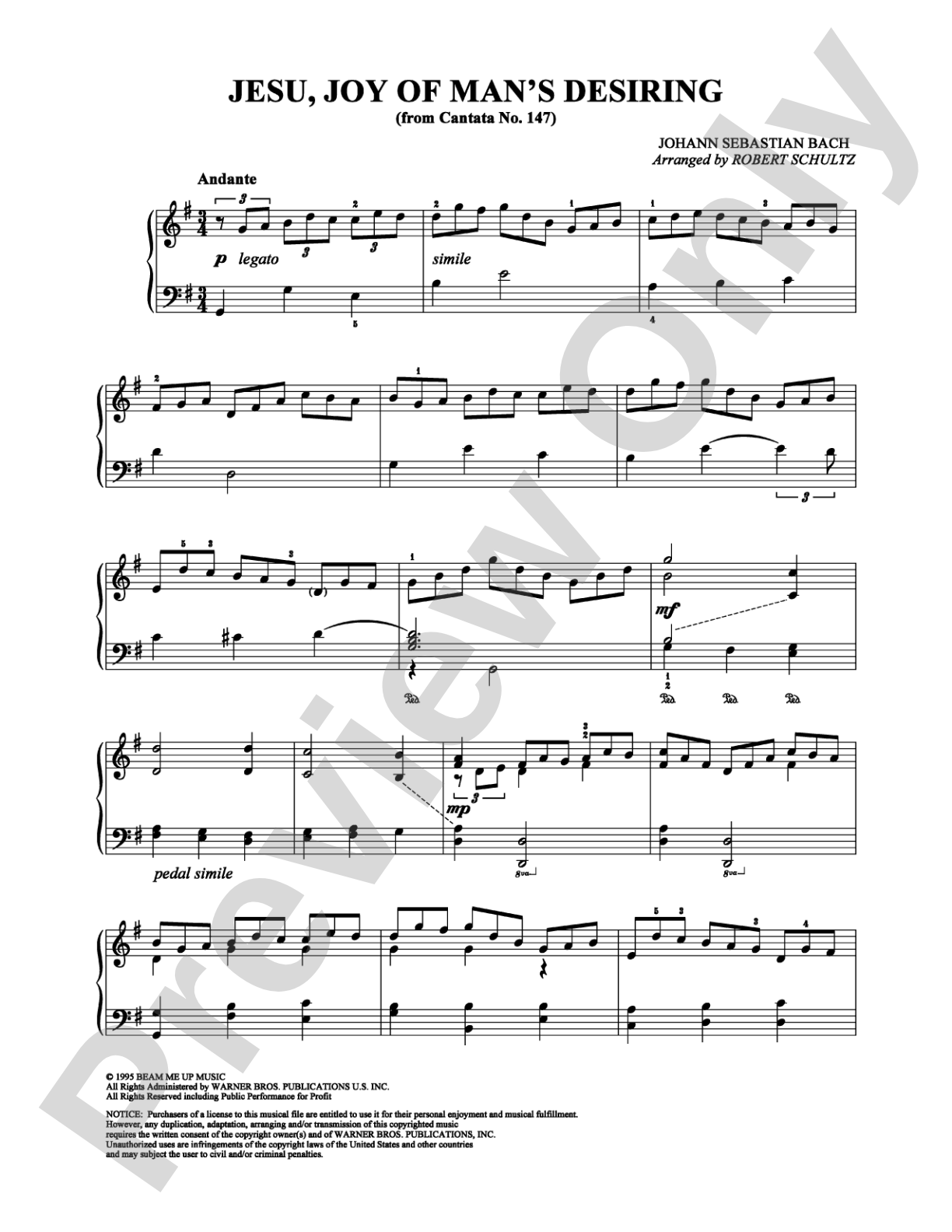
Jesu, joy of man's desiring (from Cantata No. 147): Easy Piano Digital Sheet Music

Jesu, joy of man's desiring (from Cantata No. 147): Easy Piano Digital Sheet Music

Johann Sebastian Bach, Robert Schultz

Item: 00-PS-0003283

Digital Download
$3.99
Description

Jesu, joy of man's desiring (from Cantata No. 147): Easy Piano Digital Sheet Music isn't in MakeMusic Cloud just yet...but it could be. Let us know you'd like to see it, and you'll help shape what comes next. In the meantime, start a free trial and dive into thousands of interactive titles your students can play along with today.

Sample Audio
No sample audio found.
Sample Video
Additional Details
SKU: 00-PS-0003283

More about this title

Why we love this

This arrangement strips away the complexity of Bach's original while preserving the spiritual warmth that makes this chorale so enduring. Easy piano arrangements of canonical baroque music are rare at this level; Schultz's version gives students and adult learners genuine access to a piece they've likely heard in countless contexts without oversimplifying the harmonic beauty.

What to expect

Peaceful and introspective, with the clarity of a hymn. Despite its modest technical demands, the piece carries weight; each note sits within Bach's transparent harmonic framework, creating moments of quiet beauty that feel both simple and profound.

Who it's for

Pianists in early intermediate levels (roughly grades 2-4) seeking repertoire with depth and historical significance. This works equally well for adult students returning to piano and younger players ready to experience Bach in a manageable form.

How to get the most out of it

  • Shape the melodic line with gentle dynamic swells rather than playing it flatly; the joy in the title emerges through subtle phrasing, not pedal.
  • Allow the harmony to breathe by observing rests and release points; baroque counterpoint needs air between phrases.
  • Avoid rushing; the piece's meditative quality depends on a steady, unhurried tempo that lets listeners absorb each harmonic movement.

How to use it

Fit this into a spring or year-end student recital as a solo or paired with other baroque miniatures. It also works as an interlude or opening number on a community concert, offering listeners a familiar meditation without requiring a large ensemble.

Skills your students will build

  • Reading baroque ornaments and phrasing in a simplified context
  • Balance between melody and accompaniment on a single instrument
  • Sustaining legato technique across hand position shifts
  • Interpreting harmonic movement to shape musical line

You May Also Like