
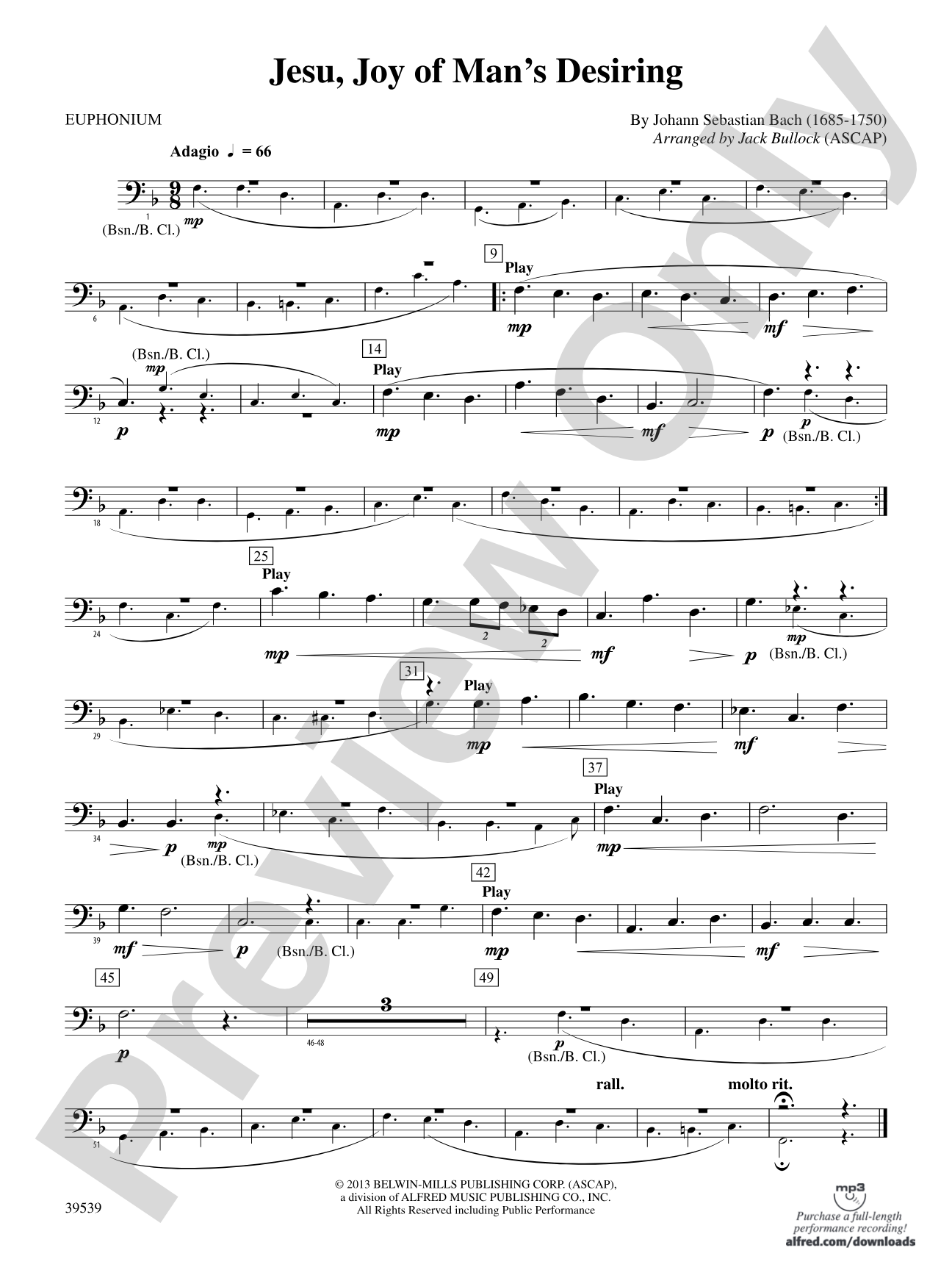

Jesu, Joy of Man's Desiring: Baritone B.C.
Clarinet Section Feature
By Johann Sebastian Bach / arr. Jack Bullock
Grade: 3 (Medium Easy)
Item: 00-PC-0015853_BBC1
$3.00
Pickup currently not available
Description
This Bach masterpiece features the entire clarinet section performing the running melody that is so famous, with the rest of the band supporting with the chorale at measured spaces. The simplicity of the melody and the supporting chorale reveals the charm of this music, pure Bach. Enchanting! (3:15)


Don't just read it, hear it, play along with it, and watch your students grow with it. In MakeMusic Cloud, Jesu, Joy of Man's Desiring: Baritone B.C. comes alive with professional accompaniment, adjustable tempo, and built-in practice tools that turn solo practice into real progress.
Open in the Player
Jump straight in and assign it today.
Start Your Free Trial
Open this title and explore the full library in minutes.
Sample Audio
1
Audio File
--:--
0:00
0:00
Sample Video
No sample videos found.
Additional Details
Series:
Belwin Concert Band
Publisher:
Alfred Music
Page Count:
130
SKU:
00-PC-0015853_BBC1
More about this title
About the Composer: Johann Sebastian Bach
Johann Sebastian Bach (1685-1750) stands as one of history's most systematic and prolific composers, creating over 1,000 works across every major Baroque form except opera. His music synthesizes German chorale traditions, Italian concerto principles, and French dance forms into a unified harmonic and contrapuntal language that remains the foundation of Western music theory and practice. Bach's ability to combine mathematical rigor with profound emotional expression makes his work endlessly rewarding for student musicians to explore.
While Bach held various positions as organist, court musician, and eventually cantor in Leipzig, his primary legacy comes through his compositions. "Jesu, Joy of Man's Desiring" originated as the tenth movement of his Cantata BWV 147, where the famous melody first appeared in its original context. The piece exemplifies Bach's gift for writing lines that sing naturally while serving larger harmonic designs, a principle that continues to guide composers and arrangers today.
Why we love this
This arrangement captures what makes Bach's work so teachable at the Grade 3 level: a melody so elegant that it sounds simple, yet the underlying harmonic structure rewards careful attention. Jack Bullock's scoring gives your clarinet section the starring role while keeping the accompaniment transparent enough that young players can hear exactly how their part contributes to the whole. The piece delivers concert impact without excessive technical demand.
What to expect
Timeless devotion expressed through flowing lines and warm harmony. The running sixteenth-note melody feels almost conversational as it winds above the steady chorale, creating a sense of gentle inevitability rather than dramatic gesture. There is profound quiet joy in this music, the kind that emerges from mathematical beauty revealing something spiritual.
Who it's for
This arrangement suits concert bands working at the Grade 3 level, particularly ensembles seeking a sacred work that showcases clarinet and builds ensemble listening skills. Directors programming a concert or festival that includes Baroque repertoire will find this setting both accessible and musically substantial. The piece works equally well for groups building confidence in Baroque style and those preparing for festival competition.
How to get the most out of it
- Balance the running sixteenth-note figures in the clarinets so the melody sings above the supportive chorale without dominating; clarity of line matters more than volume.
- Shape the phrases of the melody with gentle rubato that mirrors the breathing of a vocal line, allowing the harmony underneath to settle into each cadence.
- Mark the sectional seams in the score where the chorale shifts chords; rehearse these transition points separately so the band moves together with the melody's direction.
- Bring out the bass line lightly during the chorale sections; it anchors the harmony and helps younger players understand how the piece is built harmonically.
How to use it
Program this during the second half of a concert when the ensemble has settled into ensemble balance and intonation. Its moderate length (3:15) and contemplative character provide strong programming contrast to contemporary works or energetic openers, making it an ideal transition piece. For festival play, this arrangement meets typical Baroque competition requirements while remaining performance-ready with modest rehearsal investment.
Skills your students will build
- Baroque phrasing and articulation appropriate to the era
- Listening to and balancing a featured melody against harmonic support
- Reading and executing sustained chorale parts with rhythmic accuracy
- Ensemble intonation in sustained harmony
- Understanding harmonic progression through Bach's voice-leading