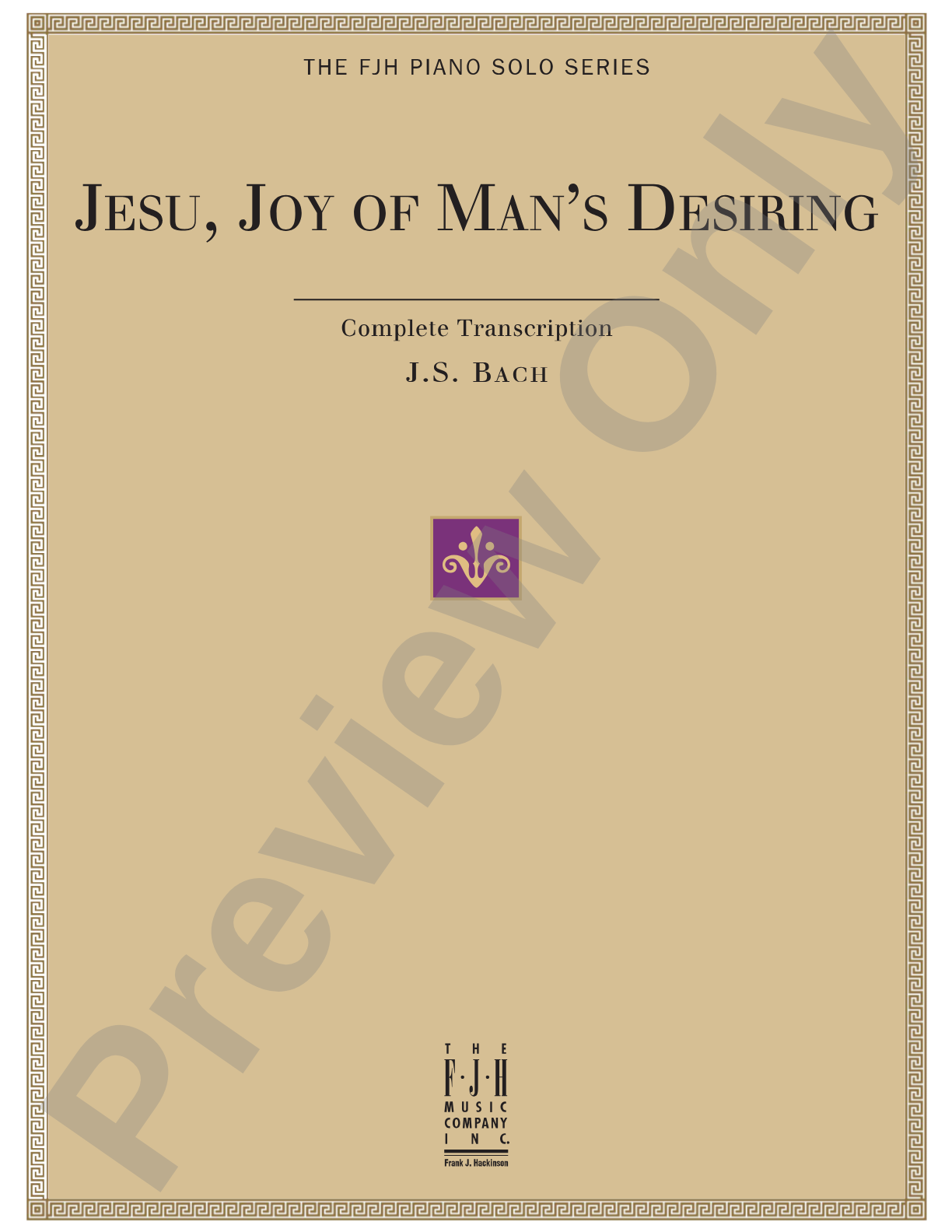
Jesu, Joy of Man's Desiring Sheet Music Preview

Jesu, Joy of Man's Desiring: Piano

By J.S. Bach / arr. Edwin McLean

Item: 98-DPS1010

Digital Download
$3.50
Description
This beloved work from J.S. Bach's Cantata No. 147 remains among the best known of all Baroque pieces. Here is the complete transcription for piano solo, suitable for all keyboard instruments. An eternal piece, whose melody should be part of every musician's vocabulary.

Jesu, Joy of Man's Desiring: Piano isn't in MakeMusic Cloud just yet...but it could be. Let us know you'd like to see it, and you'll help shape what comes next. In the meantime, start a free trial and dive into thousands of interactive titles your students can play along with today.

Sample Audio
No sample audio found.
Sample Video
Additional Details
Series: The FJH Piano Solo Series
Publisher: The FJH Music Company, Inc.
SKU: 98-DPS1010

More about this title

About the Composer: J.S. Bach

Johann Sebastian Bach (1685-1750) stands as a towering figure in Western music history, and his influence on keyboard literature remains unmatched. Working primarily in Leipzig and Weimar, Bach synthesized German contrapuntal traditions with Italian forms and French dance styles, creating a body of work of staggering breadth and technical sophistication.

Bach's sacred vocal works, including over 200 cantatas written for the Leipzig church calendar, contain some of the most enduring melodies in all of music. "Jesu, Joy of Man's Desiring" emerges from Cantata No. 147, where the chorale tune carries both spiritual weight and immediate accessibility. For musicians of any level, Bach's music remains the foundation of serious keyboard study, offering inexhaustible pedagogical and artistic rewards.

Why we love this

This transcription captures one of the most universally recognized melodies in classical music while demanding genuine musicianship from the performer. The arrangement sits well for piano, giving students access to authentic Baroque counterpoint without the complexity of the original cantata score, while still honoring Bach's voice-leading and harmonic architecture.

What to expect

The piece radiates warmth and quiet certainty. The gently rolling accompaniment creates motion without urgency, while the melody floats above with hymn-like dignity and sweetness. There is nothing frantic here; instead, a sense of timeless contemplation.

Who it's for

This arrangement works for intermediate to advanced pianists seeking repertoire that builds both technical control and musical sensitivity. It serves equally well as a recital piece for the serious student or as a meditation on one of music's most transcendent melodies.

How to get the most out of it

  • Shape the melody with singing tone and graceful phrasing rather than letting it become mechanical. The broken-chord accompaniment should support, not overwhelm, the cantus firmus line.
  • Maintain a steady, unhurried tempo that allows the inner voices to breathe clearly. Baroque music lives in the spaces between the notes as much as in the notes themselves.
  • Balance the independence of each hand; this is not accompaniment plus melody, but interlocking voices. Slight rubato in the melody works if it never compromises the pulse.
  • Listen carefully to voice crossing and hand distribution. Some editions voice notes differently; choose an edition and understand exactly which hand plays which note to avoid muddy execution.

How to use it

Program this at the opening of a recital to establish an intimate, reflective mood, or save it as an encore when you want to leave your audience in a state of quiet grace. It also pairs beautifully with other Baroque keyboard works in a thematic concert devoted to Bach or to sacred music across centuries.

Skills your students will build

  • Baroque phrasing and articulation
  • Independence of melodic and accompanying voices
  • Singing tone in the right hand while maintaining rhythmic clarity in the left
  • Tempo control and sensitivity to harmonic rhythm
  • Understanding of voice-leading principles across multiple lines

You May Also Like