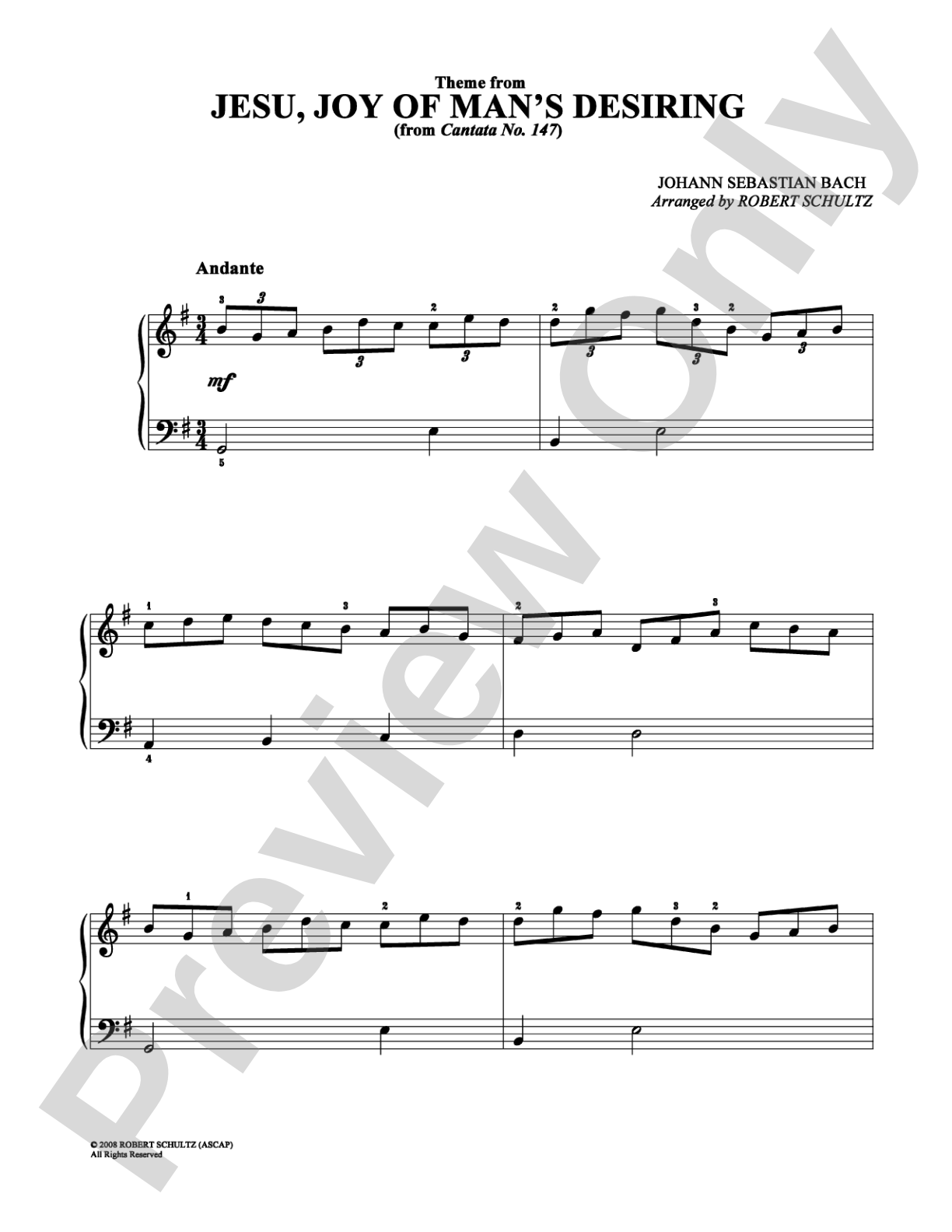
Jesu, Joy of Man's Desiring: Easy Piano Digital Sheet Music

Jesu, Joy of Man's Desiring: Easy Piano Digital Sheet Music

Johann Sebastian Bach, Robert Schultz

Item: 00-PS-0003282

Digital Download
$3.99
Description

Jesu, Joy of Man's Desiring: Easy Piano Digital Sheet Music isn't in MakeMusic Cloud just yet...but it could be. Let us know you'd like to see it, and you'll help shape what comes next. In the meantime, start a free trial and dive into thousands of interactive titles your students can play along with today.

Sample Audio
No sample audio found.
Sample Video
Additional Details
SKU: 00-PS-0003282

More about this title

Why we love this

Schultz's voicing captures the serene dignity of Bach's original while keeping the left hand manageable for pianists still building technical fluency. The arrangement respects the harmonic integrity of the work without adding unnecessary complexity, making it genuinely playable at the easy level rather than just simplified.

What to expect

Calm and introspective, with an underlying warmth that unfolds through gentle harmonic movement. The familiar melody emerges naturally from the accompaniment, inviting a meditative rather than virtuosic approach.

Who it's for

Pianists at the early intermediate level who want to access Bach's spiritually resonant writing without technical barriers. This arrangement opens the piece to students building their sight-reading and phrasing skills, as well as those exploring baroque music for the first time.

How to get the most out of it

  • Shape the melody with gentle dynamic contours rather than playing it straight; the chorale lines deserve breathing room and expressive weight even at this accessible level.
  • Keep the accompaniment texture clear by maintaining independence between hands; resist the urge to rush through the left-hand patterns, which anchor the harmonic movement.
  • Practice the hand coordination in sections rather than full-length runs, particularly any spots where the hands cross or the texture shifts between chords and broken patterns.
  • Allow space for the music's contemplative quality; resist pushing the tempo forward, especially in the second half where the melody reaches higher passages.

How to use it

Feature this as a solo piano opening for a concert or spring recital, where its contemplative nature can establish a reflective mood before more dramatic repertoire. It also works well as part of a baroque or sacred music themed program, pairing effectively with other Bach arrangements or early chorale works.

Skills your students will build

  • Reading baroque harmonic language and voice leading in a simplified context
  • Maintaining independent hand coordination across chords and broken accompaniment patterns
  • Shaping and sustaining a melody through long phrase arcs
  • Playing with stylistic restraint and musical clarity rather than virtuosic display
  • Managing hand position shifts smoothly within the easier technical framework

You May Also Like