Jerusalem Surge Sheet Music Preview

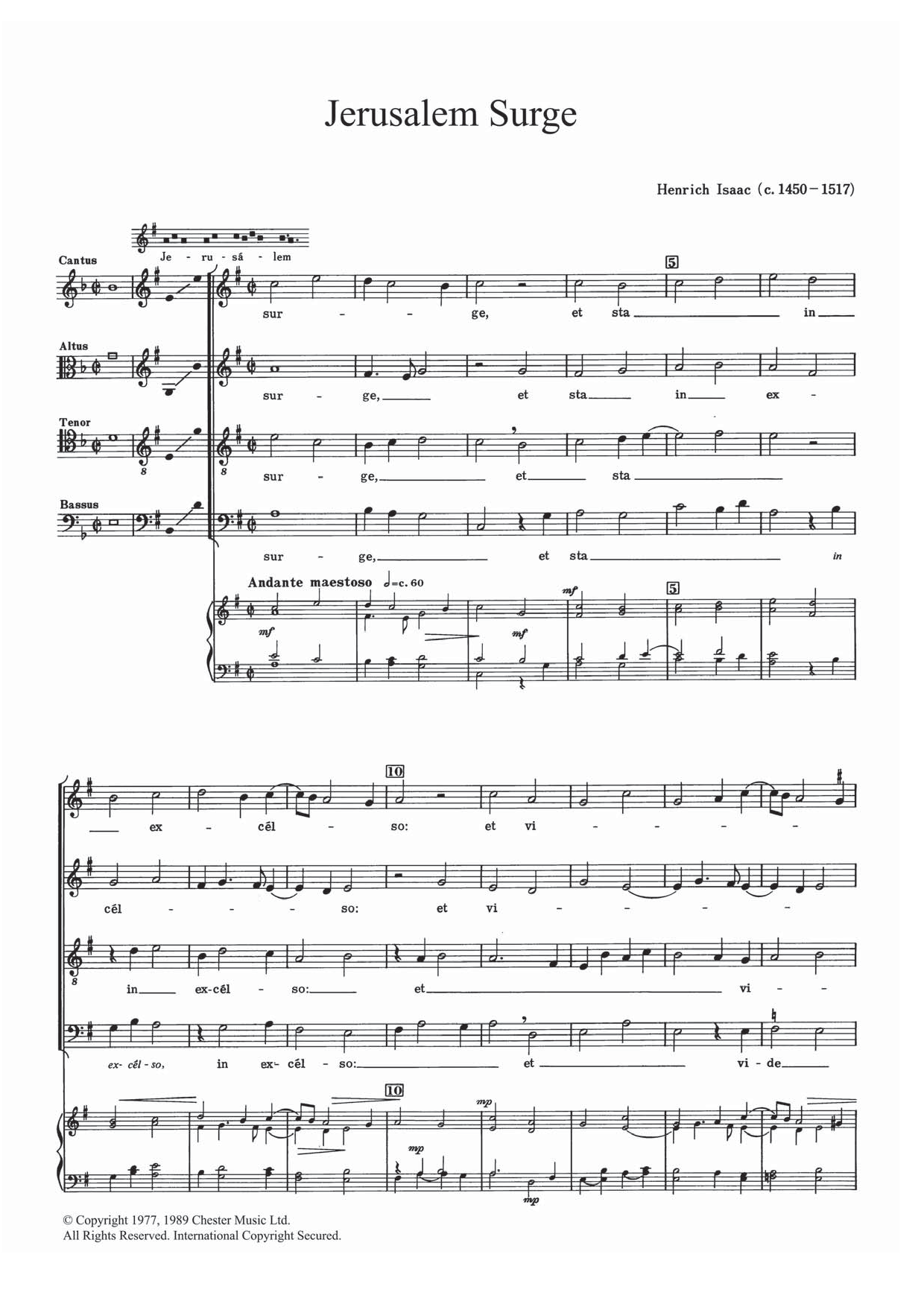
Jerusalem Surge: SATB Choral Octavo

As performed by Heinrich Isaac

Item: 35-DS00366728

Digital Download
$2.99
Description

Jerusalem Surge: SATB Choral Octavo isn't in MakeMusic Cloud just yet...but it could be. Let us know you'd like to see it, and you'll help shape what comes next. In the meantime, start a free trial and dive into thousands of interactive titles your students can play along with today.

Sample Audio
No sample audio found.
Sample Video
Additional Details
Publisher: Hal Leonard
Page Count: 2
SKU: 35-DS00366728

More about this title

About the Artist: Heinrich Isaac

Heinrich Isaac (1450-1517) was one of the Renaissance's most prolific and influential composers, equally comfortable writing sacred motets, secular chansons, and instrumental works. His career spanned the courts of Florence, Rome, Innsbruck, and the Holy Roman Empire, giving him exposure to Italian, French, and Germanic musical traditions that he synthesized into a distinctive style. Isaac's gift for clear counterpoint and memorable melodic writing made his music widely copied and performed throughout Europe during his lifetime and for centuries after.

Why we love this

This setting captures the luminous, transparent quality that Renaissance polyphony achieves so naturally. Isaac's approach to text underlay and voice leading means your singers encounter genuine compositional craftsmanship rather than an arranged novelty, and the modest voicing requirements make it accessible for many choir types without sacrificing musical substance.

What to expect

The piece radiates a quiet exaltation rather than bombastic fervor. Transparent harmonies and a measured pace create an introspective quality, with warmth emerging from the natural blend of four independent vocal lines moving in graceful counterpoint.

Who it's for

Choirs with fundamental skill in reading Renaissance notation and part singing can tackle this directly. It works equally well in academic settings studying historical repertoire, community choruses seeking shorter works for concert programs, and vocal ensembles exploring vocal chamber music.

How to get the most out of it

  • Shape phrases around the text rather than bar lines; Renaissance punctuation lives in the poetry, not the meter signature
  • Blend the four voices into a unified sonority by bringing altos and tenors forward slightly in rehearsal and letting sopranos and basses support rather than lead
  • Approach the piece with a steady, unhurried tempo that allows the harmonic color to register; rushing obscures the voice leading

How to use it

Position this as a bridge between a larger contemporary work and a familiar spiritual or hymn-tune arrangement. Its modest two-page footprint makes it ideal for filling a program slot or anchoring a thematic set exploring sacred texts across centuries. Many directors pair Renaissance motets with post-1950 choral works to create productive historical contrast in a single concert.

Skills your students will build

  • Renaissance counterpoint and voice leading conventions
  • Part independence within ensemble texture
  • Text expression in modal harmonic language
  • Sustained singing without modern vibrato techniques

You May Also Like