
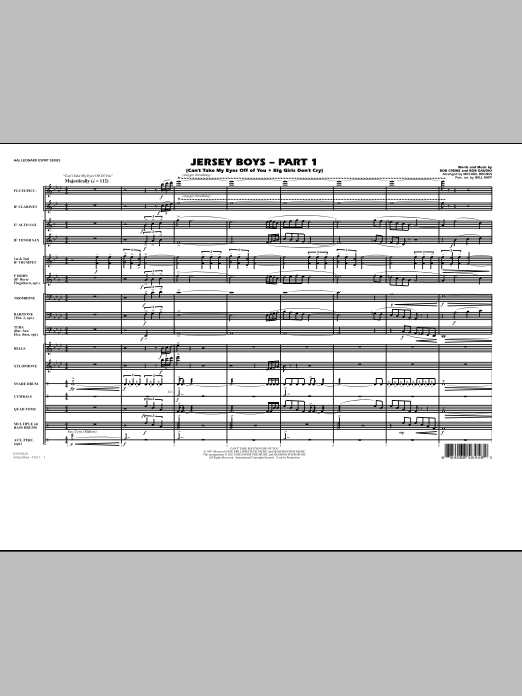

Jersey Boys: Part 1: Marching Band Conductor Score & Parts
As performed by Frankie Valli The Four Seasons / Arranged by Michael Brown / Arranged by Will Rapp
Grade: 3
Item: 35-PK00174168
$55.00
Pickup currently not available
Buy Extra Parts (Digital PDF Download)
Parts Added to Cart!
Description
From the popular Broadway musical showcasing the 1960s pop hits of Frankie Valli and the Four Seasons, here is an energetic and dynamic opener based on "Can't Take My Eyes Off of You" and "Big Girls Don't Cry."


Jersey Boys: Part 1: Marching Band Conductor Score & Parts isn't in MakeMusic Cloud just yet...but it could be. Let us know you'd like to see it, and you'll help shape what comes next. In the meantime, start a free trial and dive into thousands of interactive titles your students can play along with today.
Request This Title
Tell us you want it.
Start Your Free Trial
Explore everything that's ready to play right now.
Sample Audio
No sample audio found.
Sample Video
No sample videos found.
Additional Details
Publisher:
Hal Leonard
SKU:
35-PK00174168
More about this title
About the Artist: Frankie Valli The Four Seasons
Frankie Valli and the Four Seasons emerged from Newark, New Jersey in the early 1960s to become one of the most successful vocal groups in pop history. Their distinctive sound, built on Valli's soaring falsetto and intricate four-part harmonies, produced an unprecedented string of chart hits that defined the era and influenced generations of songwriters and performers.
The group's catalog remains a cornerstone of American pop music education. Their songs, which combine sophisticated harmonic structures with infectious melodies, teach students about vocal production, ensemble blend, and the craft of accessible songwriting. For music educators, the Four Seasons represent a bridge between classical vocal technique and contemporary popular music.
Why we love this
This arrangement captures the infectious energy of two massive hits while giving your marching band a chance to perform instantly recognizable material that audiences genuinely want to hear. Michael Brown and Will Rapp have orchestrated the vocal sophistication and rhythmic drive of the originals into a Grade 3 opener that feels both contemporary and musically substantial, not simplified.
What to expect
Pure 1960s optimism wrapped in doo-wop harmonies and propulsive rhythms. The piece channels the Four Seasons' signature blend of vocal precision and pop immediacy, translated into an arrangement that feels celebratory and approachable. Your audience will find themselves smiling before the first phrase ends.
Who it's for
Directors seeking an opener with genuine crossover appeal for fall or spring concerts. Bands at the Grade 3 level who are ready for materials that demand precision and musical maturity without excessive technical demands.
How to get the most out of it
- Keep the high brass lines crisp and articulate in the opening sections; these carry the melodic hook that audiences recognize immediately, so clarity matters as much as volume.
- Balance the lower brass and woodwind counterlines carefully. The arrangement layers supporting figures beneath the main melody, and muddiness will obscure the intricate harmonies that made these songs memorable.
- Pay attention to the rhythmic precision in the transitions between the two tunes. The seams between "Can't Take My Eyes Off of You" and "Big Girls Don't Cry" need locked ensemble timing to land effectively.
- Trust the arrangement's dynamic shape. Resist the urge to push for maximum volume throughout; the piece builds through strategic registral and textural changes, which create more impact than relentless fullness.
How to use it
Open a concert with this and set an upbeat tone immediately, signaling that the program will be engaging and fun. It works equally well as a strategic placement after a more serious opening piece, giving the audience a moment of release and connection to familiar melodies.
Skills your students will build
- Balancing melody and accompaniment in complex textures
- Executing clean articulation in fast passage work
- Transitioning between contrasting sections with rhythmic precision
- Blending upper and lower brass voices in harmonic contexts
- Responding to dynamic and textural shape in pop arrangements