
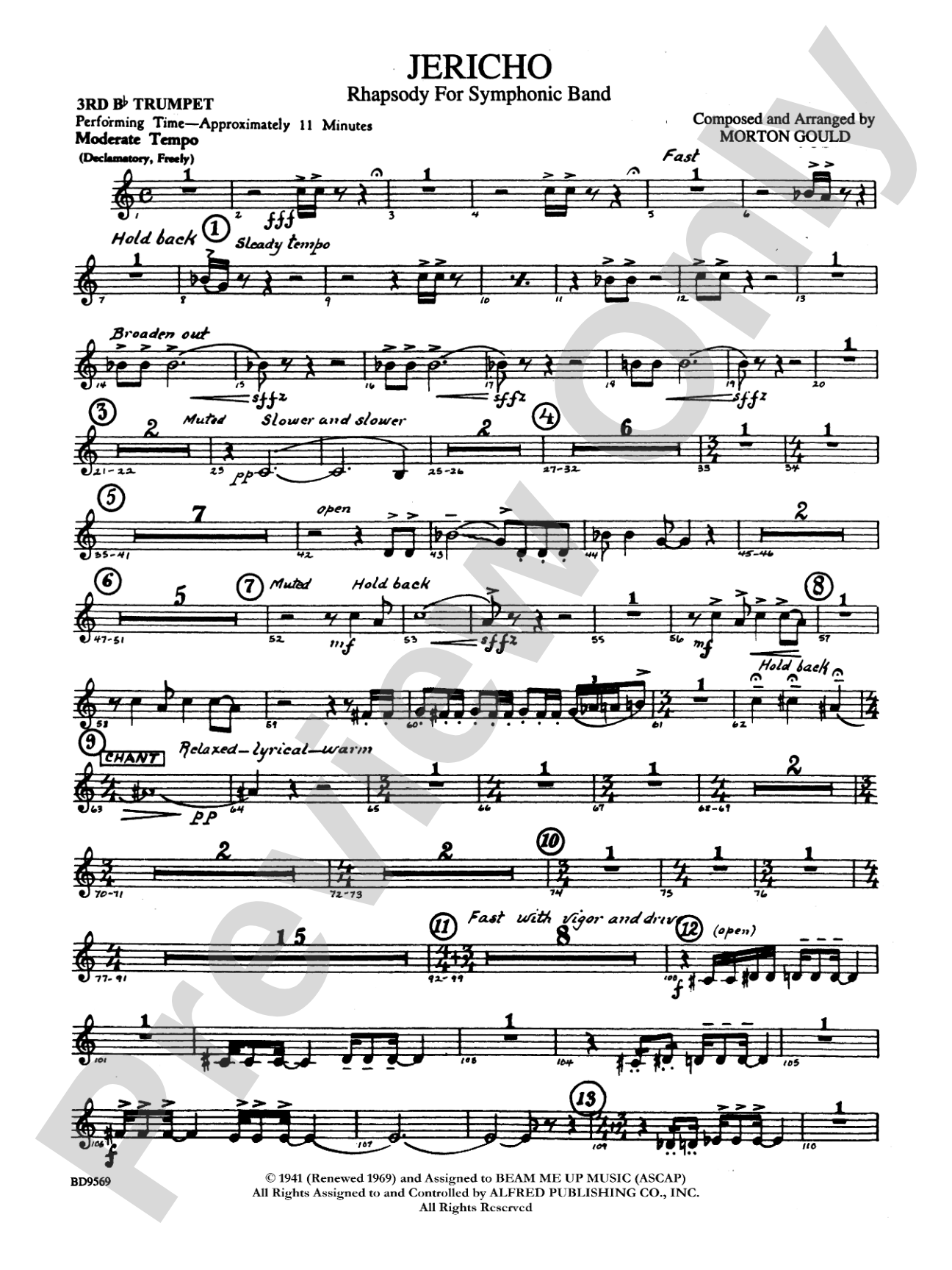

Jericho: 3rd B-flat Trumpet
By Morton Gould
Grade: 5 (Medium Advanced)
Item: 00-PC-0002020_T3
$3.00
Pickup currently not available
Description
"Jericho is a name as newsworthy today as it was in biblical times," states Col. Arnald Gabriel (Ret.), whose interpretive analysis of this Morton Gould classic now appears as part of the conductor's score through the courtesy of The Instrumentalist magazine. One of the first original works written for band, this musical depiction of the great ancient battle still stands today as a monumental work. A must for every serious library. (11:29)


Jericho: 3rd B-flat Trumpet isn't in MakeMusic Cloud just yet...but it could be. Let us know you'd like to see it, and you'll help shape what comes next. In the meantime, start a free trial and dive into thousands of interactive titles your students can play along with today.
Request This Title
Tell us you want it.
Start Your Free Trial
Explore everything that's ready to play right now.
Sample Audio
1
Audio File
--:--
0:00
0:00
Sample Video
No sample videos found.
Additional Details
Series:
Belwin Classic Band
Publisher:
Alfred Music
Page Count:
380
SKU:
00-PC-0002020_T3
More about this title
About the Composer: Morton Gould
Morton Gould (1913-1996) was a pivotal figure in American concert band composition during the twentieth century. A prolific composer, conductor, and pianist, Gould created works across symphonic, ballet, film, and band idioms; he served as conductor of the Philharmonic Symphony Orchestra of New York and guest-conducted major ensembles internationally. His band works, including Jericho, demonstrated that original concert band literature could achieve the structural sophistication and emotional depth of symphonic compositions.
Gould's approach to band writing emphasized orchestral color, rhythmic vitality, and memorable melodic content. His influence on the development of the concert band repertoire remains substantial, and his works remain central to festival and contest libraries. Educators value his scores for their musical integrity and their ability to engage performers and audiences alike.
Why we love this
Jericho commands respect as one of the first original concert band masterworks, and it remains dramatically relevant nearly a century after its composition. The Belwin edition includes Col. Arnald Gabriel's analytical notes within the conductor's score, offering performance insight that deepens interpretation without requiring additional study materials. This is a work that stretches a mature ensemble's technical and musical capabilities while delivering the kind of substantial, rewarding experience that reminds students why they chose band.
What to expect
Jericho unfolds as a vivid musical narrative. The opening builds from quiet mystery into triumphant proclamation, with Gould's instrumentation painting the ancient siege with rhythmic momentum and soaring melodic gestures. The work balances introspection and grandeur, moving listeners through contemplation, conflict, and ultimately affirmation.
Who it's for
This work is for concert bands at the Grade 5 level that are ready to tackle a substantial, structurally complex piece with real orchestral and thematic demands. Directors preparing ensembles for festival competition, regional performances, or concert season programming will find Jericho rewarding for mature musicians who can handle the technical and musical sophistication required. This is not a piece to program lightly; it asks something genuine from every section.
How to get the most out of it
- Study Col. Gabriel's interpretive analysis in the conductor's score before rehearsal; his observations on the biblical narrative and musical architecture will inform your gesture and help section leaders understand the larger context of their parts.
- Balance the work's multiple thematic layers carefully across register. Gould's orchestration is sophisticated; clarity depends on precise dynamic shaping and careful attention to inner voices.
- The battle section requires rhythmic precision and energy without sacrificing musicality. Establish a clear, confident pulse in rehearsals and allow ensemble excitement to build naturally rather than forcing intensity.
- Allow the closing passages to breathe and resonate. The resonance and grandeur of the final statement depend on ensemble control and a clear sense of the work's arc from opening to conclusion.
How to use it
Program Jericho as a centerpiece concert work or festival entry that showcases your ensemble's maturity and technical refinement. It pairs well with other twentieth-century American band classics or can anchor a concert that explores biblical or historical themes in music. The eleven-and-a-half-minute duration allows it to stand alone as a substantial offering without dominating an entire program.
Skills your students will build
- Executing complex rhythmic figures and syncopation within a fully orchestrated texture
- Balancing independent melodic lines across the ensemble while maintaining harmonic clarity
- Responding to large-scale formal architecture and thematic development across an eleven-minute work
- Interpreting dynamic and expressive nuance in an advanced concert work
- Building ensemble control and unanimity during passages of high energy and density