
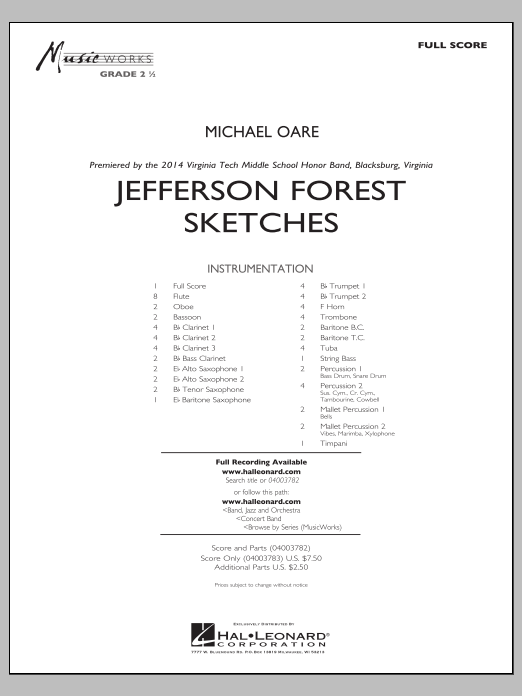

Jefferson Forest Sketches: Concert Band Conductor Score & Parts
By Michael Oare
Grade: 2.5
Item: 35-PK00292590
$55.00
Pickup currently not available
Buy Extra Parts (Digital PDF Download)
Parts Added to Cart!
Description
"Jefferson Forest Sketches" is a programmatic work depicting the beauty and grandeur of the Jefferson National Forest along the Appalachian Mountains. From dawn breaking over the mountains, to breathtaking panoramas, to a seemingly endless expanse of wilderness, composer Michael Oare takes us through a variety of scenes and moods. The piece concludes with a lively tribute to the reels and dance tunes common to the area in the colonial period. Dur: 3:15


Jefferson Forest Sketches: Concert Band Conductor Score & Parts isn't in MakeMusic Cloud just yet...but it could be. Let us know you'd like to see it, and you'll help shape what comes next. In the meantime, start a free trial and dive into thousands of interactive titles your students can play along with today.
Request This Title
Tell us you want it.
Start Your Free Trial
Explore everything that's ready to play right now.
Sample Audio
No sample audio found.
Sample Video
No sample videos found.
Additional Details
Publisher:
Hal Leonard
SKU:
35-PK00292590
More about this title
About the Composer: Michael Oare

Michael Oare has spent over three decades shaping young musicians as Director of Bands at Great Bridge Middle School in Chesapeake, Virginia, where his ensembles earned superior ratings year after year on the Virginia Concert Band Performance Assessment. His dual expertise in composition and education runs deep: he holds degrees in both fields from Old Dominion University and has published extensively for young bands, with two works selected for GIA Publications' influential "Teaching Music Through Performance" series.
Beyond the classroom, Oare serves as conductor of the Bay Youth Orchestras of Virginia Concert Band, adjudicates competitions, performs with the Virginia Wind Symphony, and maintains active involvement in state and national music educator organizations. His contributions to music education have earned him recognition as Chesapeake Public Schools' Middle School Teacher of the Year, two National Band Association Citations of Excellence, and consistent honors in national teaching directories.
Why we love this
This work delivers genuine programmatic storytelling without overwhelming a developing ensemble. Oare's instinct for what works on the 2.5 level shines through: the sunrise section builds naturally without gratuitous complexity, the wilderness passages create sonic variety through orchestration rather than technical demands, and the closing reel celebration gives students an irresistible musical payoff that energizes both rehearsals and audiences.
What to expect
The piece unfolds like a hiking trail through familiar mountains. You begin in stillness as dawn breaks, move through passages of wonder and scale, and emerge into celebratory dancing rooted in Appalachian culture. The transitions feel natural rather than abrupt, and the emotional arc carries students and listeners alike from reflection to joy.
Who it's for
Concert bands at the grade 2.5 level looking for literature that engages students through storytelling and regional character rather than technical virtuosity. Directors programming fall or spring concerts will find this accessible enough for broad ensemble participation while sophisticated enough to hold audience interest.
How to get the most out of it
- Build the opening dawn section with patience. The gradual emergence of light works best when you resist the urge to push tempo; let the students shape the dynamic arc across phrases.
- Balance the landscape passages by bringing out inner voices and countermelody lines rather than locking everything in unison. This thinner texture actually creates more landscape transparency.
- Approach the colonial reel section with rhythmic clarity and swing. Your students will naturally want to drive it; channel that energy into clean articulation and crisp ensemble togetherness.
- Record a sectional rehearsal playthrough early in preparation. Hearing their own sound developing across the three-minute arc builds ownership and musicality faster than isolated passage work.
How to use it
Open a concert with this work to establish atmosphere and draw listeners into the program narrative immediately. Alternatively, pair it with other regionally inspired pieces to create a themed concert exploring American landscape and cultural music. The three-minute fifteen-second duration fits cleanly on most concert formats without requiring awkward padding.
Skills your students will build
- Sustaining dynamic control through extended lyrical passages
- Balancing melody and accompaniment across different instrumental families
- Responding to subtle tempo and rubato gestures in programmatic contexts
- Executing dotted rhythms and syncopation in the reel section
- Interpreting time signature and metric relationships in dance-oriented material