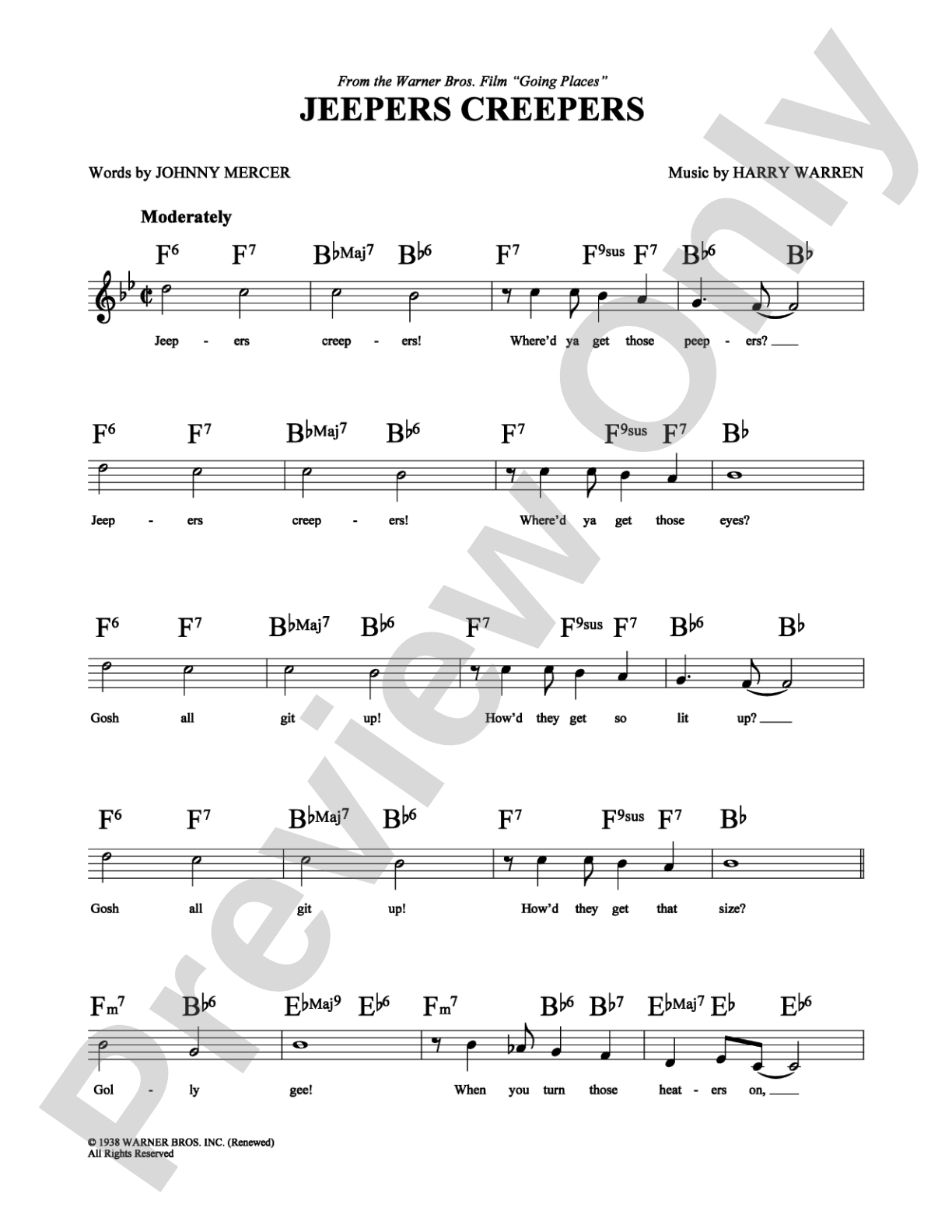
Jeepers Creepers: Lead Sheet Digital Sheet Music

Jeepers Creepers: Lead Sheet Digital Sheet Music

Harry Warren, Louis Armstrong

Item: 00-PS-0002077

Digital Download
$1.99
Description

Jeepers Creepers: Lead Sheet Digital Sheet Music isn't in MakeMusic Cloud just yet...but it could be. Let us know you'd like to see it, and you'll help shape what comes next. In the meantime, start a free trial and dive into thousands of interactive titles your students can play along with today.

Sample Audio
No sample audio found.
Sample Video
Additional Details
SKU: 00-PS-0002077

More about this title

About the Artist: Louis Armstrong

Louis Armstrong (1901-1971) revolutionized jazz and popular music through his distinctive vocal approach and masterful trumpet playing. His warm, gravelly voice and improvisational genius made him one of the most influential musicians of the 20th century, and his recordings shaped how generations of musicians understood swing, phrasing, and rhythmic freedom.

Armstrong's catalog spans jazz standards, popular songs, and novelty numbers that showcase his ability to bring personality and musicality to any tune. His interpretations remain essential listening for musicians studying jazz idiom, vocal swing style, and the art of making a lyric genuinely conversational.

Why we love this

This lead sheet captures one of Armstrong's signature novelty numbers, and its straightforward melody and accessible chord changes make it an ideal teaching tool for introducing jazz standards to students at various levels. The song's cheerful character and cultural staying power give it real classroom appeal, and any musician working from this lead sheet can study how a master improviser approaches a simple, memorable tune.

What to expect

Bright and playful, with a mischievous energy that invites musical storytelling. The melody bounces along with infectious charm, evoking a bygone era of popular entertainment while remaining instantly singable and memorable.

Who it's for

Musicians preparing jazz standards for recital or ensemble performance, jazz students learning to read and interpret lead sheets, and anyone studying Armstrong's approach to melodic phrasing and swing feel. Pianists, guitarists, horn players, and singers all benefit from working through this tune's straightforward but expressive framework.

How to get the most out of it

  • Study Armstrong's original recording to understand his phrasing and rhythmic placement. Notice how he sits slightly behind the beat and uses space as part of his interpretation.
  • Experiment with different rhythmic feels when interpreting the melody. The swing eighth-note feel is essential, but the degree of swing can shift depending on tempo and context.
  • Use the lead sheet as a springboard for improvisation rather than a strict reading exercise. The chord changes are stable enough to support exploration while keeping harmonic clarity.
  • Pay attention to dynamics and articulation as tools for expressing personality. Armstrong rarely plays a phrase the same way twice, and variation in how you deliver the melody keeps the tune fresh.

How to use it

Feature this as a jazz standards unit in a general music or jazz history course, pair it with other Armstrong recordings to explore interpretive style, or include it in a nostalgia-themed concert program where its lighthearted character shines. The lead sheet format also makes it perfect for student jam sessions or small ensemble arrangements.

Skills your students will build

  • Reading and interpreting lead sheet notation with chord symbols
  • Understanding swing eighth-note feel and jazz phrasing conventions
  • Listening for and emulating Armstrong's characteristic vocal inflection and rhythmic placement
  • Creating simple improvisations over stable diatonic chord changes
  • Recognizing how melody, rhythm, and lyrical content work together in jazz standards

You May Also Like