
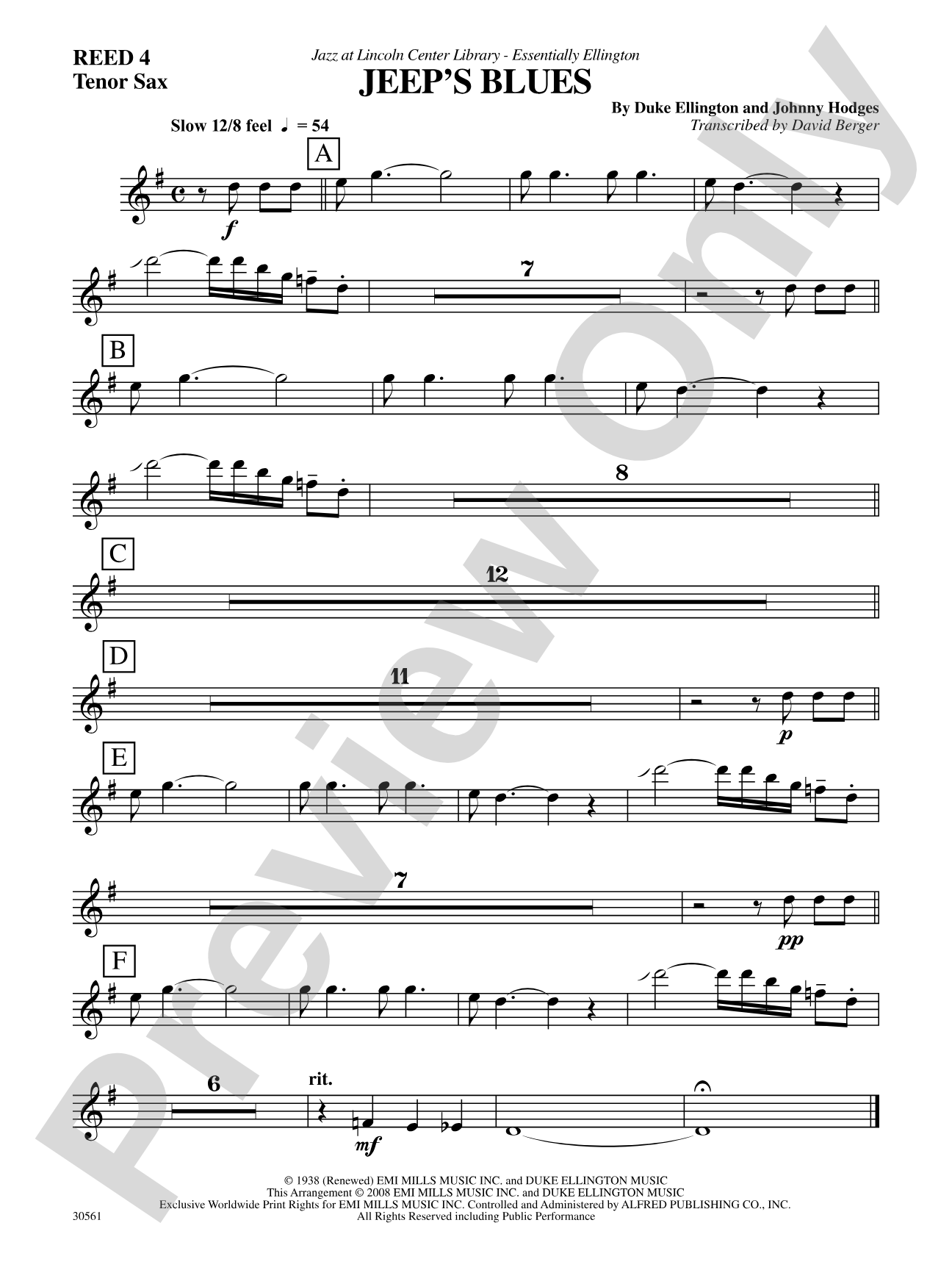

Jeep's Blues: 2nd B-flat Tenor Saxophone
By Duke Ellington and Johnny Hodges / transcr. David Berger
Grade: 5 (Advanced / Difficult)
Item: 00-PC-0014296_TX2
$3.00
Pickup currently not available
Description
Jeep's Blues is one of many blues lines written by Ellington's star alto saxophonist Johnny Hodges. This one was for an Ellington small group recording under Hodges' name in the late 1930's. It's basically just the first 4 bars of the blues and then Hodges improvises the rest of the 12-bar form. Ellington's later big band arrangement is a very simple enlargement of that original 4-horn chart. There are 2 ensemble choruses, 2 solo choruses, 2 sax section choruses ending with a stride piano cadence. The opening is a loud and glorious ensemble; the closing is a soft and introspective sax section.


Don't just read it, hear it, play along with it, and watch your students grow with it. In MakeMusic Cloud, Jeep's Blues: 2nd B-flat Tenor Saxophone comes alive with professional accompaniment, adjustable tempo, and built-in practice tools that turn solo practice into real progress.
Open in the Player
Jump straight in and assign it today.
Start Your Free Trial
Open this title and explore the full library in minutes.
Sample Audio
1
Audio File
--:--
0:00
0:00
Sample Video
No sample videos found.
Additional Details
Series:
Essentially Ellington: Jazz at Lincoln Center Library
Publisher:
Alfred Music
Page Count:
38
SKU:
00-PC-0014296_TX2
More about this title
About the Composer: Duke Ellington
Duke Ellington stands as one of the most prolific and inventive composers in American music. His career spanned nearly six decades, during which he elevated jazz from improvised entertainment to a sophisticated art form worthy of concert halls and symphonic ambition. Ellington's compositional voice was instantly recognizable: he wrote for the specific timbres and abilities of his band members, creating works that balanced tight ensemble writing with space for individual brilliance.
Why we love this
This arrangement captures the essence of Ellington's small-group sound without sacrificing the power and clarity that Grade 5 ensembles can deliver. The contrast between the brash opening ensemble and the introspective sax section closing gives your students a genuine interpretive challenge; they'll learn what dynamics and balance actually communicate. It's a touchstone piece from the Jazz at Lincoln Center Library that respects the original's sophistication while remaining accessible to advanced high school and college players.
What to expect
The piece opens with Ellington's big-band energy compressed into an ensemble that swings hard and announces itself with confidence. Once the soloists take over, the music becomes more introspective and conversational, moving between moments of collective statement and individual voice before settling into the soft, contemplative exchange of the sax section. The stride piano cadence sends you out with a wink of technical virtuosity and swagger.
Who it's for
Advanced jazz ensembles in high school, college, and community settings will find a piece that challenges their reading, ensemble balance, and improvisational control without requiring a massive horn section. The Grade 5 difficulty places it squarely for musicians who've moved beyond basics and are ready to tackle authentic Ellington repertoire.
How to get the most out of it
- Shape the opening ensemble with real aggression in the attack and weight in the low end; this isn't a timid statement. Let the trumpets cut through while the trombones anchor the harmony.
- Balance the solo choruses carefully. The featured soloist should sit at the front of the mix, but the rhythm section and comping horns must stay locked and responsive without crowding the space.
- Treat the closing sax section as a genuine conversation rather than a fade-out. Each saxophone voice has a distinct role; make sure the inner voices aren't buried by the lead alto.
- The stride piano cadence at the end demands a soloist who can articulate cleanly and swing the rhythmic figures. This is a moment of technical display and style; give it room to breathe.
How to use it
Include this alongside other Ellington charts to build a concert around his compositional range, or use it as a centerpiece for a jazz standards set where modern arrangements meet the real thing. The contrast between the loud opening and soft closing makes it an excellent closer for a set, or a strong opener that immediately establishes the ensemble's control and musicality.
Skills your students will build
- Comping and rhythm section dialogue in a small-group jazz setting
- Dynamic contrast and balance between ensemble and featured soloists
- Reading complex harmonic changes and reacting to improvised lines
- Articulation and phrasing in a swing idiom
- Interpretation of stride piano style and execution