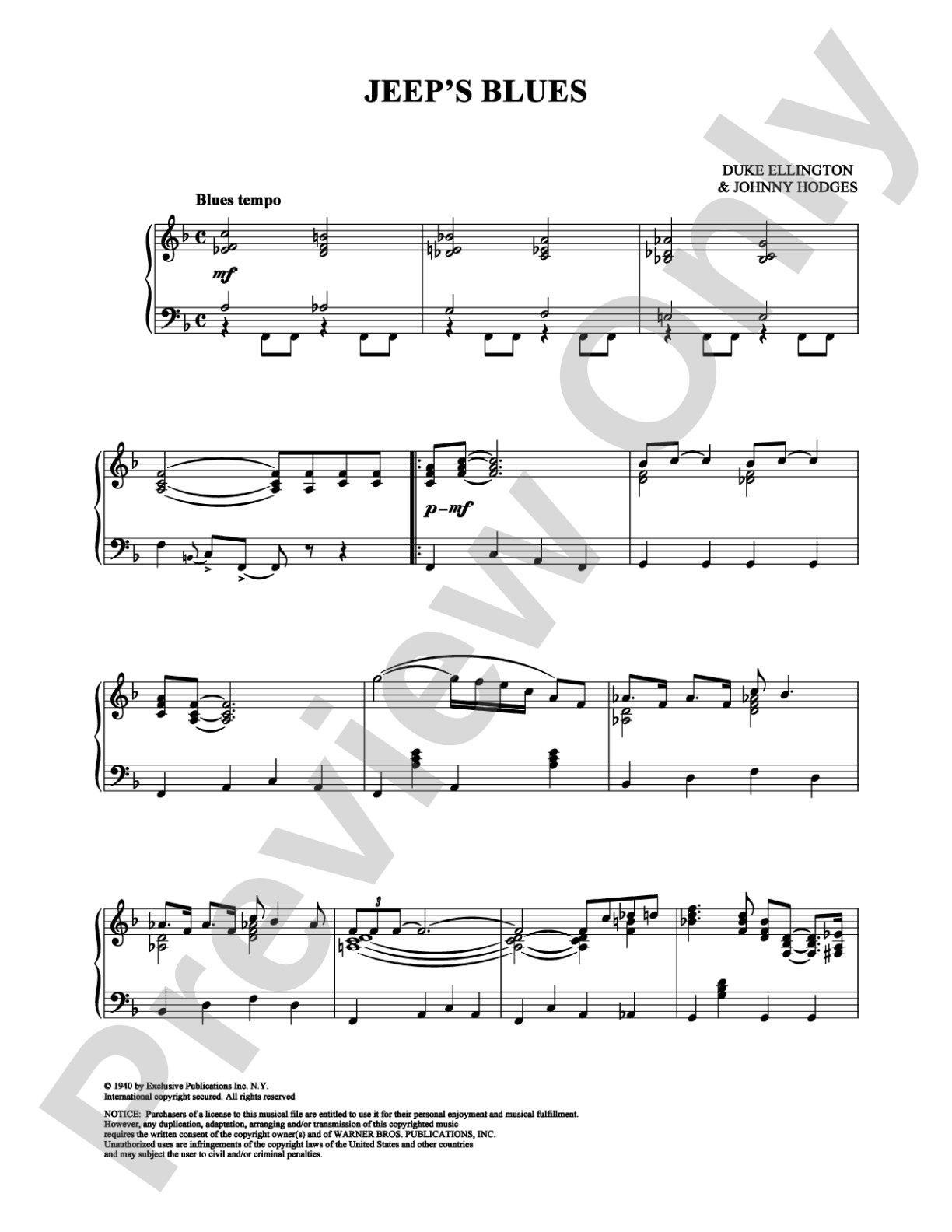
Jeep's Blues: Piano Digital Sheet Music

Jeep's Blues: Piano Digital Sheet Music

Johnny Hodges, Duke Ellington

Item: 00-PS-0008209

Digital Download
$3.99
Description

Jeep's Blues: Piano Digital Sheet Music isn't in MakeMusic Cloud just yet...but it could be. Let us know you'd like to see it, and you'll help shape what comes next. In the meantime, start a free trial and dive into thousands of interactive titles your students can play along with today.

Sample Audio
No sample audio found.
Sample Video
Additional Details
SKU: 00-PS-0008209

More about this title

About the Artist: Duke Ellington

Duke Ellington (1899-1974) stands as one of the most consequential composers in American music history. His output spanned six decades and encompassed thousands of compositions, from three-minute standards to extended works for orchestra and ballet. Beyond his role as a bandleader and pianist, Ellington's genius lay in his ability to write idiomatically for jazz ensemble while maintaining sophisticated harmonic language and structural integrity.

Ellington's influence on jazz pedagogy remains profound. His compositions have become the foundation of jazz education curricula because they demand musicianship at every level. Whether a student is sight-reading lead sheets or analyzing harmonic progressions, Ellington's work rewards close study and offers pathways into the jazz tradition that remain vital today.

Why we love this

Jeep's Blues captures the essence of Ellington's piano voice, sophisticated harmonic movement wrapped in a deceptively accessible blues frame. Students get a masterclass in how to navigate standard changes while maintaining melodic clarity, and the piece rewards both careful practice and creative interpretation in equal measure.

What to expect

Jeep's Blues carries the relaxed swing of a late-night set, unhurried but with propulsive forward motion. The melody settles into the blues form with a kind of conversational ease, reflecting Ellington's mastery of writing songs that feel inevitable once you hear them.

Who it's for

Jazz pianists from intermediate through advanced levels will find this accessible yet musically substantial. Students learning the jazz standard repertoire and developing skills in blues forms and jazz harmony will benefit from its direct approach and elegant construction.

How to get the most out of it

  • Listen closely to how the harmony moves beneath the melody line. Ellington often shifts chords in ways that feel natural to the ear but require intentional voicing choices on piano.
  • Shape the melody with rubato appropriate to the blues feel. Jazz phrasing isn't metronomic; let the underlying groove breathe while keeping the line singing.
  • Anchor the left hand with a steady sense of time. The comping doesn't need to be complex, but rhythmic clarity underneath allows the melody to flex.
  • Reference recordings of the Duke Ellington Orchestra to hear how the arrangement sits in the full band context. Solo piano requires you to suggest that fuller sound.

How to use it

Feature this in a jazz recital or student showcase as a solo piece that demonstrates jazz piano fundamentals without requiring extensive arrangements or accompaniment. It also works well as a learning piece in jazz improvisation study, offering a familiar harmonic framework that invites exploration.

Skills your students will build

  • Blues form and 12-bar harmonic progression
  • Jazz voicing and comping techniques
  • Swing phrasing and rhythmic flexibility within meter
  • Reading lead sheets and interpreting chord changes
  • Balancing melodic line with accompaniment texture

You May Also Like