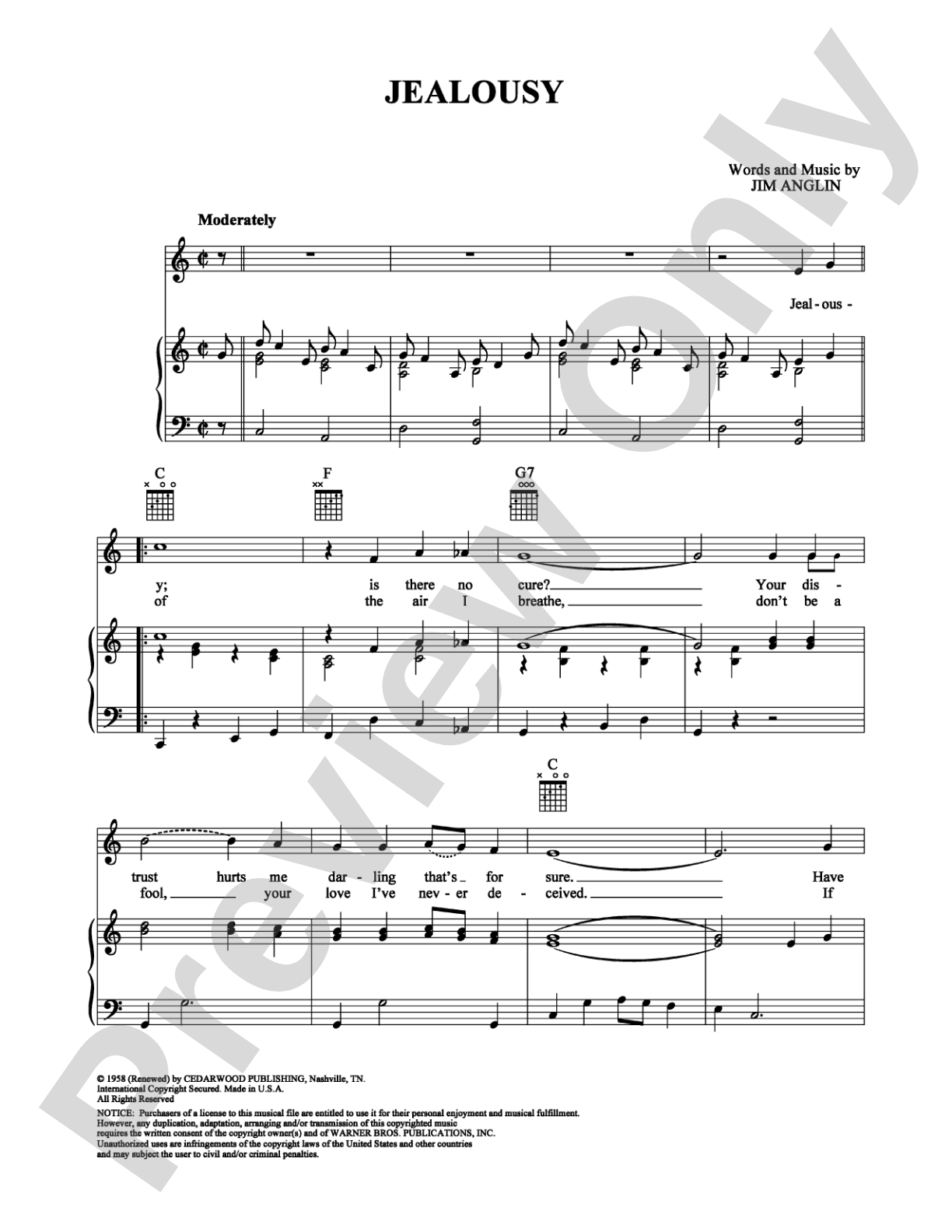
Jealousy: Piano/Vocal/Chords Digital Sheet Music

Jealousy: Piano/Vocal/Chords Digital Sheet Music

Kitty Wells, Jim Anglin

Item: 00-PS-0002787

Digital Download
$2.95
Description

Jealousy: Piano/Vocal/Chords Digital Sheet Music isn't in MakeMusic Cloud just yet...but it could be. Let us know you'd like to see it, and you'll help shape what comes next. In the meantime, start a free trial and dive into thousands of interactive titles your students can play along with today.

Sample Audio
No sample audio found.
Sample Video
Additional Details
SKU: 00-PS-0002787

More about this title

About the Artist: Kitty Wells

Kitty Wells earned her place in country music history as the first female country music star to achieve sustained commercial success. Her 1952 recording of 'It Wasn't God Who Made Honky Tonk Angels' became a watershed moment for women in country music, proving that female artists could lead on the charts and command their own careers.

Wells' vocal approach, direct, emotionally honest, and unflinching, shaped how generations of country singers approached storytelling. She recorded hundreds of songs across a career spanning decades, leaving behind a catalog that remains a teaching resource for understanding how vocal phrasing and restraint can carry lyrical weight.

Why we love this

This is a standard country ballad with genuine emotional weight and straightforward harmonic movement that works beautifully in a vocal jazz or American songbook context. The piano/vocal/chords format gives singers and accompanists the flexibility to interpret the arrangement while maintaining the song's classic country character.

What to expect

The song carries the emotional directness of classic country heartbreak, with a melody that sits naturally in the voice and harmony that supports rather than complicates the narrative. The arrangement respects the vintage country aesthetic while remaining singable for contemporary performers.

Who it's for

Vocalists preparing country, Americana, or classic popular music repertoire will find this arrangement accessible and performance-ready. Pianists and guitarists seeking authentic country ballad accompaniments can use the chords to develop their comping skills.

How to get the most out of it

  • Study the original recording to grasp Wells's phrasing and subtle vocal inflections; her restraint and clarity shaped how this song should breathe.
  • Honor the lyrical narrative by shaping the dynamic arc to match the emotional journey rather than maintaining an even volume throughout.
  • Adjust the tempo to suit your voice's natural resonance in the key provided; country ballads often benefit from slight flexibility in the accompaniment.
  • Use the chord symbols to explore reharmonization if working with an accomplished pianist; country songs often allow tasteful harmonic variation.

How to use it

Include this in a recital program exploring American songwriting or country music history, pairing it with other standards from Wells's era to create a focused set. It works equally well in a mixed-repertoire recital as a palate cleanser between art song or contemporary material.

Skills your students will build

  • Interpreting country phrasing and vocal styling
  • Reading and realizing lead sheet notation with chord symbols
  • Building narrative arc through dynamic shaping in a ballad setting
  • Collaborating with accompanists using standardized chord notation

You May Also Like