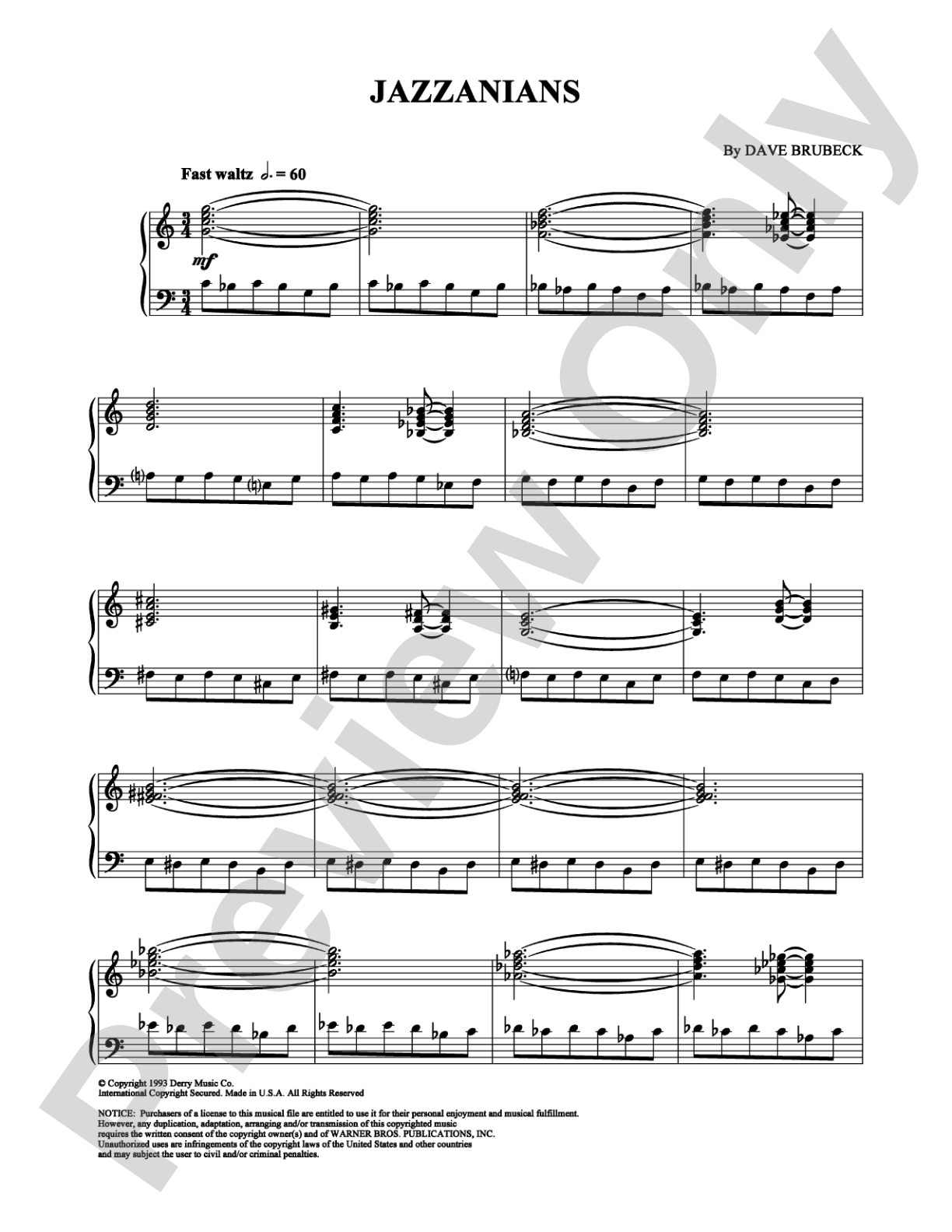
Jazzanians: Piano Digital Sheet Music

Jazzanians: Piano Digital Sheet Music

Dave Brubeck

Item: 00-PS-0000753

Digital Download
$3.99
Description

Jazzanians: Piano Digital Sheet Music isn't in MakeMusic Cloud just yet...but it could be. Let us know you'd like to see it, and you'll help shape what comes next. In the meantime, start a free trial and dive into thousands of interactive titles your students can play along with today.

Sample Audio
No sample audio found.
Sample Video
Additional Details
SKU: 00-PS-0000753

More about this title

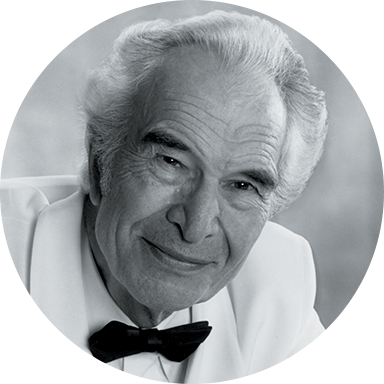
About the Artist: Dave Brubeck

Dave Brubeck

Dave Brubeck was a pianist and composer whose improvisational command matched his gift for large-scale classical forms. Beyond his iconic jazz recordings, he wrote choral works, orchestral pieces, chamber music, and solo compositions that drew equally from jazz idiom and European tradition. His studies with Darius Milhaud at Mills College proved formative; Milhaud urged him to synthesize both languages, a directive Brubeck pursued throughout his career.

Brubeck's cultural impact extended beyond music. He was instrumental in dismantling racial barriers in mid-20th-century jazz and classical music, and his 1959 album Time Out became the first jazz record to sell over a million copies. His sacred works, including To Hope!, have been performed internationally and recorded by major ensembles. The Grammy Lifetime Achievement Award, the Presidential Medal of the Arts, and his 2003 induction into the American Classical Music Hall of Fame reflect a career that bridged jazz and concert hall with equal authority.

Why we love this

Jazzanians lets pianists taste Brubeck's compositional approach to jazz form without requiring transcription skills or deep harmonic analysis. The piece captures his characteristic rhythmic sophistication and harmonic clarity in a format you can put directly in front of students. It's the rare jazz composition that reads as fully notated music rather than a lead sheet, giving your pianists a genuine score to study and interpret.

What to expect

Jazzanians swings with a clean, architectural intelligence. The piece has the rhythmic animation of jazz but speaks through fully realized harmonic and melodic ideas rather than improvisation cues. Playing it feels like stepping inside Brubeck's compositional mind, where swing rhythm and classical form coexist without compromise.

Who it's for

This works for pianists at the intermediate to advanced level who are ready to engage with notated jazz composition. It suits both jazz emphasis students and classical pianists exploring twentieth-century repertoire that sits at the intersection of styles. Solo recitalists, jazz ensemble pianists, and serious students building a contemporary concert program will all find value here.

How to get the most out of it

  • Respect the written rhythms precisely, even where they feel syncopated; Brubeck's notation is intentional and part of the compositional idea.
  • Approach comping sections with sensitivity to dynamics and articulation markings rather than generic jazz groove patterns.
  • Use the melodic content as your anchor for tempo decisions; let the phrasing breathe naturally rather than rushing through scalar passages.
  • Experiment with touch and voicing to distinguish sections; Brubeck often shifts textural density to create form and momentum.

How to use it

Feature this in a jazz recital or a mixed program that pairs classical and jazz traditions. It works especially well on a concert exploring twentieth-century American piano music, where it can sit alongside Gershwin or Copland. For a jazz ensemble concert, it can anchor a set of composed works and give your accompanists a featured moment.

Skills your students will build

  • Interpreting syncopated rhythms with accuracy and musical intent
  • Understanding harmonic language that blends jazz vocabulary with classical voice leading
  • Balancing melodic clarity with rhythmic propulsion
  • Navigating modulation and form in twentieth-century jazz composition
  • Developing touch and articulation control for swing idiom in a notated score

You May Also Like