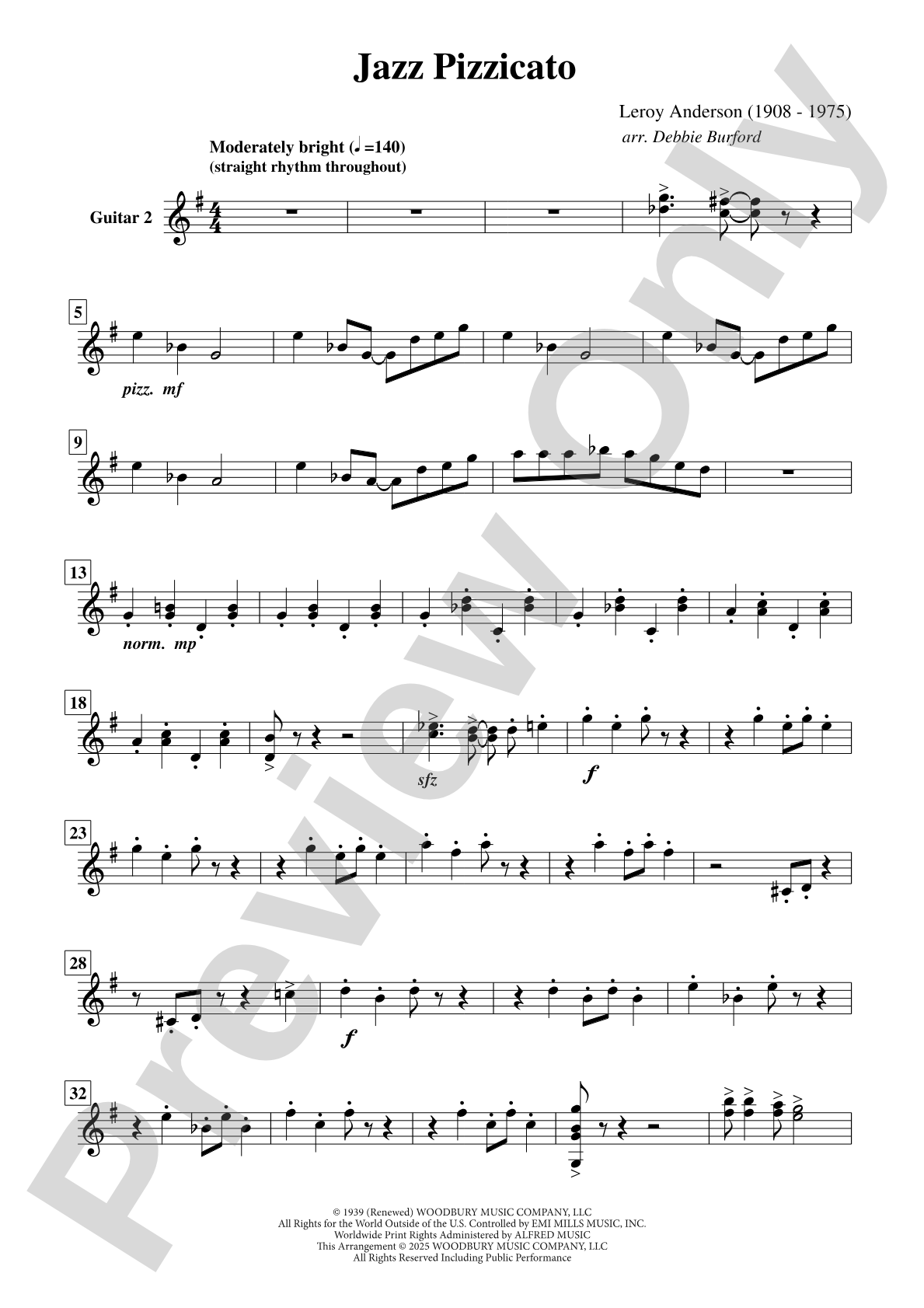
Jazz Pizzicato: Guitar 2 Sheet Music Preview

Jazz Pizzicato: Guitar 2

for Guitar Quartet

By Leroy Anderson / arr. Debbie Burford

Item: 00-PC-0019638_GTR2

Digital Download
$5.99
One moment…
One moment…
Description
Leroy Anderson's orchestral classic arranged for guitar quartet.

Jazz Pizzicato: Guitar 2 isn't in MakeMusic Cloud just yet...but it could be. Let us know you'd like to see it, and you'll help shape what comes next. In the meantime, start a free trial and dive into thousands of interactive titles your students can play along with today.

Sample Audio
No sample audio found.
Sample Video
Additional Details
SKU: 00-PC-0019638_GTR2

More about this title

About the Composer: Leroy Anderson

Leroy Anderson (1908-1975) was an American composer and conductor known for his light orchestral works that bridged classical and popular idioms. His gift for catchy melodies, clever orchestration, and witty musical narratives made him one of the most performed American composers of the twentieth century. Anderson's catalog includes beloved concert staples like "Plink, Plank, Plunk!" and "Sleigh Ride," pieces that combine technical sophistication with immediate accessibility.

Anderson's music appeared regularly on radio and television during the 1950s and 60s, and his arrangements have become standard repertoire for ensembles across genres. His compositional voice remains relevant in music education because it demonstrates how to write for instruments with clarity and personality while maintaining genuine musical substance.

Why we love this

Anderson's orchestral charm translates beautifully to guitar quartet, and Burford's arrangement preserves the character and rhythmic snap of the original while making the texture idiomatic for strings. Guitar ensembles rarely get to perform repertoire this sophisticated and recognizable, which means students perform with genuine musical stakes and audiences immediately connect with the piece.

What to expect

Playful, sophisticated, and urbane. The pizzicato articulation gives the piece a lighthearted, almost comedic energy while the harmonic language and contrapuntal detail command respect. Anderson's hallmark wit comes through in the rhythmic interplay between parts, creating moments of musical surprise that delight both players and listeners.

Who it's for

Advanced guitar quartet ensembles and chamber groups looking for repertoire that combines technical control, ensemble precision, and genuine musicality. This arrangement works for college guitar studios, chamber ensembles preparing for competition or concert programming, or advanced high school guitar ensembles with strong rhythmic discipline.

How to get the most out of it

  • Establish a conversational tone between guitar lines so the pizzicato figures emerge as distinct voices rather than blending into one texture; the upper voices should lead dialogue while the bass voices anchor the rhythm.
  • Lock the rhythmic precision between all four players in the syncopated passages; even slight timing variations become audible in the close voicing of a quartet.
  • Shape the melodic phrases as if they were being sung, giving yourself room to breathe at cadences and letting the accompaniment patterns settle into a groove rather than sounding mechanical.
  • Pay attention to dynamic relationships between parts; Anderson's orchestrations thrive on color changes, so highlight inner voices when they carry musical ideas and pull back when they support.

How to use it

Program this as a standalone chamber work on a guitar ensemble concert, or pair it with other light classical arrangements to create an accessible program that draws audiences unfamiliar with guitar quartet repertoire. Its recognizability and humor make it an excellent opener or closer that establishes a warm, engaging tone for the recital.

Skills your students will build

  • Rhythmic precision in syncopated ensemble passages
  • Voice independence in four-part writing
  • Dynamic shaping and phrasing in non-melodic guitar parts
  • Pizzicato articulation control and consistency across four players
  • Reading conductor score notation alongside individual parts

You May Also Like