Jauchzet Gott, Alle Lande Sheet Music Preview

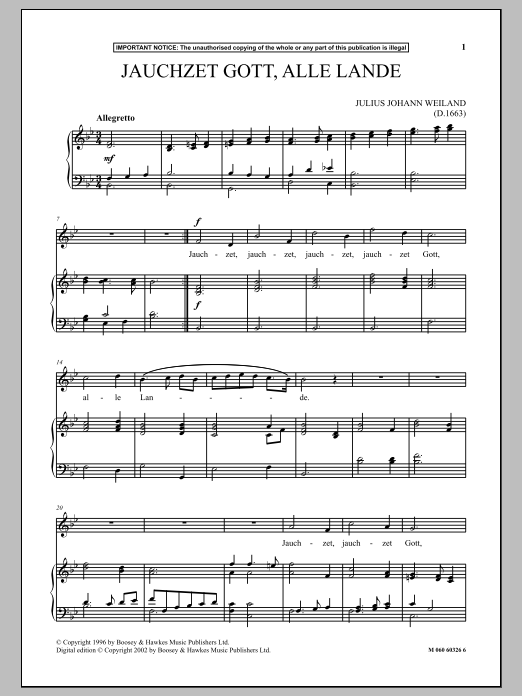
Jauchzet Gott, Alle Lande: Piano Vocal

As performed by Julius Johann Weiland

Item: 35-DS00238122

Digital Download
$5.99
Description

Jauchzet Gott, Alle Lande: Piano Vocal isn't in MakeMusic Cloud just yet...but it could be. Let us know you'd like to see it, and you'll help shape what comes next. In the meantime, start a free trial and dive into thousands of interactive titles your students can play along with today.

Sample Audio
No sample audio found.
Sample Video
Additional Details
Publisher: Hal Leonard
Page Count: 6
SKU: 35-DS00238122

More about this title

About the Artist: Julius Johann Weiland

Julius Johann Weiland was a German composer and organist active in the 18th century, contributing to the rich tradition of sacred vocal music during the Baroque and early Classical periods. His works reflect the German Protestant choral tradition, blending accessibility with genuine musical substance in settings designed for both liturgical use and concert performance.

Why we love this

This setting captures the jubilant character of its text ("Jauchzet Gott, alle Lande" means "Shout to God, all lands") through straightforward, singable vocal writing supported by capable piano accompaniment. The six-page score avoids unnecessary complications while maintaining the warmth and dignity expected of German sacred music from this era. It's the kind of piece that sounds substantial without demanding extraordinary technical display from either vocalist or pianist.

What to expect

Bright and affirmative, with the earnest sincerity of German Baroque sacred music. The text speaks to joy and proclamation, and the music meets that emotional content straightforwardly, inviting the listener into genuine celebration rather than virtuosic display.

Who it's for

This suits soloists preparing sacred repertoire for recital or worship contexts, as well as voice teachers seeking classical material that develops legit technique without excessive demands. It works equally well for singers developing confidence with period style.

How to get the most out of it

  • Shape the opening with steady forward momentum; this is celebratory music that shouldn't drag despite its classical restraint.
  • Balance the voice clearly against the piano rather than burying it in accompaniment texture. The text carries meaning and needs projection.
  • Let the harmonic movement breathe naturally without exaggerating phrase breaks. Weiland's voice leading reveals itself through connected singing.

How to use it

Include this in a sacred music recital focused on lesser-known German composers, or pair it with more familiar Bach or Buxtehude settings to show stylistic connections. It also serves well in worship contexts where the congregation's familiarity with the text provides added resonance to an unfamiliar setting.

Skills your students will build

  • Legit vocal line singing with clean phrasing over Baroque-era harmonic language
  • Accompaniment partnerships between vocalist and pianist with balanced texture
  • German text interpretation and pronunciation in a liturgical context
  • Sustaining musical line through steady tempo and harmonic navigation

You May Also Like