Jasmine Sheet Music Preview

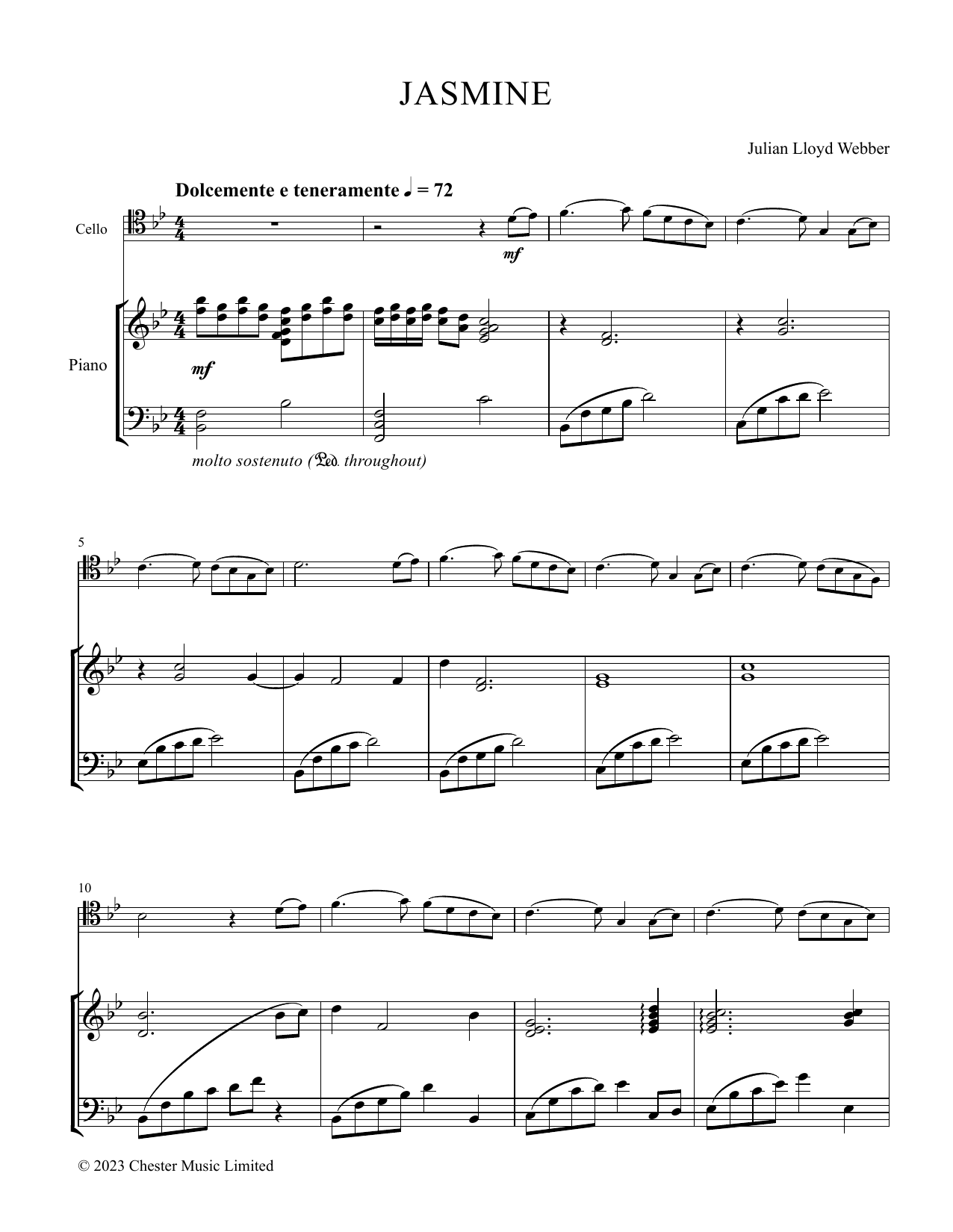
Jasmine: Cello and Piano

As performed by Julian Lloyd Webber

Item: 35-DS01715587

Digital Download
$9.99
Description

Discover MakeMusic Cloud: thousands of interactive titles your students can play along with today.

Sample Audio
No sample audio found.
Sample Video
Additional Details
Publisher: Hal Leonard
Page Count: 6
SKU: 35-DS01715587

More about this title

About the Artist: Julian Lloyd Webber

Julian Lloyd Webber is a British cellist and composer whose career spans four decades of performance, recording, and original composition. Beyond his work as a concert soloist and chamber musician, he has written extensively for his instrument, creating pieces that sit comfortably in both classical and contemporary idioms. His compositions balance technical interest with emotional directness, making them valuable additions to the cello repertoire.

Why we love this

Webber writes with an intuitive understanding of the cello's lyrical voice, and Jasmine delivers a piece that feels both substantial and singable for advanced players. The pairing with piano is straightforward but musically rich, avoiding unnecessary technical display in favor of genuine melodic and harmonic interest. It works beautifully as a recital piece or as part of a contemporary music program.

What to expect

Jasmine unfolds with a contemplative, flowing quality that feels both intimate and expressive. The writing favors legato phrasing and sustained melodic lines that allow the cellist to explore tonal color and emotional nuance.

Who it's for

This score is for advanced high school and college cellists seeking accessible contemporary repertoire with genuine musical substance. It works equally well for private lesson study and ensemble performance contexts.

How to get the most out of it

  • Shape the opening melody with clear direction, allowing the piano to establish the harmonic foundation before the cello enters fully.
  • Balance tone production between lyrical passages and moments where the cello needs definition against the piano texture.
  • Coordinate with your pianist on the handling of rubato, particularly in transition passages where independence between parts matters.

How to use it

Include this in a contemporary music recital or mixed chamber program where it provides a lyrical anchor alongside more experimental works. The six-page length makes it suitable for concert programming at both community and university performance levels.

Skills your students will build

  • Sustaining lyrical phrasing across longer melodic lines
  • Coordinating with piano accompaniment in a chamber setting
  • Interpreting contemporary notation and musical intent
  • Tonal control and expressive rubato in non-traditional harmonic contexts

You May Also Like