
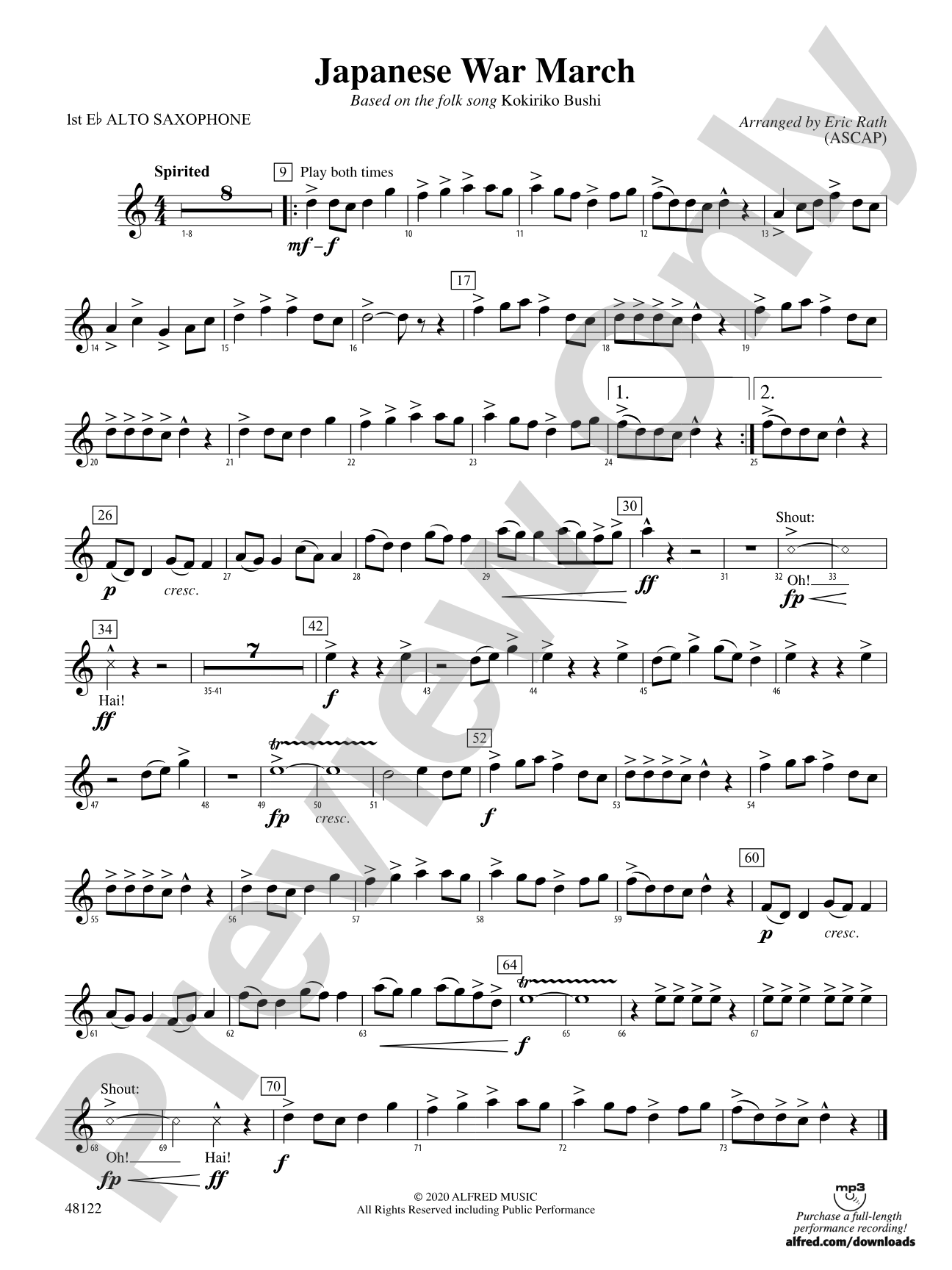

Japanese War March: E-flat Alto Saxophone
Based on the Folk Song "Kokirko Bushi"
Traditional Japanese Folk Song / arr. Eric Rath
Grade: 2 (Medium Easy)
Item: 00-PC-0018435_AX1
$3.00
Pickup currently not available
Description
"Kokiriko Bushi" is long believed to be the oldest folk song in Japan. Normally, this song is presented in a serene setting, but has a new life as an up-tempo, war-like march. A vast array of authentic sounds is used, inspired by Japanese Noh Theater. (2:30) This title is available in MakeMusic Cloud.


Don't just read it, hear it, play along with it, and watch your students grow with it. In MakeMusic Cloud, Japanese War March: E-flat Alto Saxophone comes alive with professional accompaniment, adjustable tempo, and built-in practice tools that turn solo practice into real progress.
Open in the Player
Jump straight in and assign it today.
Start Your Free Trial
Open this title and explore the full library in minutes.
Sample Audio
1
Audio File
--:--
0:00
0:00
Sample Video
Additional Details
Series:
Alfred Debut Series
Publisher:
Alfred Music
Page Count:
142
SKU:
00-PC-0018435_AX1
More about this title
About the Composer: Eric Rath

Eric Rath combines active work as a band director, clinician, and adjudicator with a prolific composing and arranging career. His publications span Alfred Music, FJH Music, Tapspace Publications, and TRN Music, earning recognition for music that engages both performers and audiences. He has presented his work at the Midwest Clinic, the Texas Music Educator's Association Convention, and the International Double Reed Society's Convention.
Rath's background includes percussion instruction at the middle and high school levels, adjunct teaching at Amarillo College, and collaborative projects like the percussion ensemble collection "Beyond Basic Percussion" (co-authored with Ralph Hicks) and transcription books published by Tapspace. He holds degrees from West Texas A&M University and maintains active involvement with the Amarillo Symphony Orchestra, the Amarillo Opera, and the Percussive Arts Society. His professional affiliations also include the Texas Bandmasters Association and ASCAP.
Why we love this
Rath takes one of Japan's most revered melodies and strips away the serene tradition to reveal its martial core, creating a piece that electrifies both ensemble and audience. The orchestration draws deliberately on Noh Theater textures, giving your students an authentic entry point into non-Western musical color without requiring specialized knowledge. At Grade 2, it delivers real musical sophistication and novelty in a fully accessible package.
What to expect
The piece unfolds like a theatrical transformation. It begins with the contemplative, almost floating quality of "Kokiriko Bushi," inviting listeners into centuries of Japanese tradition. Then the ground shifts. The tempo quickens, the texture hardens, and that same melody marches forward as something fierce and urgent, colored throughout by the shimmering, metallic-edged sounds of Noh Theater that make the familiar suddenly foreign and vital.
Who it's for
Concert bands at the Grade 2 level looking for repertoire that expands musical horizons beyond European tradition. Directors seeking a piece that combines accessibility with genuine artistic substance and will hold audience attention through its dramatic arc.
How to get the most out of it
- Lean into the stark dynamic contrasts. The march-like sections will snap into place when you distinguish clearly between the measured, deliberate passages and the moments of full ensemble energy.
- Shape the opening carefully so the folk melody registers as clearly Japanese in character before the tempo and meter shift it into war march territory. This sets up the transformation.
- Balance the Noh-inspired colors across your instrumentation. Rath's orchestration works because every section has a role in creating authentic texture, not padding.
- Keep the march section rhythmically locked. The military character depends on precision; a loose rhythm will flatten the theatrical impact.
How to use it
Program this as a centerpiece of a concert exploring cultural traditions in music, pairing it with Western folk arrangements or original works inspired by other musical cultures. Its two-and-a-half minute duration makes it ideal for festival competitions where you want a strong, memorable selection that showcases musicianship and tonal control. It also works beautifully as a conversation starter in educational concerts, where you can explain the transformation and have students listen for the moment the folk melody becomes militarized.
Skills your students will build
- Articulating contrasting musical characters (serene vs. martial) within a single composition
- Balancing and blending unconventional timbral combinations inspired by non-Western theater traditions
- Executing precise dynamic control and ensemble unity in march-style sections
- Recognizing and performing melodic material in different harmonic and textural contexts
- Interpreting cultural musical references and period-appropriate performance practices