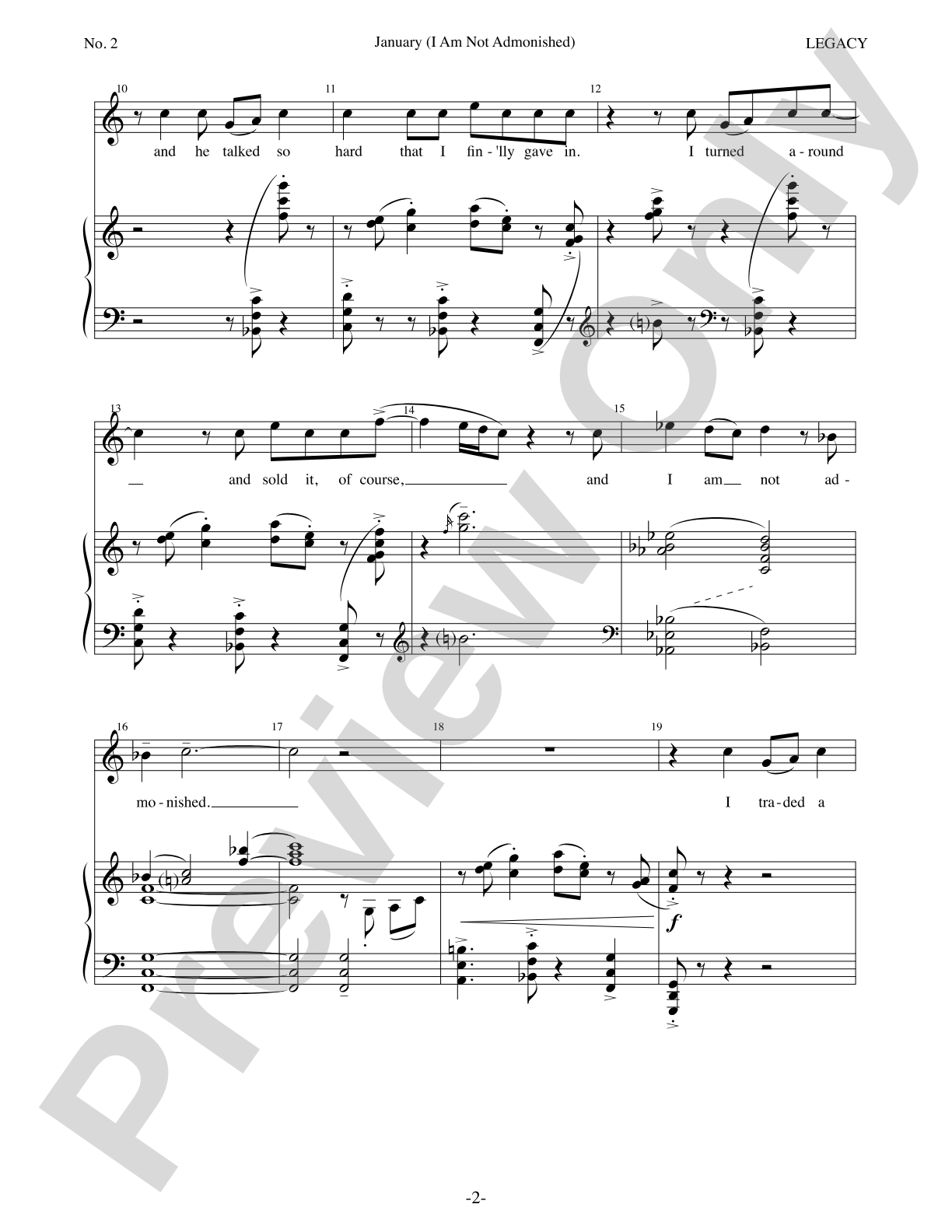
January (I Am Not Admonished) Sheet Music Preview

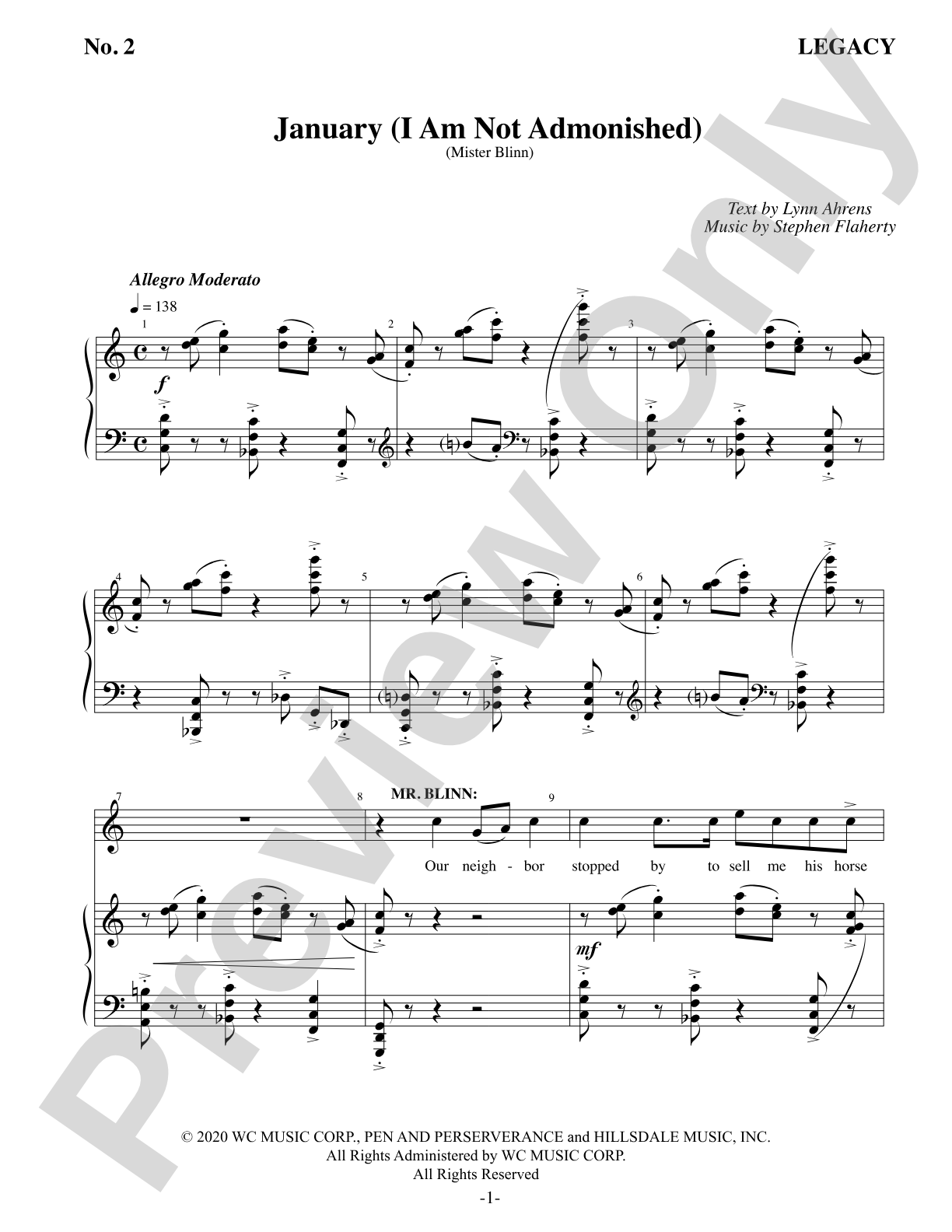
January (I Am Not Admonished): Piano/Vocal

Music by Stephen Flaherty / Lyrics by Lynn Ahrens

Item: 00-PS-0016333

Digital Download
$3.99

One moment…

Description
From the song cycle 1859: A Farmer's Diary on the album Legacy by Flaherty & Ahrens. 1859: A Farmer's Diary is based on excerpts from the diaries of Philo Blinn, a man who owned and worked a farm in Chatham, New York in the 19th century.

January (I Am Not Admonished): Piano/Vocal isn't in MakeMusic Cloud just yet...but it could be. Let us know you'd like to see it, and you'll help shape what comes next. In the meantime, start a free trial and dive into thousands of interactive titles your students can play along with today.

Sample Audio
No sample audio found.
Sample Video
Additional Details
SKU: 00-PS-0016333

More about this title

About the Composer: Stephen Flaherty

Stephen Flaherty is a composer whose work spans musical theatre, film, and concert music. His collaborative partnership with lyricist Lynn Ahrens has produced major theatrical works including Ragtime, Anastasia, and Natasha, Pierre & The Great Comet, all of which showcase his gift for integrating historical narratives with sophisticated musical language.

Flaherty's compositional voice draws on American folk traditions, classical forms, and contemporary harmonic language. His work for concert and educational contexts demonstrates his ability to write accessibly without sacrificing musical depth, making his pieces valuable for performers seeking repertoire that is both artistically substantial and performable at various levels.

Why we love this

This song offers singers and pianists a genuine dramatic moment rooted in 19th-century American life. Flaherty's setting of a farmer's diary entry feels intimate and historically grounded rather than generically nostalgic, giving performers something real to inhabit rather than a sentiment to perform.

What to expect

The music carries the quiet weight of solitary reflection. There is an understated eloquence here, the kind that emerges from listening to someone speak honestly about their life and labor rather than from grand gestures. The piano writing suggests both the rural landscape and the inner life of the speaker.

Who it's for

This piece suits intermediate to advanced singers with solid piano accompanists. The song cycle context makes it especially valuable for recital programming, vocal studios exploring American art song, and performers interested in musical theatre song literature that carries literary and historical weight.

How to get the most out of it

  • Explore the relationship between the vocal line and the piano part as a conversation rather than accompaniment; the dialogue between voice and keyboard shapes the emotional arc of the piece.
  • Pay attention to the specific language of the text (note the title's parenthetical remark) to unlock the speaker's emotional subtext and vocal coloration.
  • Balance transparency in the piano writing with enough support to frame the vocal line clearly; Flaherty's orchestrations often favor clarity over density, and that principle applies to the keyboard part.

How to use it

Program this as part of a recital exploring American song cycles or 19th-century American life through music. It pairs naturally with other Flaherty and Ahrens settings from the same cycle, or alongside folk-influenced art songs by Copland or Bernstein.

Skills your students will build

  • Singing text-driven melody with attention to speech rhythms and dialect
  • Coordinating vocal phrasing with piano accompaniment that doesn't always align metrically
  • Interpreting historical context to inform vocal characterization
  • Balancing narrative clarity with lyrical expression

You May Also Like