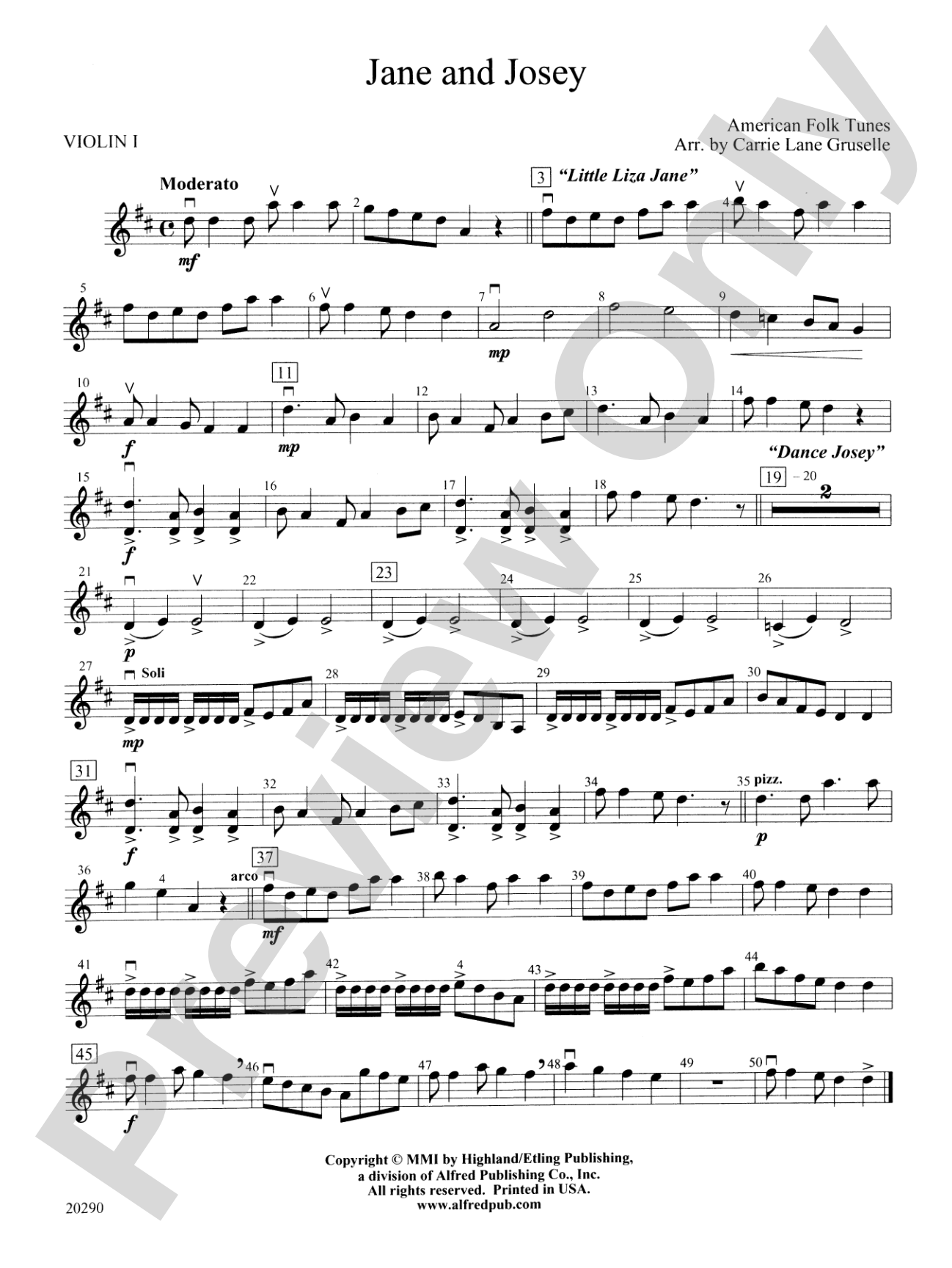
Jane and Josey: 1st Violin Sheet Music Preview

Jane and Josey: 1st Violin

Arr. Carrie Lane Gruselle

Grade: 2

Item: 00-PC-0000381_VN1

Digital Download
$5.99
Description
"Little Liza Jane" and "Dance Josey" are American folk tunes abounding with energy and vitality. In this arrangement, these companion songs give young string players an opportunity to develop pizzicato, a variety of bowing styles, and syncopation in the comfortable key of D major. Minimal shifting occurs in the bass part; otherwise, the arrangement stays in first position.

Don't just read it, hear it, play along with it, and watch your students grow with it. In MakeMusic Cloud, Jane and Josey: 1st Violin comes alive with professional accompaniment, adjustable tempo, and built-in practice tools that turn solo practice into real progress.

Sample Audio
0:00
0:00
Sample Video
Additional Details
Series: Highland/Etling String Orchestra
Publisher: Alfred Music
Page Count: 31
SKU: 00-PC-0000381_VN1

More about this title

About the Arranger: Carrie Lane Gruselle

Carrie Lane Gruselle

Carrie Lane Gruselle earned her Bachelor of Music Education from the University of Wisconsin–Eau Claire and her Master of Music Education from the University of Wisconsin–Stevens Point, where she specialized in Suzuki pedagogy. She teaches strings to elementary and middle school students in the Appleton Area School District and serves as cello instructor for the Lawrence University Arts Academy in Appleton, Wisconsin.

Why we love this

Gruselle constructs a genuine learning progression within a single piece: students encounter pizzicato and varied bowing techniques alongside syncopated rhythms, all without the shifting demands that often derail Grade 2 ensembles. The pairing of two distinct folk melodies gives young musicians the chance to develop confidence in a musically satisfying package rather than isolated technical exercises.

What to expect

These paired folk tunes spark with American vitality and infectious energy. The interplay between pizzicato and bowed sections creates rhythmic momentum, while D major's open-string resonance gives young musicians an immediate sense of ensemble blend and acoustic warmth.

Who it's for

Grade 2 string orchestras with mixed experience levels and beginning shifting skills. This arrangement serves ensembles that want genuine musical content without overwhelming technical demands, as well as directors seeking contest or festival material that builds confidence while maintaining pedagogical purpose.

How to get the most out of it

  • Establish the pizzicato groove early in rehearsals by having the ensemble pluck in rhythm before adding the bowed voices; this clarifies the syncopation and locks the pocket.
  • Balance the piece so that whichever section carries the melody sits slightly forward of the accompanimental texture, whether that's a single voice or a full section.
  • Keep the bowing styles distinct in your physical conducting; clearly show detaché strokes and any staccato markings so students absorb the articulation visually before they hear it in their own playing.
  • Use D major's brightness to your advantage and encourage a warm tone quality; young players often tighten up in faster folk arrangements, so model relaxed shoulders and a singing bow hold.

How to use it

Ideal for mid-year festival submissions or spring concerts where you want to program something energetic without demanding advanced techniques. The pairing of two contrasting folk melodies also works well as a bridge piece between a slow, lyrical work and something more virtuosic, or as a closing selection that leaves audiences with uplifted spirits.

Skills your students will build

  • Pizzicato technique and rhythmic precision
  • Multiple bowing styles (detaché, staccato, and sustained strokes)
  • Syncopated rhythm reading and execution
  • Ensemble balance between melody and accompaniment
  • First-position comfort and minimal-shift awareness in the bass line

You May Also Like