
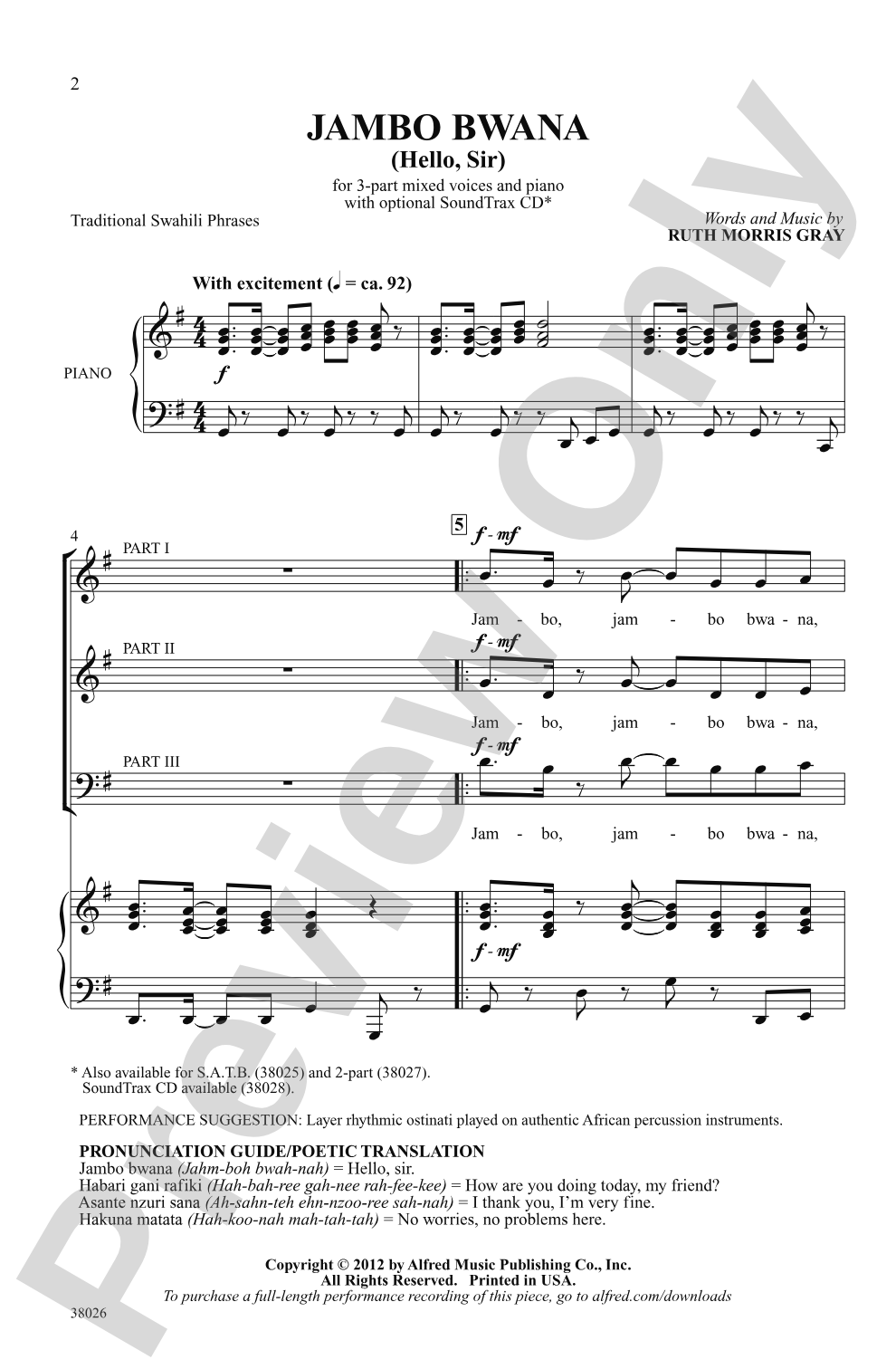
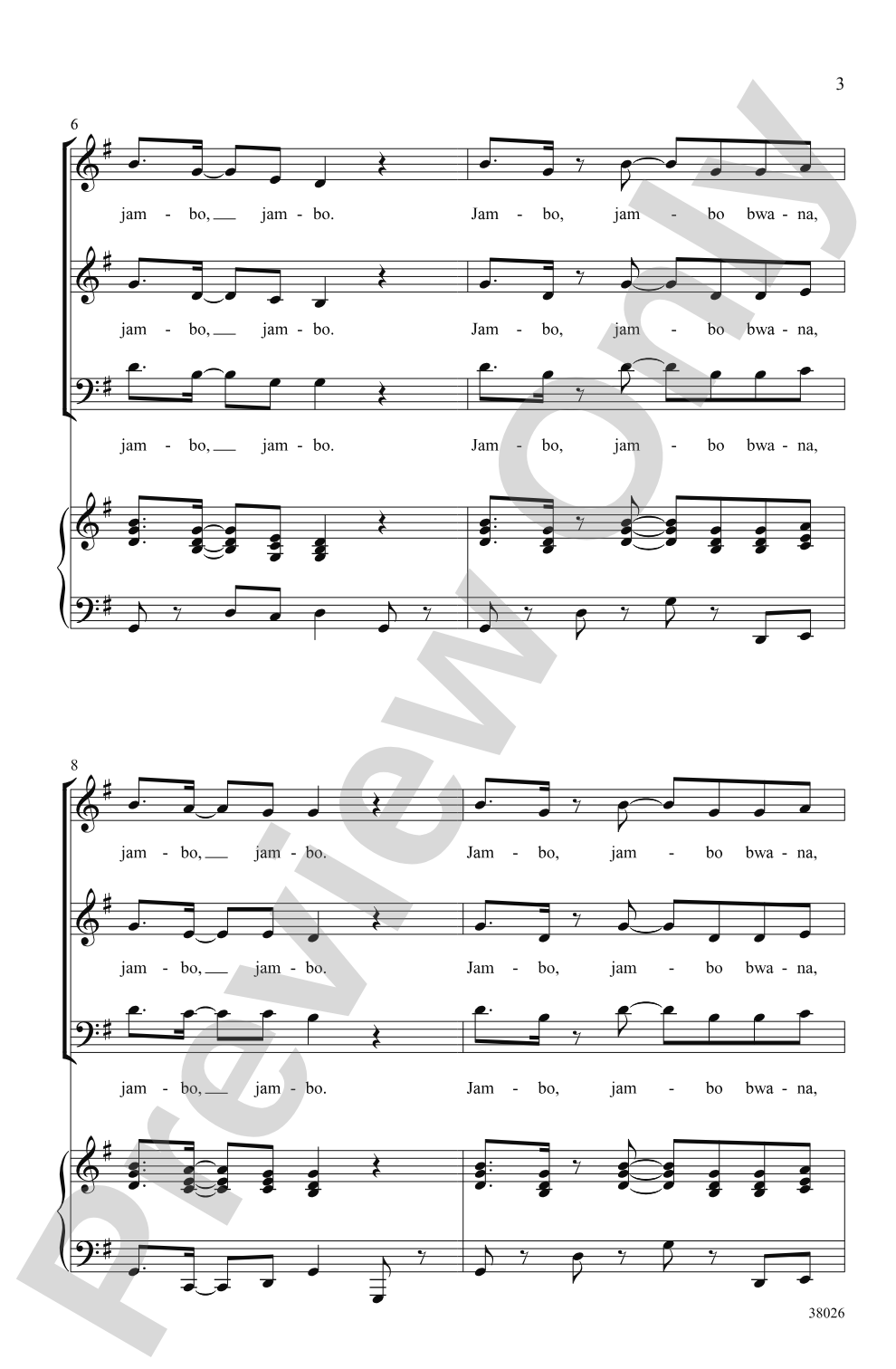

Jambo Bwana: 3-Part Mixed Choral Octavo
(Hello, Sir)
Words and music by Ruth Morris Gray
Item: 00-PO-0001341
$1.80
Minimum order quantity: 20 copies
Pickup currently not available
Related Items
Jambo Bwana: SoundTrax Digital Audio Download |
$27.99
|
View | |
Jambo Bwana: SATB Choral Octavo |
$1.80
|
View | |
Jambo Bwana: 2-Part Choral Octavo |
$1.85
|
View | |
Jambo Bwana: SATB Choral Octavo |
$1.80
|
View | |
Jambo Bwana: 3-Part Mixed Choral Octavo |
$1.80
|
View | |
Jambo Bwana: 2-Part Choral Octavo |
$1.85
|
View | |
Jambo Bwana: Choral Octavo SoundTrax CD |
$27.99
|
View |
Description
A multicultural feature for all choirs! Feel the pulse of African rhythms, sing Swahili salutations, experience world music. Hakuna matata! Check this out! https://leapingbrain.com/modshop/product/?shop=9&product=5653


Jambo Bwana: 3-Part Mixed Choral Octavo isn't in MakeMusic Cloud just yet...but it could be. Let us know you'd like to see it, and you'll help shape what comes next. In the meantime, start a free trial and dive into thousands of interactive titles your students can play along with today.
Request This Title
Tell us you want it.
Start Your Free Trial
Explore everything that's ready to play right now.
Sample Audio
1
Audio File
--:--
0:00
0:00
Sample Video
No sample videos found.
Additional Details
Series:
Alfred Choral Designs
Publisher:
Alfred Music
Page Count:
12
SKU:
00-PO-0001341
More about this title
About the Composer: Ruth Morris Gray

Ruth Morris Gray brings over two decades of choral direction and composition to her work at Rosemead High School in California, where she has led the choir program since 2004. Her catalog includes more than 100 published choral works, reflecting a deep commitment to expanding the repertoire available to student singers.
Gray holds a Bachelor of Music in Piano Performance and Composition from Biola University and a Master of Arts in Music Composition from UC Santa Barbara. She earned her California Single Subject Music Credential at Cal State Northridge. Beyond her work as composer, director, and educator, Gray is an active traveler and musician who finds inspiration in diverse cultural experiences.
Why we love this
Gray has written a piece that genuinely engages students with African musical language rather than treating world music as a surface-level addition to the concert. The incorporation of Swahili text and rhythmic patterns creates an authentic learning moment, and the inclusion of movement and staging options means singers physically inhabit the piece rather than stand still and sing it.
What to expect
The piece carries the warmth and vitality of East African celebration. Swahili greetings and layered rhythmic patterns create a soundscape that feels both joyful and grounded, inviting singers and audiences alike into a musical conversation that extends beyond the concert hall.
Who it's for
This octavo works for any 3-part mixed choir, from middle school to community ensembles, seeking repertoire that celebrates world cultures while remaining accessible and engaging. Singers who typically dismiss choral music as "boring" often connect immediately with the rhythmic energy and cultural authenticity here.
How to get the most out of it
- Spend time with the recorded accompaniment before rehearsal so singers can internalize the rhythmic foundation; African polyrhythms sit differently in the ear than standard Western patterns.
- Layer the movement and staging choices gradually. Start with the vocal lines locked in, then add choreography once parts are secure; this prevents rhythmic slippage when students focus on learning steps.
- Emphasize the pulse and groove rather than metric precision alone. These rhythms breathe and swing; encourage singers to feel the forward motion in their bodies.
- Isolate any Swahili text passages by ear first, then add written reinforcement. Hearing the authentic pronunciation from the recording model creates better diction than syllable-by-syllable breakdown.
How to use it
Position this as a concert centerpiece that pivots audiences away from European art song and into world music territory. It pairs well alongside other multicultural repertoire or stands alone as a standalone feature that justifies a thematic concert about cultural connection and global music.
Skills your students will build
- Singing in Swahili with accurate diction and cultural sensitivity
- Navigating polyrhythmic accompaniment patterns and maintaining rhythmic independence
- Coordinating vocal lines with movement and staging cues
- Understanding the musical characteristics and performance practices of East African music traditions