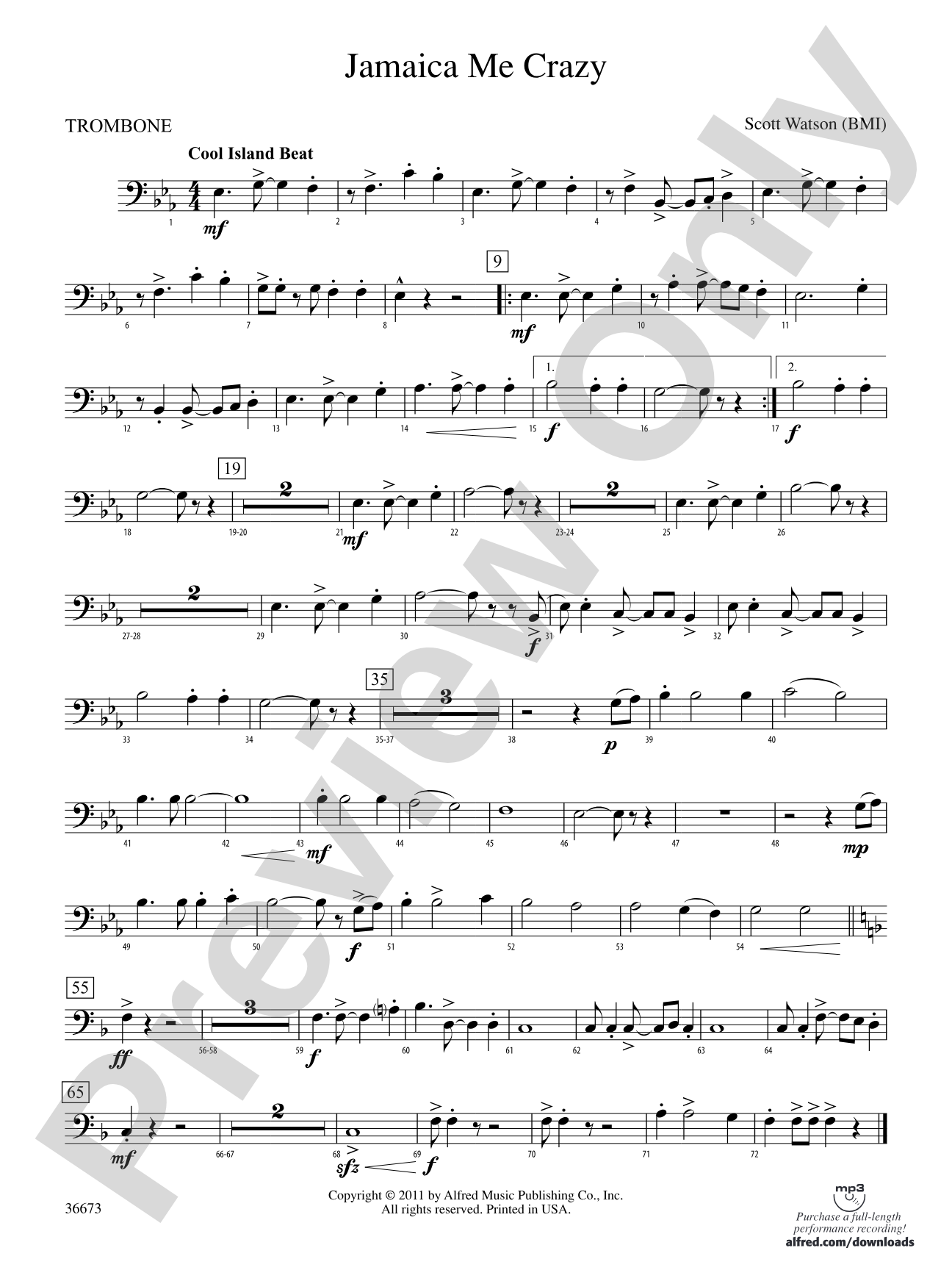
Jamaica Me Crazy: 1st Trombone Sheet Music Preview

Jamaica Me Crazy: 1st Trombone

By Scott Watson

Grade: 1.5 (Easy)

Item: 00-PC-0015101_TN1

Digital Download
$3.00
Description
The catchy, syncopated melody and happy island beat of this piece will musically transport you and your students to the blue water, white sands, and balmy air of the Caribbean! The piece, which demonstrates Jamaican mento and reggae influences, provides a fun opportunity to work with students on a recurring syncopated rhythm and characteristic articulations. These, together with some simple yet important folk percussion writing, capture the spirit of Jamaican music. "Jamaica Me Crazy," "mon," but everything is "irie!"

Don't just read it, hear it, play along with it, and watch your students grow with it. In MakeMusic Cloud, Jamaica Me Crazy: 1st Trombone comes alive with professional accompaniment, adjustable tempo, and built-in practice tools that turn solo practice into real progress.

Sample Audio
0:00
0:00
Sample Video
Additional Details
Series: Challenger Band Series
Publisher: Alfred Music
Page Count: 120
SKU: 00-PC-0015101_TN1

More about this title

About the Composer: Scott Watson

Scott Watson

Scott Watson has spent four decades shaping young musicians as a classroom teacher, school district coordinator, and university faculty member. His work in Pennsylvania's Parkland School District spanned three decades, where he built comprehensive instrumental programs from the elementary level through high school bands before moving into higher education at Cairn University as Associate Professor of Music.

As a composer, Watson has produced over 120 works across concert band, string orchestra, and chamber ensembles. His voice draws equally from contemporary art music and practical band pedagogy, a combination that has earned him commissions and performances at venues ranging from the Academy of Music in Philadelphia to the White House. He contributes regularly to Alfred Publications' Sound Innovations series, leads clinics for music educators, and authored the Oxford University Press text Using Technology to Unlock Musical Creativity.

Why we love this

Watson crafts an irresistibly approachable piece that doesn't sacrifice musical substance for accessibility. The syncopated rhythmic motif and reggae/mento influences give students genuine stylistic territory to explore rather than generic "easy" content, while the folk percussion parts ensure every section of the ensemble feels engaged in shaping the piece's character.

What to expect

The piece radiates warmth and motion. Its catchy syncopated melody and buoyant rhythm evoke the sensory immediacy of Caribbean music, while the articulations and percussion colors create a vivid soundscape that students can visualize and inhabit rather than simply play.

Who it's for

Directors seeking repertoire that combines genuine musical learning with high student engagement. This Grade 1.5 piece works equally well for young concert bands building foundational skills and for mixed-ability ensembles where you want everyone playing on-level material that still offers interpretive richness.

How to get the most out of it

  • Lock in the syncopated rhythmic pattern as an ensemble before adding harmonic layers; have students sing or tap the recurring rhythm figure during sectionals to build ownership of the groove.
  • Balance the melody clearly against the harmonic voices without drowning the characteristic articulations that define the Jamaican style.
  • Delegate the folk percussion writing intentionally; these parts are not decorative, so select players who can listen across the ensemble and maintain the island pulse.

How to use it

Program this as a concert opener or closer when you want to lift the mood and showcase your band's rhythmic precision without taxing young players. It pairs naturally with world music units, cultural celebrations, or spring concerts where lighter fare signals a shift in season or theme.

Skills your students will build

  • Playing syncopated rhythms with precision and style
  • Understanding reggae and mento musical influences
  • Executing characteristic articulations that define Caribbean music
  • Balancing melody and harmonic accompaniment
  • Coordinating ensemble rhythm when percussion patterns anchor the texture

You May Also Like