Jai Ho (from The Motion Picture Slumdog Millionaire) Sheet Music Preview

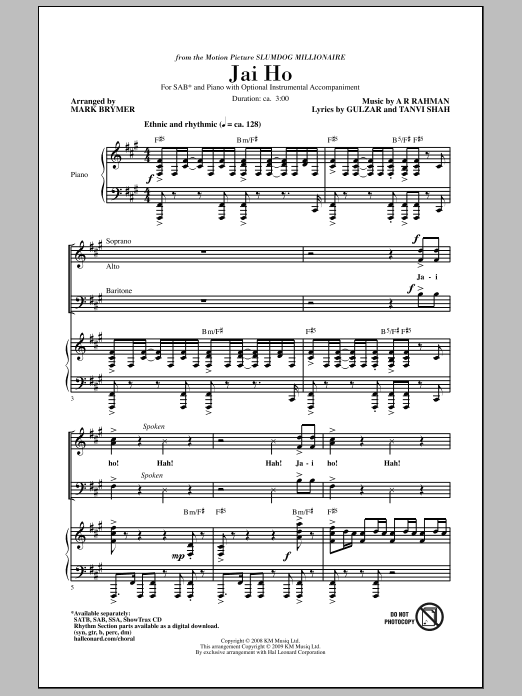
Jai Ho (from The Motion Picture Slumdog Millionaire): SAB Choral Octavo

By A.R. Rahman / By Gulzar / By Tanvi Shah / Arranged by Mark Brymer

Item: 35-DS00141977

Digital Download
$2.95
Description

Jai Ho (from The Motion Picture Slumdog Millionaire): SAB Choral Octavo isn't in MakeMusic Cloud just yet...but it could be. Let us know you'd like to see it, and you'll help shape what comes next. In the meantime, start a free trial and dive into thousands of interactive titles your students can play along with today.

Sample Audio
No sample audio found.
Sample Video
Additional Details
Publisher: Hal Leonard
Page Count: 15
SKU: 35-DS00141977

More about this title

About the Composer: A.R. Rahman

A.R. Rahman stands as one of the most globally influential film composers of the 21st century, bringing orchestral ambition and cross-cultural musical vocabulary to mainstream cinema. His Oscar-winning work on Slumdog Millionaire introduced millions of listeners to the rhythmic complexity and melodic richness of Indian classical music filtered through a contemporary pop sensibility, fundamentally expanding what audiences expect from film scores.

In the classroom and rehearsal hall, Rahman's music offers directors a rare opportunity to engage students with genuinely current material that carries artistic weight. His arrangements bridge East and West without exoticizing either tradition, making his work a natural entry point for conversations about musical identity and cultural expression.

Why we love this

Mark Brymer's arrangement captures the infectious energy of the original while maintaining the melodic integrity that made 'Jai Ho' a cultural phenomenon. The SAB voicing opens this powerful celebration to choirs that might otherwise pass on the piece, and the 15-page score offers enough textural variety and rhythmic drive to hold your singers' attention across multiple rehearsals without wearing thin.

What to expect

Propulsive and celebratory, with a rhythmic sophistication that feels both accessible and surprising. The piece carries the optimism and movement of its film context; your singers will feel the momentum building beneath their lines, and audiences will respond to the unmistakable joy radiating from the stage.

Who it's for

Choirs seeking contemporary repertoire with genuine cultural substance will find this invaluable. It works equally well for community choirs wanting to expand beyond standard pops fare and middle or high school ensembles ready to engage with music that reflects the world their students actually inhabit.

How to get the most out of it

  • Anchor the rhythm section (particularly the bass line) early in rehearsal. The groove is the foundation; once your singers feel it locked in their bodies, the melodic content flows naturally.
  • Layer the SAB parts progressively rather than learning all three simultaneously. Start with the soprano melody, then add alto harmony, then let basses ground the chord structure. This builds confidence in everyone's part.
  • Lean into the articulation and diction to bring out the Hindustani vocal quality Rahman's melodic writing implies. Crisp consonants and energized vowel placement elevate the entire performance.
  • Consider how dynamic contrast shapes the arc. The piece thrives on moments of textural thinning and building, so resist the urge to stay at full volume throughout.

How to use it

Program this as a concert closer or as part of a film music set alongside orchestral underscores or other soundtrack arrangements. It also serves as an excellent vehicle for discussing how contemporary cinema shapes musical identity, especially valuable if you're pairing it with other world music repertoire or exploring non-Western compositional approaches in your ensemble.

Skills your students will build

  • Rhythmic precision in syncopated ensemble lines
  • Sustaining energy through repetitive melodic material
  • Blending SAB voicing with independent part integrity
  • Executing diction and articulation in a non-English language context
  • Responding to Indian classical music idioms in contemporary arrangement

You May Also Like