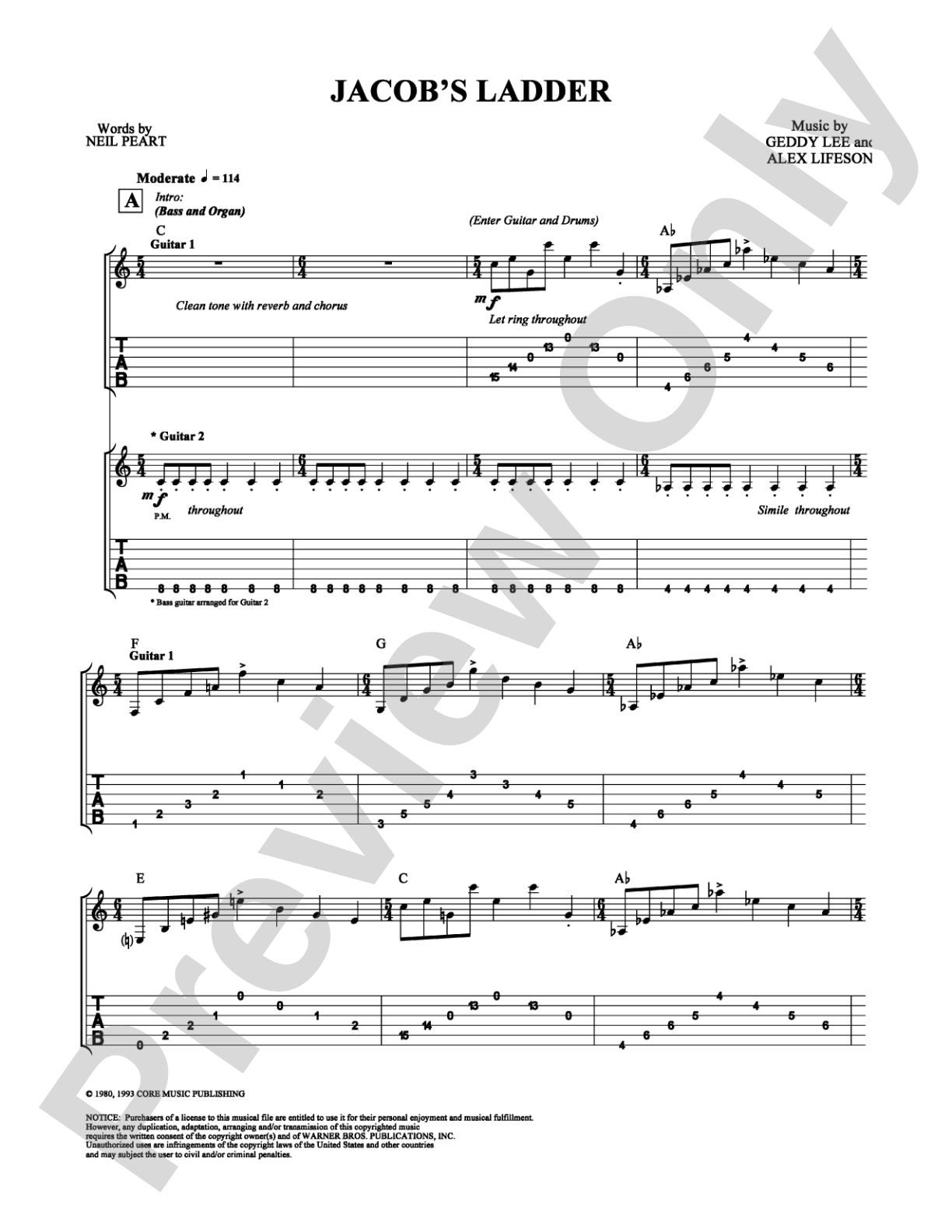
Jacob's Ladder: Guitar TAB Digital Sheet Music

Jacob's Ladder: Guitar TAB Digital Sheet Music

Rush, Geddy Lee, Alex Lifeson

Item: 00-PS-0006750

Digital Download
$2.95
Description

Jacob's Ladder: Guitar TAB Digital Sheet Music isn't in MakeMusic Cloud just yet...but it could be. Let us know you'd like to see it, and you'll help shape what comes next. In the meantime, start a free trial and dive into thousands of interactive titles your students can play along with today.

Sample Audio
No sample audio found.
Sample Video
Additional Details
SKU: 00-PS-0006750

More about this title

About the Artist: Rush

Rush stands as one of rock music's most technically demanding and intellectually ambitious bands. Formed in Toronto in 1968, the trio of Geddy Lee (vocals and keyboards), Alex Lifeson (guitar), and Neil Peart (drums and lyrics) built a reputation for virtuosic musicianship and complex compositional structures that pushed the boundaries of what rock music could be. Their influence on progressive rock and metal is immeasurable, earning them a devoted following among musicians who value technical excellence and artistic risk-taking.

The band's catalog spans decades of evolution, from heavy blues-rock origins through elaborate concept albums to more stripped-down explorations of rhythm and groove. For guitar players, Rush's work represents both a technical benchmark and a creative inspiration, demonstrating how precision and innovation can coexist within the rock idiom.

Why we love this

Rush's catalog demands serious players and rewards the effort generously. This track gives guitarists access to one of the most recognizable and technically interesting Rush compositions, allowing them to tackle the precision, rhythmic sophistication, and dynamic control that defines the band's appeal. Working through Rush material builds musicianship in ways that generic rock tabs simply cannot.

What to expect

Steady, propulsive, and hypnotic. The piece builds momentum through precise rhythmic execution and layered guitar textures, creating a sense of forward motion that feels both cerebral and visceral. There's an elegant simplicity beneath the technical surface, revealing itself once the mechanics become second nature.

Who it's for

Advanced to intermediate rock guitarists ready to tackle material with genuine technical and rhythmic complexity. This tab appeals to players who want to expand beyond standard rock repertoire and understand how progressive rock approaches composition and arrangement. It's equally valuable for guitarists studying Rush's influence on metal and rock guitar technique.

How to get the most out of it

  • Focus on the rhythmic precision of the main riff. Rush's compositions live and die by exact timing; use a metronome at slower tempos first, then gradually increase speed until the groove locks in naturally.
  • Pay attention to dynamics and muting. The TAB notation shows the notes, but listening to the original recording is essential for understanding where Alex Lifeson uses palm muting, partial muting, and open resonance to create texture.
  • Practice the transitions between sections deliberately. Rush songs often shift between different rhythmic feels or picking patterns; mapping these transitions in advance prevents stumbling during performance.
  • Use the TAB as a starting point for understanding the harmonic movement, then listen critically to hear how Lifeson's tone and effects contribute to the overall sound.

How to use it

Feature this in a rock ensemble context, a guitar recital showcasing versatility, or a program exploring rock's technical foundations. It works well alongside other progressive or complex rock material that challenges students to think beyond three-chord progressions. This is ideal for spring recitals where advanced students can demonstrate serious woodshedding.

Skills your students will build

  • Rhythmic precision and metronomic consistency in rock contexts
  • Reading and executing complex picking patterns and syncopation
  • Understanding palm muting and dynamic control for tonal variation
  • Interpreting TAB notation in conjunction with careful listening to the original recording
  • Building stamina and finger strength through sustained technical passages

You May Also Like