
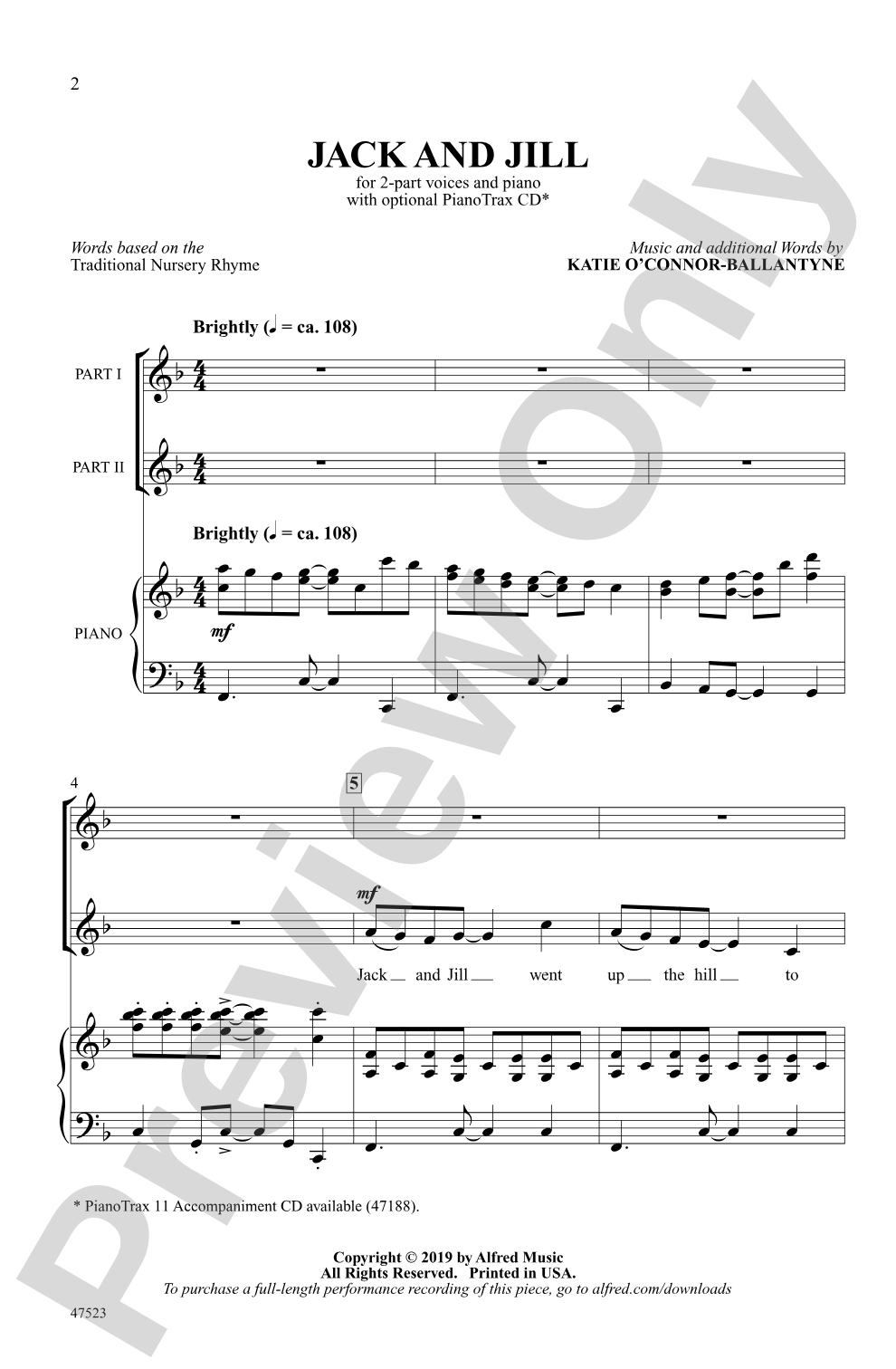
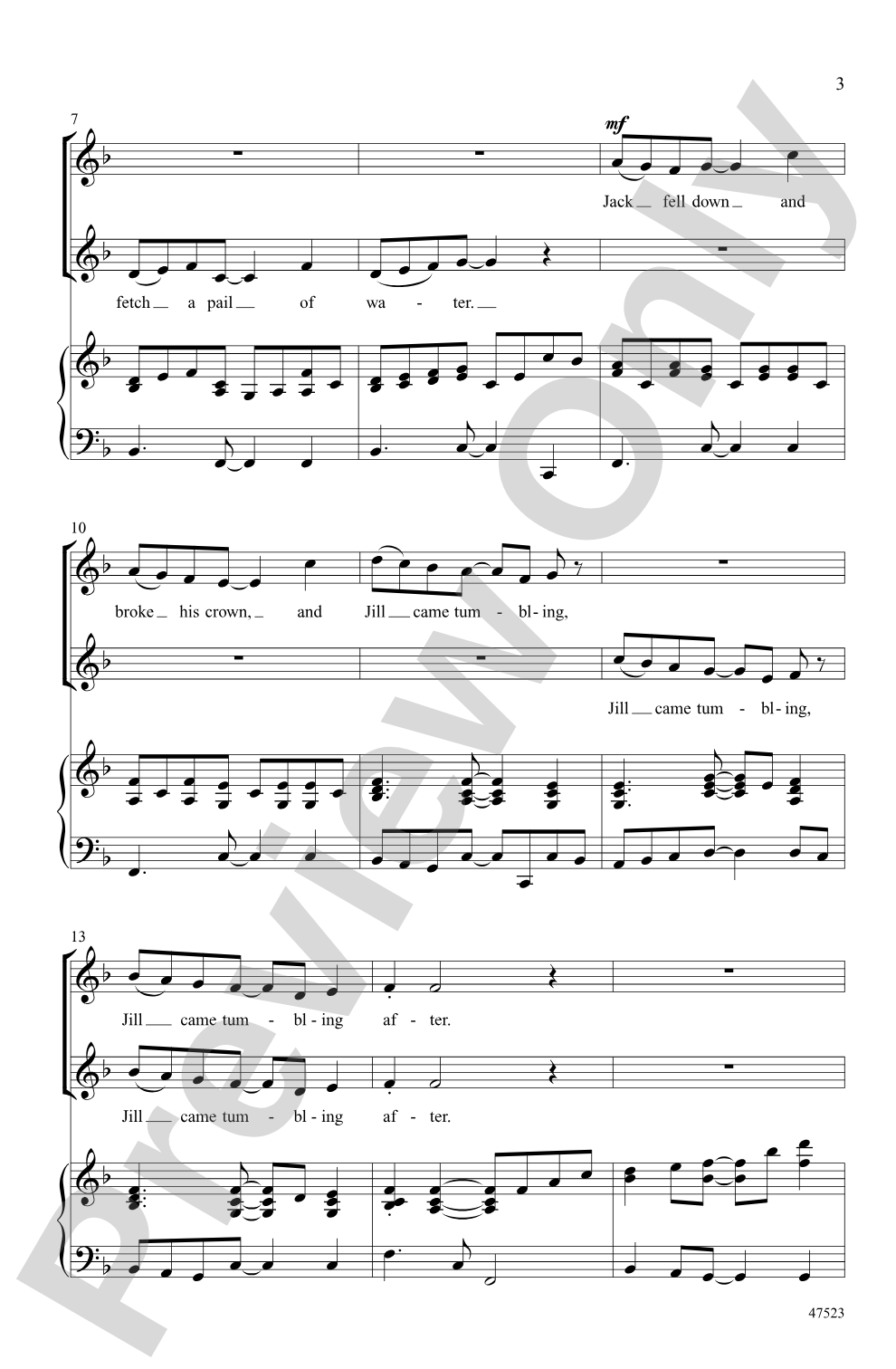

Jack and Jill: 2-Part Choral Octavo
Words based on the Traditional Nursery Rhyme, music and additional words by Katie O'Connor-Ballantyne
Item: 00-PO-0005912
$2.05
Minimum order quantity: 20 copies
Pickup currently not available
Related Items
Jack and Jill: 2-Part Choral Octavo |
$2.05
|
View |
Description
What would happen if Jack and Jill didn't give up on their quest to fetch a pail of water? This clever setting of the traditional nursery rhyme harbors a positive message on the value of perseverance and cooperation. Text painting, mode changes, and invigorating rhythms bring the storybook words to life.


Jack and Jill: 2-Part Choral Octavo isn't in MakeMusic Cloud just yet...but it could be. Let us know you'd like to see it, and you'll help shape what comes next. In the meantime, start a free trial and dive into thousands of interactive titles your students can play along with today.
Request This Title
Tell us you want it.
Start Your Free Trial
Explore everything that's ready to play right now.
Sample Audio
1
Audio File
--:--
0:00
0:00
Sample Video
1 / 2
Additional Details
Series:
Alfred Choral Designs
Publisher:
Alfred Music
Page Count:
8
SKU:
00-PO-0005912
More about this title
About the Composer: Katie O'Connor-Ballantyne

Katie O'Connor-Ballantyne brings deep expertise across composition, pedagogy, and choral leadership. She has authored instructional texts including Harmony Handbook and Finding Your Teacher Voice, while simultaneously building a catalog of choral works published by Alfred Music and Heritage Music Press. Her experience spans teaching musicians across the full spectrum: elementary general music and piano, secondary choral ensembles, and university-level aural skills and music theory.
As a guest conductor, adjudicator, and clinician, O'Connor-Ballantyne remains active in the music education community nationwide. She holds degrees from Ithaca College (BM in Music Education and Vocal Performance) and the University of Limerick (MA in Chant and Ritual Song from the Irish World Academy of Music & Dance), and has served on the faculty at Ithaca College's School of Music and as Artistic Director of the Ithaca Children and Youth Chorus.
Why we love this
O'Connor-Ballantyne transforms a familiar nursery rhyme into something genuinely musical, using text painting and mode shifts to reinforce the narrative arc of resilience. The piece works equally well as a concert opener that engages audiences with its cleverness or as a festival selection that showcases your singers' ability to execute rhythmic precision and blend shifts. Young choristers appreciate the story; experienced directors recognize the craft underneath.
What to expect
Playful yet purposeful, this setting spirals upward with infectious rhythm and clever harmonic surprises. The narrative arc moves from mishap toward determination, with the music itself becoming the storyteller. Singers emerge feeling they've sung something substantial that also delights audiences.
Who it's for
This piece works beautifully for middle school, high school, and community choirs ready to tackle two-part writing with character and musical substance. It's equally suited for concert presentations and festival competition; the compact eight-page format makes it manageable for developing ensembles without sacrificing musical integrity.
How to get the most out of it
- Lean into the rhythmic energy as a primary expressive tool. These invigorating rhythms aren't decoration; they're how the narrative momentum builds, so lock them in early during rehearsal.
- Attend closely to the mode changes marked in the score. They're intentional shifts that mirror the emotional turning points in the text, so singers should feel them as story markers, not just harmonic variations.
- If using the recorded accompaniment, have your singers listen to it first without singing along. This builds ownership of the melodic line and prevents over-reliance on the track during performance.
- Clarify text painting moments with your ensemble before drilling. When the music mirrors the words (climbing a hill, falling down), singers who understand the 'why' behind the musical choices will execute them with genuine conviction.
How to use it
Open a concert with this piece to establish an engaging, accessible tone that immediately connects with listeners. Place it alongside other accessible novelty selections at a festival to demonstrate your choir's range beyond traditional sacred repertoire, or program it early in the season as an approachable entry point into two-part writing while you're building confidence on more demanding repertoire.
Skills your students will build
- Two-part part independence and blend
- Text painting and expressive phrasing
- Reading and executing rhythmic precision in a contemporary idiom
- Understanding and performing modal shifts
- Cooperative ensemble singing (reinforced through narrative about cooperation)