
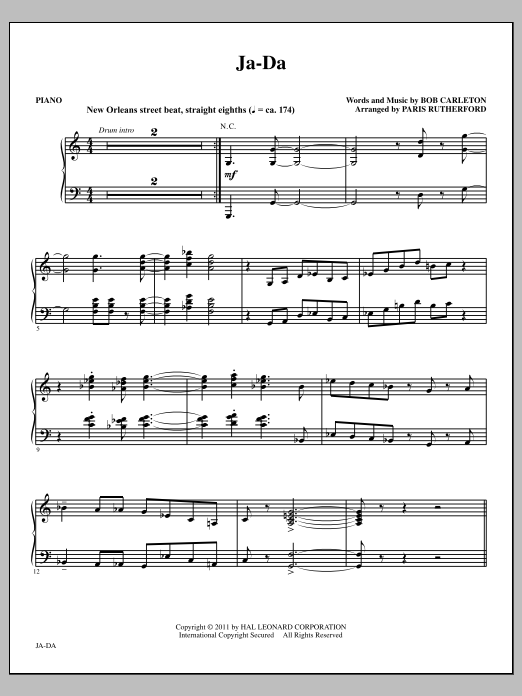

Ja-Da: Choral Instrumental Pak
By Bob Carleton / Arranged by Paris Rutherford
Item: 35-PK00211026
$30.00
Pickup currently not available
Buy Extra Parts (Digital PDF Download)
| Product | Price | Quantity |
|---|---|---|
| Ja-Da - Piano: Choral Instrumental Pak | $7.00 | |
| Ja-Da - Guitar: Choral Instrumental Pak | $7.00 | |
| Ja-Da - Bass: Choral Instrumental Pak | $7.00 | |
| Ja-Da - Drums: Choral Instrumental Pak | $7.00 |
Parts Added to Cart!
Description
The old popular novelty song from Tin Pan Alley days is recast as a contemporary arrangement with a New Orleans street beat, making it fun to sing and play! The middle section moves into swing-four style and may be repeated ad lib for either vocal or instrumental solos. Such a "simple bit of melody" will be a super vocal jazz showcase!


Ja-Da: Choral Instrumental Pak isn't in MakeMusic Cloud just yet...but it could be. Let us know you'd like to see it, and you'll help shape what comes next. In the meantime, start a free trial and dive into thousands of interactive titles your students can play along with today.
Request This Title
Tell us you want it.
Start Your Free Trial
Explore everything that's ready to play right now.
Sample Audio
No sample audio found.
Sample Video
No sample videos found.
Additional Details
Publisher:
Hal Leonard
SKU:
35-PK00211026
More about this title
About the Composer: Bob Carleton
Bob Carleton composed "Ja-Da" in 1918, and the piece became one of the era's most enduring novelty songs. His gift for writing memorable, singable melodies made him a fixture in American popular music during the Tin Pan Alley period, and his work has proven remarkably durable across decades and musical contexts.
Carleton's ability to craft simple yet infectious melodies translates effectively to the choral classroom. "Ja-Da" demonstrates why his compositions remain valuable teaching tools: they balance accessibility with genuine musical content, allowing singers to focus on style, phrasing, and ensemble blend rather than wrestling with complex vocal writing.
Why we love this
Paris Rutherford's arrangement strips away the novelty song's original context and reimagines it as a genuine vehicle for jazz interpretation. The contrast between the New Orleans street beat framing and the swing-four middle section gives your singers multiple musical personalities to explore within a single, manageable chart.
What to expect
The opening captures the swagger of New Orleans brass bands filtered through a contemporary sensibility. The swing section feels like your ensemble has stepped into a smoky club where anything goes, where soloists emerge from the ensemble and the rhythm section drives everyone forward with infectious momentum.
Who it's for
This arrangement works best with singers who have some exposure to jazz vocabulary and style but need accessible material that doesn't demand extensive harmonic sophistication. It suits high school choirs, community vocal jazz groups, and concert choirs looking to add a stylistic detour into popular music from the American songbook.
How to get the most out of it
- Lock the groove in the opening section by having your rhythm section sit comfortably on the backbeat rather than forcing a metronomic feel; the street beat gains energy from a relaxed pocket.
- Treat the swing-four section as an invitation for genuine solos, not just vocal decoration. Your singers will respond better if you frame these sections as solo moments where individuals step into the spotlight.
- Balance the text clarity with the rhythmic groove; "Ja-Da" lives in the consonants, so encourage clean articulation without sacrificing the laid-back swing feel.
- Consider how you'll signal the ad lib repetitions to your ensemble. Visual cues from a soloist or conductor work better than relying on written endings in this style of chart.
How to use it
Slot this into a concert as a palate cleanser between heavier classical selections or as a contemporary capstone to an American music-themed concert. It works equally well as a finale to a jazz-focused concert where the ad lib structure lets your ensemble show off both precision and spontaneity.
Skills your students will build
- Jazz phrasing and behind-the-beat articulation
- Distinction between swing rhythms and straight eighth notes
- Navigating repeated ad lib sections with ensemble communication
- Supporting solo singers while maintaining rhythmic integrity