
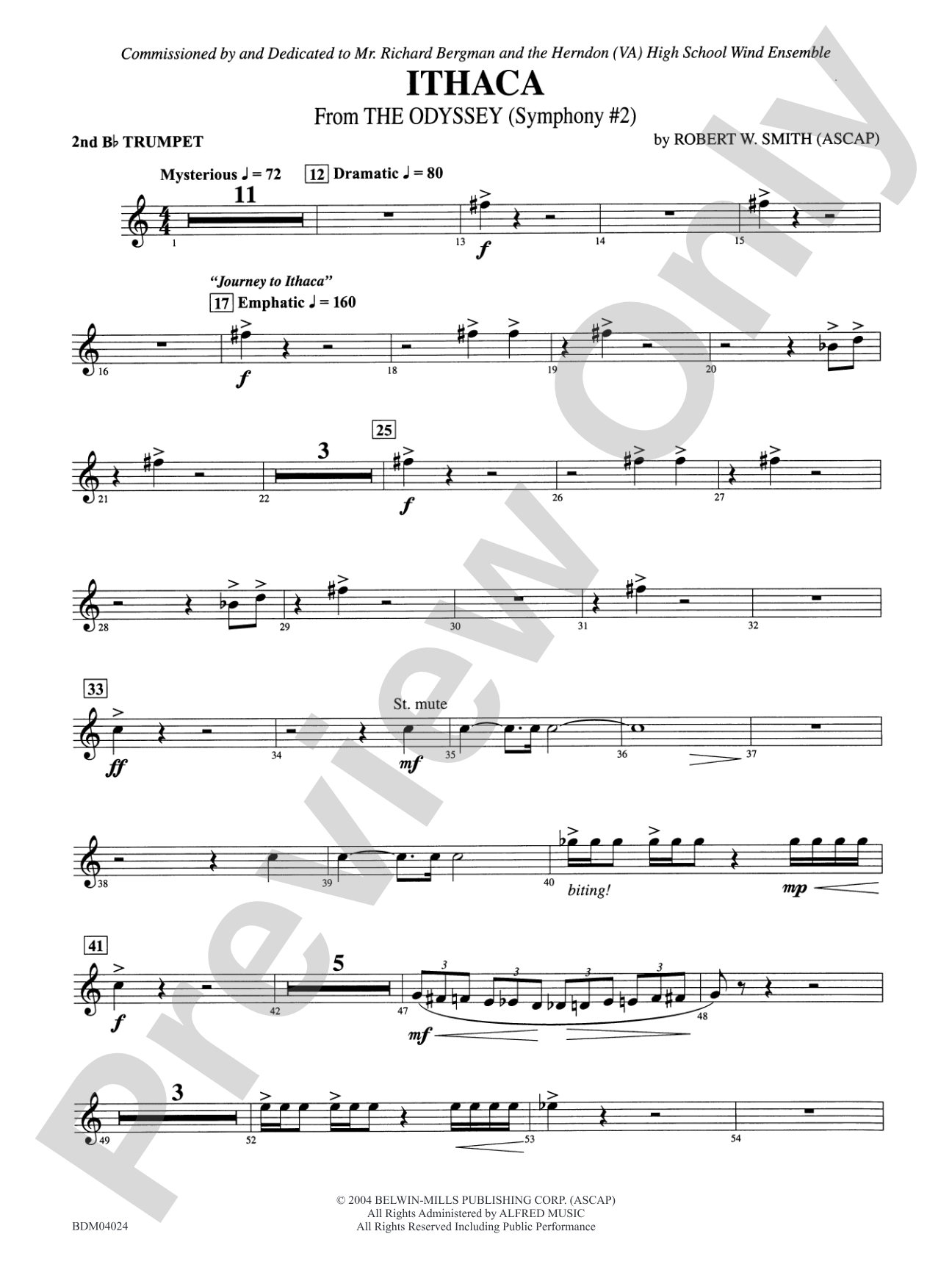

Ithaca (from The Odyssey (Symphony No. 2)): 2nd B-flat Trumpet
By Robert W. Smith
Grade: 4 (Medium)
Item: 00-PC-0017765_T2
$3.00
Pickup currently not available
Description
The dynamic conclusion to Robert W. Smith's long awaited second symphony, The Odyssey, will bring the house down without fail. You'll hear the arrows pass right by your head, the sword fight ensue, and an overall tremendous work for concert band. Monumental! Program it alone or, for a awe-inspiring concert, program it with the other three movements, "The Iliad" (BDM00052), "The Winds of Poseidon" (BD9923), and "The Isle of Calypso" (BDM01042). (5:50)


Don't just read it, hear it, play along with it, and watch your students grow with it. In MakeMusic Cloud, Ithaca (from The Odyssey (Symphony No. 2)): 2nd B-flat Trumpet comes alive with professional accompaniment, adjustable tempo, and built-in practice tools that turn solo practice into real progress.
Open in the Player
Jump straight in and assign it today.
Start Your Free Trial
Open this title and explore the full library in minutes.
Sample Audio
1
Audio File
--:--
0:00
0:00
Sample Video
No sample videos found.
Additional Details
Series:
Belwin Symphonic Band
Publisher:
Alfred Music
Page Count:
284
SKU:
00-PC-0017765_T2
More about this title
About the Composer: Robert W. Smith

Robert W. Smith has established himself as one of America's most frequently performed composers of concert band and orchestral music, with over 400 works in print across Alfred Music and other publishers. He holds degrees from Troy State University and the University of Miami, and his original compositions have been heard on stages worldwide, from North America to Europe, Australia, and Asia.
Smith's symphonic works, particularly The Divine Comedy and The Odyssey, have resonated with musicians and audiences across multiple continents. His influence extends beyond the concert hall; his compositions and arrangements have appeared on major television broadcasts, from the Macy's Thanksgiving Day Parade to the Olympic Games opening ceremonies, and his conducting and clinician work has taken him across the United States, Canada, Japan, Australia, and throughout Europe.
Why we love this
Smith captures the sweeping narrative arc of Homer's epic with genuine dramatic force. The work demands excellence from your ensemble while remaining accessible at Grade 4, and the visceral imagery of arrows, sword fights, and triumph gives your musicians something concrete to play toward rather than abstract expressions of grandeur.
What to expect
Ithaca immerses you in Homeric grandeur: the tension of approaching danger, the clash and urgency of combat, and finally the overwhelming sense of homecoming and triumph. Smith's orchestration creates visceral imagery without sacrificing lyricism, building to a conclusion that lands with undeniable force.
Who it's for
Band directors programming intermediate-to-advanced concert bands who want substantial, meaningful repertoire with genuine dramatic substance. This work demands focused musicianship and engages ensembles capable of handling nuanced dynamic control and sectional balance.
How to get the most out of it
- Balance the lyrical passages against the dynamic action sequences; the piece draws its power from contrast, so resist the urge to play loudly throughout.
- Pay attention to sectional independence during the more intricate ensemble writing; clarity of line matters as much as weight of sound.
- Use the dramatic pauses as breathing room for both the ensemble and audience; these moments build anticipation for the monumental conclusion.
- Shape phrases with intention toward the epic scope Smith envisions; this music rewards conductors who think architecturally across entire sections.
How to use it
Program this as the culminating work on a concert or festival performance, where it can serve as your anchor piece and final statement. Alternatively, perform the complete Odyssey symphony with all four movements (The Iliad, The Winds of Poseidon, The Isle of Calypso, and Ithaca) for a concert-length exploration of Smith's symphonic vision.
Skills your students will build
- Shaping long melodic lines with sustained focus across extended passages
- Balancing dynamic contrast and sectional independence in complex ensemble writing
- Interpreting narrative and dramatic imagery through musical gesture and phrasing
- Managing tempo and ensemble cohesion during rhythmically intricate sections
- Building stamina and concentration for substantial, concert-length works