
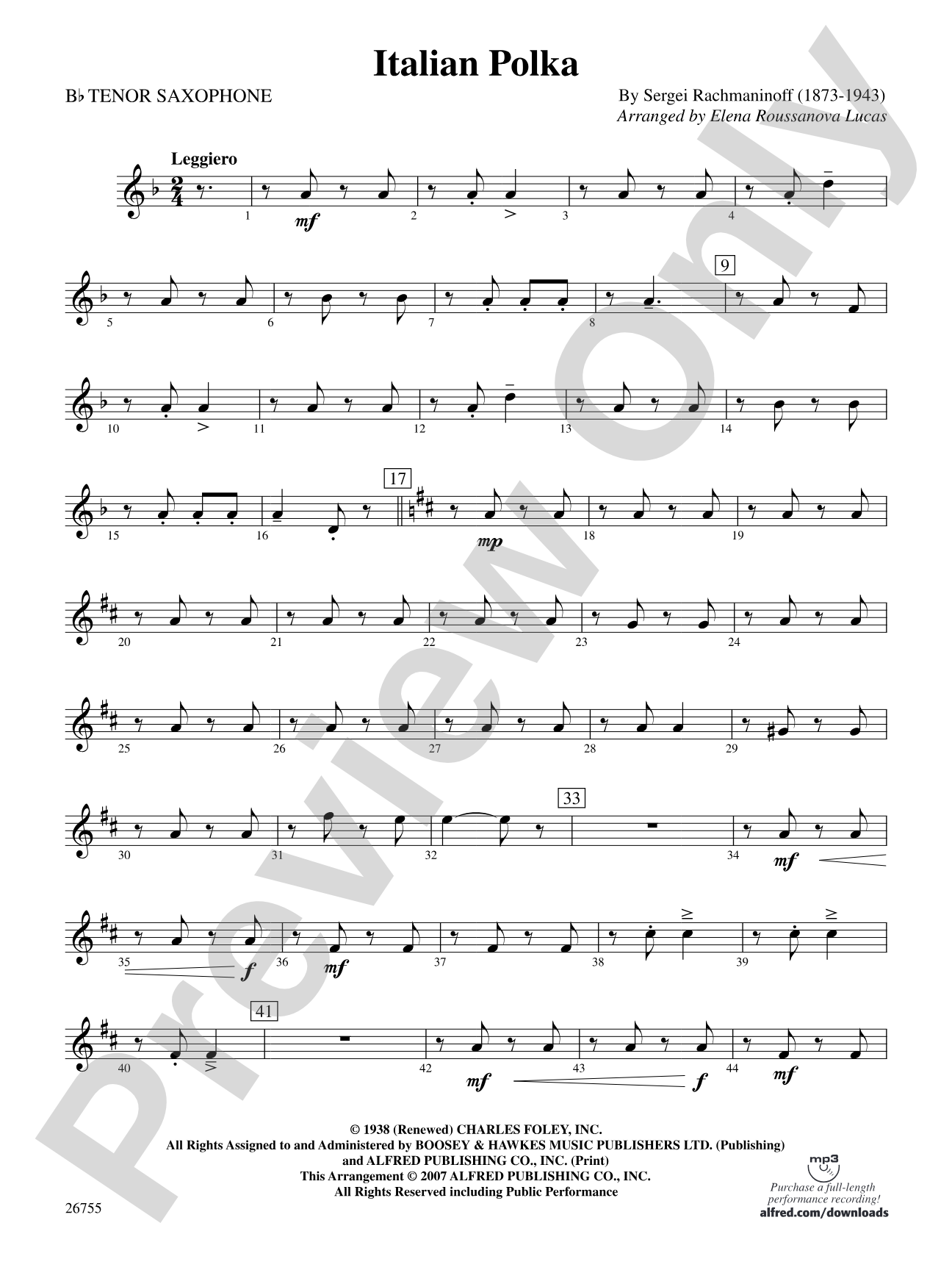

Italian Polka: B-flat Tenor Saxophone
By Sergei Rachmaninoff / arr. Elena Roussanova Lucas
Grade: 3 (Medium Easy)
Item: 00-PC-0014803_TX1
$3.00
Pickup currently not available
Description
Contrary to his reputation for dark, massive chords, this Rachmaninoff work is as light and bouncy as the title suggests. Scored by Elena Roussanova Lucas, this work is exuberant and festive. With careful attention to nuance you'll find simplicity and virtuosity, as well as fantasy and humor. A truly charming work! This title is available in MakeMusic Cloud.


Don't just read it, hear it, play along with it, and watch your students grow with it. In MakeMusic Cloud, Italian Polka: B-flat Tenor Saxophone comes alive with professional accompaniment, adjustable tempo, and built-in practice tools that turn solo practice into real progress.
Open in the Player
Jump straight in and assign it today.
Start Your Free Trial
Open this title and explore the full library in minutes.
Sample Audio
1
Audio File
--:--
0:00
0:00
Sample Video
No sample videos found.
Additional Details
Series:
Belwin Concert Band
Publisher:
Alfred Music
Page Count:
106
SKU:
00-PC-0014803_TX1
More about this title
About the Composer: Sergei Rachmaninoff
Sergei Rachmaninoff (1873-1943) stands as one of the most performed composers in concert halls worldwide, yet many know him primarily through his sweeping concertos and moody solo piano works. His gift for melody and harmonic color shaped early 20th-century music across all genres, from operas and symphonies to chamber works and songs. What often surprises musicians encountering his lighter works is the same compositional mastery at play: Rachmaninoff never wrote down to an audience, even when the mood was playful.
His influence extends well into music education through transcriptions and arrangements that make his sophisticated voice accessible to developing ensembles. Teachers and directors value his works for their blend of musical substance and immediate appeal, qualities that engage student musicians while demanding genuine artistry.
Why we love this
Rachmaninoff's reputation rests on such monumental works that conductors often overlook his lighter output, making this arrangement a genuine discovery for many programs. The Italian Polka proves he could write with infectious charm and spirited grace without sacrificing craft or interest. Elena Roussanova Lucas has voiced this for concert band with such clarity and energy that it reads freshly, giving your ensemble a genuinely festive moment that still demands musical attention.
What to expect
Imagine a spirited dance that never takes itself too seriously, full of unexpected turns and orchestral flourishes that catch you mid-smile. The work bounces with vitality and charm, revealing small moments of fantasy and unexpected color that remind you Rachmaninoff is at the helm, even when the tempo is lively and the mood is light.
Who it's for
Concert band programs at the Grade 3 level seeking a piece that sounds more sophisticated than it plays, offering genuine musical substance for developing musicians. Directors preparing a concert that needs variety in mood and energy will find this arrangement delivers both festivity and musicianship without requiring advanced technical chops.
How to get the most out of it
- Shape the rhythmic figures with buoyancy rather than mechanical precision; the polka's charm hinges on flexible phrasing and conversational give-and-take between sections.
- Balance the tutti passages so that melodic lines sing through the accompaniment texture; Rachmaninoff's orchestration rewards clarity of part writing.
- Attend to the marked dynamics and articulations as structural signposts; they define character shifts and prevent the piece from settling into one mood.
- Let the humor emerge naturally from tempo steadiness and clean entrances; rushing or dragging will muddy the work's wit.
How to use it
This piece works beautifully as a contrast item in a concert pairing weightier material with something that invites the audience to relax and enjoy. Its accessible difficulty makes it ideal for mid-concert placement, where it can refresh both ensemble and listeners before returning to more demanding repertoire. Consider programming it alongside a march or another energetic work to build momentum through a concert's second half.
Skills your students will build
- Maintaining steady pulse and ensemble cohesion through syncopated rhythmic figures
- Balancing melodic lines against harmonic accompaniment across the full ensemble
- Responding to dynamic and articulation markings as musical expression, not technical requirements
- Playing with stylistic lightness while preserving tonal quality and intonation
- Coordinating sectional entrances and transitions with precision and musical intent